


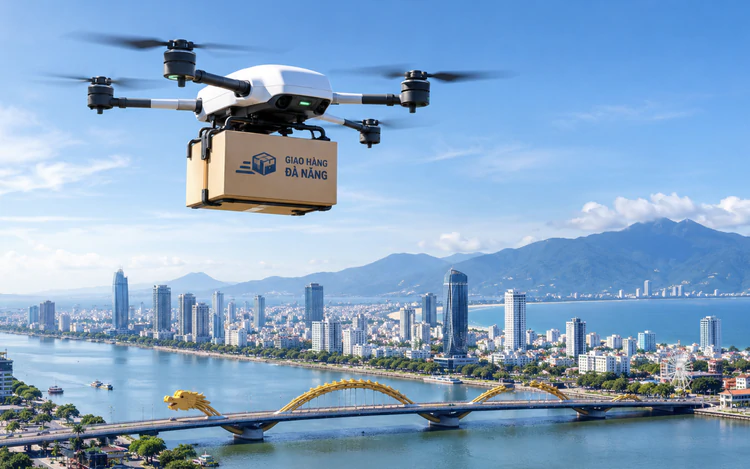
Da Nang looks to pilot UAV delivery flights in three wards and one commune. Photo: AI
The proposal was presented at a workshop on Tuesday to develop the ‘Pilot Development of Low-Altitude Airspace in Da Nang Through 2030’ project.
The central Vietnamese city identifies two groups of areas and flight routes for UAV operations.
In the city's downtown Da, two areas have been proposed in Son Tra and Ngu Hanh Son Wards.
In Son Tra Ward, the proposed area is defined by specific coordinates, covering more than 11 square kilometers with a perimeter of over 14 kilometers.
It would be used for tourism, delivery, urban services, and maritime search and rescue.
Meanwhile, the proposed area in Ngu Hanh Son Ward covers more than 138 square kilometers, with a perimeter of over 53 kilometers, and would serve the same purposes.
In the southern part of the city, two additional areas have been proposed in Tam Ky Ward and Tien Phuoc Commune.
The area in Tam Ky Ward covers more than 22 square kilometers and has a perimeter of over 21 kilometers.
It would support tourism, delivery, urban services and emergency medical response.
The area in Tien Phuoc Commune spans 0.48 square kilometers and has a perimeter of more than three kilometers.
Proposed uses include delivery, agriculture and emergency medical services.
The low-altitude economy generally refers to an economic sector centered around crewed and uncrewed aerial vehicles operating in airspace below 1,000 meters—and up to 3,000 meters depending on regional regulations—covering manufacturing, flight services, infrastructure, and integrated support applications.
Da Nang authorities view low-altitude airspace as a new space for socio-economic development, requiring the coordinated integration of infrastructure, technology and policy, Ho Quang Buu, vice-chairman of the municipal People’s Committee, told the workshop.
As such, the project is not simply aimed at deploying UAVs in individual sectors, but at building an ecosystem involving the government, businesses, research institutes, universities and technology stakeholders.
The core approach is to establish an ‘open but controlled’ model that encourages innovation while ensuring a balance between economic development, national defense, security and data safety.
Addressing the workshop, Dr. Nguyen Hai Yen of Hanoi Law University said that a key requirement for the effective operation of the low-altitude economy would be establishing a ‘digital authorization’ mechanism for UAV activities.
Digital authorization should be more than an electronic interface or automated procedure.
It must incorporate four elements: an electronic format, a degree of automation, legal consequences–including the right to begin or continue a flight–and clearly defined authority.
The expert also highlighted the need for legal regulations governing flight-authorization powers, particularly a dedicated mechanism for UAV operations conducted repeatedly under a single flight authorization.

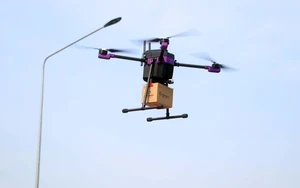
Da Nang City, central Vietnam aims to have at least three low-altitude flight service applications by 2028. Photo: Truong Trung / Tuoi Tre
Three low-altitude UAV apps planned by 2028
Under the project, Da Nang aims to have at least three low-altitude flight service applications in operation by 2028.
The city also plans to involve five firms in pilot UAV flights, 10 companies in the value chain, and five universities offering courses related to the low-altitude space economy.
From 2028, Da Nang plans to expand UAV operations and gradually establish a broader low-altitude economic ecosystem.
As part of this effort, the city plans to establish a hub for UAV research, manufacturing, training, instruction and testing in central Vietnam.
It also intends to develop semiconductor integrated circuits and artificial intelligence while supporting national defense and security requirements.
By 2029, Da Nang aims to establish an ecosystem covering UAV research, education and training, manufacturing, testing and practical applications across the city.








Max: 1500 characters
There are no comments yet. Be the first to comment.