
Vietnam eyes bigger role in Asia’s air cargo network despite foreign dominance
Cargo throughput at Vietnam’s airports has reached record highs amid booming exports and rising demand for air freight. Yet foreign airlines still control more than 80 percent of the country’s international air cargo market, raising questions over how far Vietnam can climb the regional logistics value chain as Vietnam Airlines prepares to launch its first dedicated freighter in the third quarter of 2026.
Cargo moving through the country's airports reached 1.8 million tonnes in 2025, an all-time high, and kept climbing, with 920,900 tonnes recorded in the first half of 2026 alone.
Yet most of the value in that flow, particularly high-value goods such as phones, electronic components, and pharmaceuticals, continues to end up in the pockets of foreign carriers.
So what would change if Vietnam had a cargo fleet strong enough to take that role into its own hands?
Why foreign carriers still hold lion's share
Gordon Heap, Principle, Aviation, DXC Technology, told Tuoi Tre News that the answer lies not in infrastructure or technology but in simple business math.
“I don’t believe this situation has anything to do with systems or infrastructure. Despite volume growth, a dedicated cargo fleet is typically less profitable than serving passengers. The most profitable cargo movements are belly cargo where the revenue is additive to passengers,” said Heap.
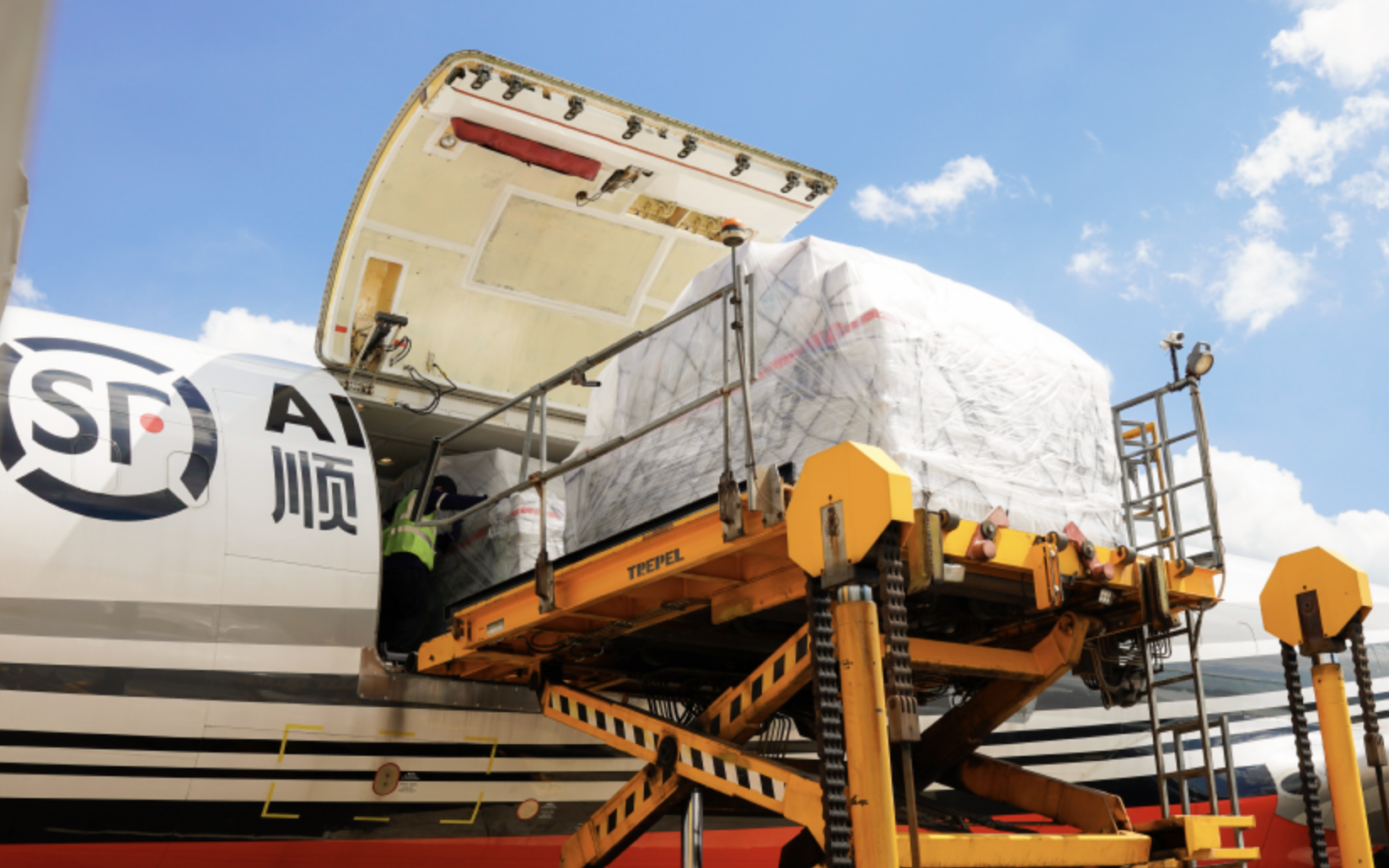
That is also why, for many years, Vietnam's airlines have largely stayed on the sidelines of the international cargo business.
More than 80 percent of the international cargo market to and from Vietnam currently sits with foreign carriers, while domestic firms mainly move goods via belly cargo on passenger aircraft, without a dedicated fleet large enough to compete.
In 2021, entrepreneur Johnathan Hanh Nguyen proposed investing roughly VND 2,400 billion (US$90.7 million) to launch a dedicated cargo airline, IPP Air Cargo, but the project was ultimately shelved amid unfavorable market conditions and the scale of capital and infrastructure it would require.
That picture is now shifting. Dang Ngoc Hoa, board chairman of Vietnam Airlines, has confirmed that cargo will be one of the airline's two strategic pillars going forward, backed by heavy investment.

Phase 1 of Long Thanh Airport is set to begin operations in December 2026. Photo: ACV
Under the latest plan, the carrier will put its first dedicated freighter into service in the third quarter, initially flying to Hong Kong, South Korea, Singapore, and India. From 2029, it plans to add wide-body aircraft to open intercontinental routes to Europe and the United States.
Notably, Vietnam is currently the only country among the world's top 30 economies by import-export turnover that does not yet own a nationally registered freighter aircraft.
Associate Professor Dr. Nguyen Thien Tong, an aviation expert, told Tuoi Tre that Vietnamese carriers' cargo capacity remains too limited, which is why foreign carriers absorb most of the market.
A new dedicated cargo carrier, he said, would sharpen competition, add capacity, and could help bring international freight rates down to more reasonable levels.
Infrastructure, two-way cargo, investor confidence
Asked about the imbalance in two-way cargo flows, uneven volumes of exports versus imports, Heap candidly admitted this was outside his expertise, noting that integrating multimodal transport is essential, and that trade imbalances are not unique to aviation; they show up in container shipping too.
On infrastructure, Heap said Long Thanh Airport in Dong Nai City, just outside Ho Chi Minh City, has a real chance to become a world-class logistics hub, precisely because it is being built from scratch.
That potential depends on planning several elements carefully from the outset: dedicated ground-handling equipment, integrated customs clearance, warehousing, and seamless connections to freight forwarders as well as road and rail networks.
He also stressed a key lesson: cargo operations run most efficiently when a single entity can connect the systems of every stakeholder involved -- airlines, customs, freight forwarders, and warehouse operators.
Investors and global logistics firms, he said, weigh both economic and operational data when sizing up a market, paying particular attention to indicators like customs clearance time and cargo dwell time.
Signs of that interest are already appearing on the ground.
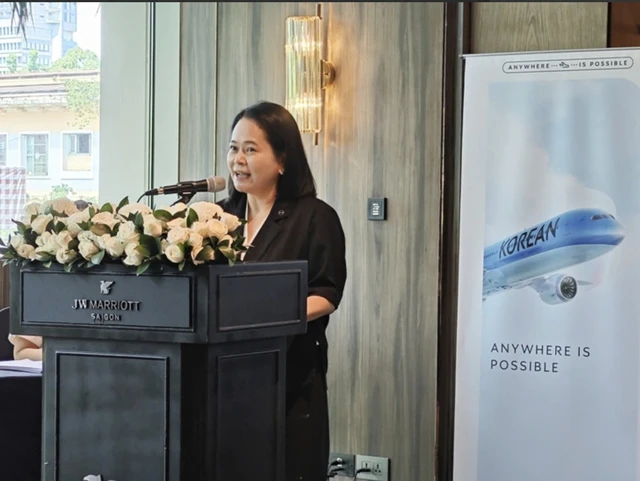
Kyoung Hee Kang, Korean Air's country manager for Vietnam, says Vietnam is currently the airline's largest destination market in Southeast Asia. Photo: Cong Trung / Tuoi Tre
All Nippon Airways and Korean Air have recently surveyed Long Thanh Airport as the project gears up for trial operations from September and commercial operations from December 1.
Kyoung Hee Kang, Korean Air's country manager for Vietnam, said Long Thanh has the potential to become a major regional aviation and logistics hub.
The airline forecasts that its total cargo volume across the Vietnamese market could reach or exceed 50,000 tonnes this year, a sharp jump from the roughly 16,000 tonnes of export cargo it carried through Ho Chi Minh City in 2024.
The infrastructure story does not stop at big airports or new runways, it also plays out in operational links on the ground that can seem small.
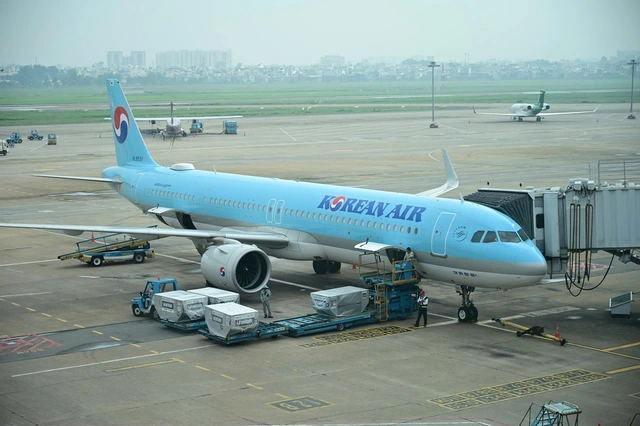
International carriers are expanding their cargo operations in Vietnam. Photo: Quang Dinh / Tuoi Tre
By Tuoi Tre's own observations, ground-handling services, from check-in procedures and baggage handling to weight-and-balance control and aircraft towing, have become an area where many airlines in Vietnam are moving to take control themselves rather than rely entirely on outsourced partners.
In early August 2026, Vietnam's Sun Group launched Phu Quoc Airport Ground Services Company Limited, adding another link to the group's aviation-tourism ecosystem on the eponymous island.
In April 2025, Vietjet switched to self-handling ground services at Tan Son Nhat Airport rather than renew its full-service contract with Saigon Ground Services Joint Stock Company (SAGS), a partner that earned around VND591 billion ($22.3 million) from Vietjet alone in 2024, nearly 39 percent of SAGS's total revenue that year.
Losing its largest customer to self-handling put that revenue at risk, forcing SAGS to seek out additional international carriers to make up the volume.
Associate Professor Dr. Nguyen Thien Tong said more players entering the ground-handling market will raise competitive pressure, pushing existing operators to invest in equipment, improve productivity, and lift service quality.
In other words, if Vietnam truly wants to compete in the regional air cargo chain, that race has to be run simultaneously in the sky and on the ground, from the dedicated freighter fleet down to every tow tractor on the tarmac.
“With Vietnam’s infrastructure, I think there is a good opportunity to be a logistic hub for the sub-region. Much of this will depend on trade agreements and ground transport infrastructure between the airport hubs and the neighboring countries' centers of commerce,” Heap remarked.
Vietnam's ambition to become link in air cargo logistics chain
On October 9, 2025, the Vietnamese prime minister issued Decision No. 2229/QD-TTg approving the Vietnam Logistics Services Development Strategy for 2025-35, with a vision to 2050, as the sector's first comprehensive strategy.
The goal is to cut logistics costs from the current 16-17 percent of GDP to 10-12 percent of GDP by 2050, while building at least five modern, world-class logistics service centers by 2035 and at least 10 by 2050.
Underpinning that ambition are 17 signed free trade agreements, giving Vietnamese goods access to roughly 60 percent of the world market.
Kim Thoa / Tuoi Tre news
Link nội dung: https://news.tuoitre.vn/vietnam-eyes-bigger-role-in-asias-air-cargo-network-despite-foreign-dominance-103260808095927984.htm