
Vietnam needs tens thousands of green energy workers, but training falls short
Vietnam's renewable energy sector is projected to need tens of thousands of workers by 2030, but training institutions lack practical equipment and lecturers have limited opportunities to gain experience in large-scale projects, according to industry experts.

Dr. Do Van Long of the Vietnam Institute of Strategy and Policy for Industry and Trade discusses the current shortage of workers in the energy sector. Photo: Trong Nhan / Tuoi Tre
The challenges were discussed at a conference on developing human resources for Vietnam's key and priority industries in Ho Chi Minh City on Monday.
The conference was organized by the Vietnam Institute of Strategy and Policy for Industry and Trade (VIOIT) under the Ministry of Industry and Trade and Cao Thang Technical College.
Renewable energy sector faces workforce shortages
Dr. Do Van Long, head of energy research at the VIOIT, projected that Vietnam's onshore and offshore wind power sectors would need around 60,000-80,000 workers by 2030.
The solar power sector would require around 40,000-50,000 workers, while green hydrogen and green ammonia would need around 10,000-15,000, he said.
Wind power projects require marine construction engineers, operations and maintenance workers, and specialists in marine ecology and geology surveys.
Workers in the green hydrogen sector need knowledge of electrolysis, chemical safety, and high-pressure storage.
Smart grids and battery energy storage systems require workers capable of integrating systems, processing data, and managing real-time power dispatch.
However, Long said training programs had been slow to adapt to industry needs.
He said specialized training programs in offshore wind power and green hydrogen remained limited.
Educational institutions also lacked simulation laboratories, specialized software and practical training models, he added.
"Lecturers have few opportunities to gain experience in large-scale renewable energy projects, while workers have limited proficiency in specialized English and lack international certifications," Long said.
He proposed investing in 10-15 key vocational colleges and developing training programs in offshore wind power, green hydrogen, and smart grids.
Long also identified oil and gas workers, including marine mechanical engineers and technicians, as a potential source of workers who could be retrained for the renewable energy sector.
Workers experienced in building drilling rigs and conducting marine surveys could receive additional training to manufacture offshore wind turbine foundations and offshore substations, he said.
Semiconductor sector faces training challenges
Associate Professor Nguyen Van Hieu, chairman of the Ho Chi Minh City Semiconductor Industry Association (HSIA), said educational institutions faced a gap between their training conditions and the requirements of semiconductor production.
Schools had not kept pace with the industry's need for equipment and simulation laboratories meeting industrial standards, he said.
The number of engineers specializing in chip design, packaging and testing remained limited compared with the sector's development targets.
He proposed concentrating resources on chip design and advanced packaging and testing.
He also called for short-term training courses alongside undergraduate and postgraduate programs to help existing workers upgrade their skills or transition to new jobs.
Such training should be linked to internships at businesses, he said.
The Alliance for Research and Training in Semiconductor and Microelectronics Industry (ARTSeMI) aims to train 300 core lecturers between 2025 and 2030.
The target includes 100 lecturers specializing in chip design, 150 in semiconductor technology, and 50 in the Internet of Things and artificial intelligence.
The alliance also plans to train workers in chip design and semiconductor technology based on business demand.
Businesses urged to participate in workforce training
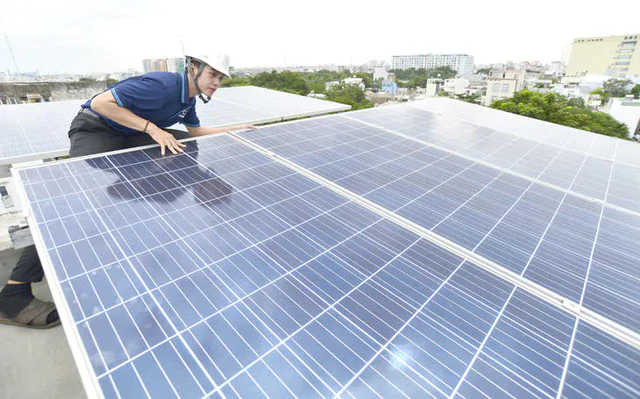
Rooftop solar panels on a residential building in Ho Chi Minh City. Photo: Quang Dinh / Tuoi Tre
Le Dinh Kha, rector of Cao Thang Technical College, said the number of positions businesses wanted to fill was around three times the number of graduates the college produced annually.
The college supplies around 3,200 graduates with practical engineering qualifications to the labor market each year, he said.
Kha said engineers, experts and business managers participated in the college's Industry Advisory Board to help align training with business requirements.
The board advises the college on the knowledge and skills students should acquire before graduation, necessary curriculum adjustments and equipment needed for practical training, he said.
"Feedback from businesses after recruitment continues to be used to revise training content," Kha said.
He said investment in equipment should be based on the skills that need to be taught and the technologies currently used by businesses.
Equipment for foundational skills could be shared across disciplines to avoid duplicate purchases.
Lecturers should also visit businesses to understand production requirements and update their teaching materials accordingly, Kha said.
Le Nguyen Thanh, head of industrial research at the VIOIT, said Vietnam aims to develop more than 50,000 semiconductor professionals with university degrees or higher by 2030.
Of the total, around 15,000 would work in chip design, while 35,000 would work in manufacturing, packaging and testing.
"Labor demand has never been as high or urgent as it is now," Thanh said.
To meet the target, training institutions should align their programs with business needs and cooperate with foreign partners to obtain additional funding and technical expertise.
Foreign businesses should be encouraged to provide regular on-the-job training for Vietnamese workers, enabling them to learn manufacturing techniques and supply chain management, Thanh said.
He also proposed connecting Vietnamese semiconductor and electronics experts working overseas with domestic businesses.
The experts could support local companies in researching and manufacturing next-generation electronic equipment using specialized chips and artificial intelligence chips.
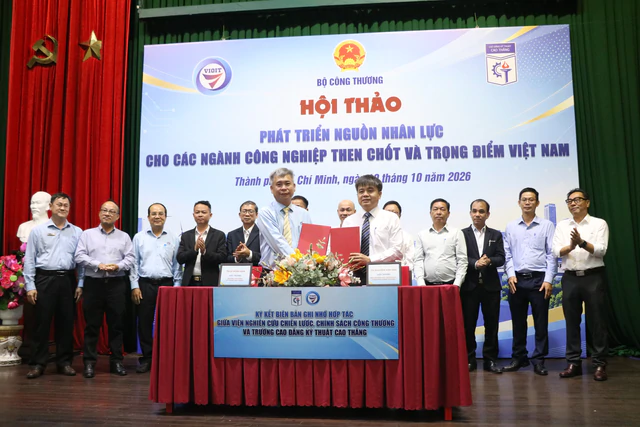
The Vietnam Institute of Strategy and Policy for Industry and Trade and Cao Thang Technical College sign a memorandum of understanding. Photo: Trong Nhan / Tuoi Tre
At the conference, the VIOIT and Cao Thang Technical College signed a memorandum of understanding on cooperation in research, policy consultancy and curriculum updates based on business demand.
The two institutions will also study the application of artificial intelligence, automation and clean energy in production and business operations.
The Ky - Trong Nhan / Tuoi Tre News
Link nội dung: https://news.tuoitre.vn/vietnam-needs-thousands-of-green-energy-workers-but-training-falls-short-103261019200019043.htm