
Vietnamese businesses seek to break 'screw-making curse,' join global supply chains
Vietnam's supporting industries have long been associated with the perception that local manufacturers can produce only screws.
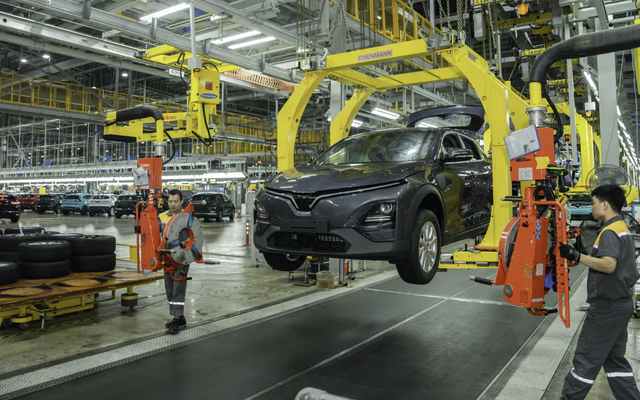
Production at a VinFast factory. The company is seeking more domestic suppliers to increase localization rates and supply components to its overseas factories. Photo: VinFast
However, this perception cannot persist indefinitely as Vietnamese businesses aspire to work together to join global supply chains.
Although parts of the supporting industries remain underdeveloped, support and cooperation from major corporations are creating strong momentum for local businesses to strengthen their positions in the domestic market and participate in global supply chains.
Vingroup gives local suppliers a boost
Vingroup, the largest private conglomerate in Vietnam, held a conference on strengthening localization and developing its supplier network in Hanoi on October 16.
The conference covered a broader range of industries and targeted technology, industrial manufacturing, mechanical engineering, fabrication, processing, and software businesses in Vietnam.
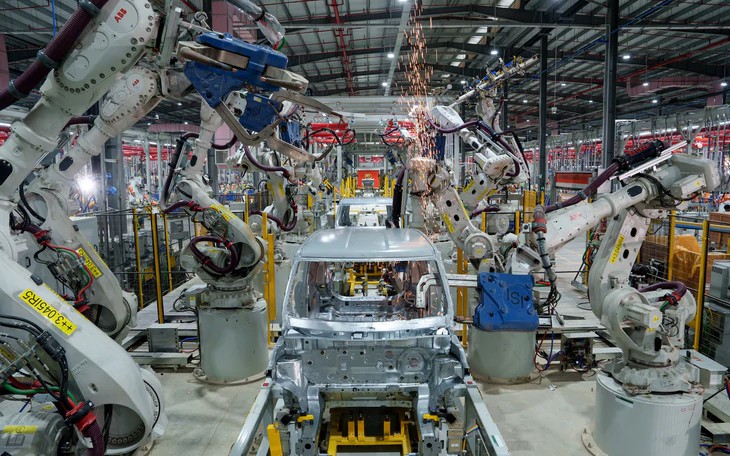
VinFast, Vingroup's automaking arm, is seeking to expand its domestic supplier network for car and motorbike production to increase the proportion of components manufactured in Vietnam.
The company also wants to bring more Vietnamese businesses into the supply chains of its factories in India and Indonesia.
Components manufactured in Vietnam could be supplied to these factories if local businesses meet requirements for production capacity, quality, and scale.
Speaking to Tuoi Tre (Youth) online newspaper, Thai Thi Thanh Hai, vice-chairwoman of Vingroup, said the group had consistently pursued its policy of supporting domestic businesses and developing alongside them.
"With the philosophy of 'Strong Vietnamese Spirit,' we want to accompany and promote domestic businesses, provide a springboard for their growth, and open up equal opportunities for cooperation so that they can develop sustainably, expand internationally, and contribute to the development of Vietnam's supporting industries," Hai said.
"Our approach is to create opportunities, raise standards, and grow together."
Vingroup selects suppliers based on product quality, production capacity, the ability to ensure stable supplies, and reasonable costs.
Suppliers must also comply with environmental and safety standards.
Vingroup is prepared to provide different forms of support depending on individual businesses' needs.
These include consultancy, technical assistance, and connections with technology partners and suppliers, as well as product offtake arrangements.
The group can also support businesses in leasing land and factories and offer rental discounts for land and factory space at industrial parks within its ecosystem.
However, Hai acknowledged that major challenges include gaps in technology, management capabilities, investment capital, and the ability of some domestic businesses to meet international standards.
Some businesses lack experience in industries that are relatively new to Vietnam, such as automotive manufacturing and green energy.
Others remain hesitant to invest in expanding production or upgrading their operations to improve quality, costs, and operational efficiency and compete on an equal footing with foreign businesses.
The ultimate goal of the conference is to build a Vietnamese supply chain that can compete internationally and participate more deeply in global supply chains, Hai said.

Electric vehicles are gaining acceptance among consumers, with sales continuing to grow in the Vietnamese market. Photo: VinFast
Small businesses struggle to access major orders
Nguyen Ngo Long, chairman of NhatLong Mechanical Trading Co. Ltd., told Tuoi Tre on October 13 that his company had identified a market niche in manufacturing components and replacement parts for industrial plants after more than 25 years in operation.
According to Long, Vietnamese mechanical engineering businesses have sufficient capacity to participate more deeply in industrial supply chains.
However, their main obstacle is gaining access to orders from major corporations.
Efforts by Vingroup and other large businesses to seek domestic suppliers for the automotive, metallurgy, industrial, infrastructure, and green energy sectors are opportunities that local companies welcome.
However, mechanical engineering businesses still do not know where to start or what they need to prepare to meet the requirements of major corporations.
"Businesses can no longer afford to buy machinery first and then go around asking companies to give them work. We are studying the opportunities and waiting," Long said.
The participation of major corporations such as Vingroup and Truong Hai Group Corporation (Thaco), along with Hoa Phat in metallurgy and steel production, is creating better conditions for the domestic mechanical engineering industry to develop and gradually participate in higher-value activities in supply chains, he said.
Long said businesses need detailed information about product types, technical standards, order volumes, and long-term cooperation plans before deciding to invest.
He cited the railway sector as an area offering significant potential to domestic mechanical engineering businesses.
As railway projects are implemented, demand for manufacturing, maintaining, and replacing components for locomotives and carriages will increase.
If Vietnam fails to gradually master the necessary technologies, the country will continue to depend on imported spare parts.
However, Long said major corporations, including Vingroup, Thaco, and Vietnamese steel giant Hoa Phat Group, need to clearly announce their procurement needs, supplier selection criteria, and localization road maps to help domestic businesses prepare and make investment decisions.
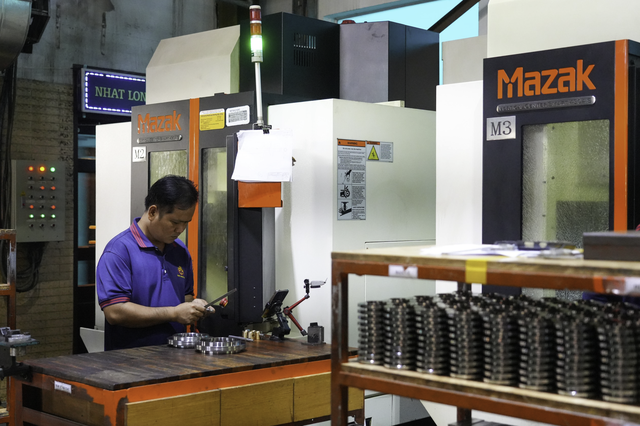
A worker at NhatLong Mechanical Trading’s factory. Photo: Huu Hanh / Tuoi Tre
Only 18 percent of businesses linked to global value chains
Research by the Ministry of Industry and Trade shows that although Vietnam has a high degree of economic openness and is attracting increasing foreign investment in high-tech industries, many of the country's major export sectors remain dependent on imported raw materials, components, and materials.
Only 18 percent of Vietnamese businesses are linked to global value chains, according to the research.
Medium-technology and high-technology industries account for 35 percent of the value added in Vietnam's manufacturing and processing sectors, compared with 40 percent in Thailand, 48 percent in Malaysia, and 57 percent in China.
Research by the Central Policy and Strategy Commission also found that only around 1,000 businesses in Vietnam had sufficient capacity to supply assemblers and multinational corporations directly.
Domestic businesses constituted only around 30 percent of this group, while their participation in high-value-added activities remained limited.
Vietnam has few companies capable of leading production chains and exerting a strong influence at the regional and international levels.
Components manufactured by domestic businesses mainly fall into the category of simple parts with medium or low technological content, according to the research.
Therefore, cooperation and joint development between major corporations and domestic businesses are necessary to break the perception that Vietnamese manufacturers can only produce screws and address the fact that only 18 percent of the businesses are linked to global supply chains.
The Ky - Ngoc An - Cong trung / Tuoi Tre News
Link nội dung: https://news.tuoitre.vn/vietnamese-businesses-seek-to-break-screw-making-curse-join-global-supply-chains-103261020142216452.htm