
Vietnamese entrepreneur sees new horizons in Vietnam-Australia ties
Vietnam and Australia are entering a new phase of economic partnership, with opportunities expanding from human resources to entire value chains, according to Jimmy Le, a Vietnamese entrepreneur who is founder and CEO of Practical IT Solutions Pty Ltd based in Australia.
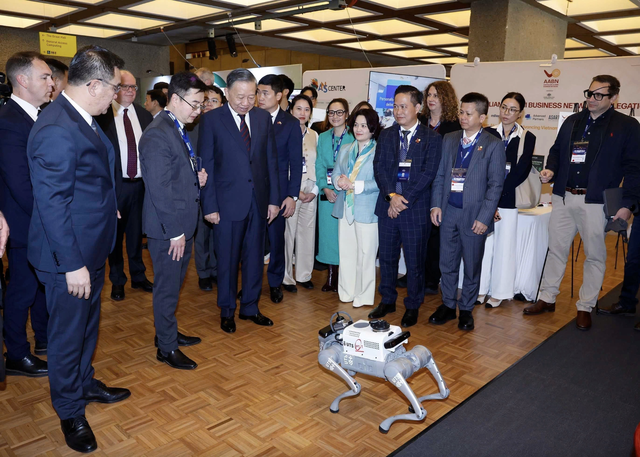
Vietnam’s Party General Secretary and State President To Lam visits an exhibition showcasing Vietnam-Australia cooperation achievements in science, technology, innovation, investment, and education. Photo: Vietnam News Agency
Jimmy, who has been living and doing business, particularly in information technology, in Australia for years, has had opportunities to work with many Vietnamese professionals and recruit young people trained in Vietnam.
He commended many Vietnamese engineers and technicians for showing strong technical foundations, quick learning ability, and adaptability to new technologies, saying that these are key strengths in a fast-changing industry.
However, he noted gaps when young Vietnamese professionals enter international workplaces. These often lie not in technical expertise but in language proficiency, communication skills, problem-solving and analytical abilities, expressing opinions, handling disagreements and understanding the workplace culture of another country.
In Australia, companies value independent work, direct communication, critical thinking, and personal responsibility. Employees are expected to analyze options, present risks, and propose solutions, even if they do not have immediate answers.
In a meeting, an employee telling a manager, "I disagree with this approach, and this is why," can be viewed positively, as long as the opinion is presented professionally and supported by sound reasoning.
This can be a significant difference for young people coming from an education system that places strong emphasis on knowledge and correct answers but may provide fewer opportunities for debate, critical thinking or dealing with situations that have no single correct answer.
Le suggested Vietnam’s education system should emphasize soft skills such as teamwork, negotiation, and conflict resolution from high school onward.
“If we do that, Vietnam will not only provide the world with skilled technicians but also a generation of specialists, managers, and entrepreneurs capable of working anywhere,” he said.
Through his interactions with Vietnamese and Australian businesspeople, Jimmy has also seen rapidly growing interest between the two markets in a range of other sectors, such as agriculture and food.
Australia has strengths in large-scale agriculture, breeding, agricultural technology, quality management, and food safety, while Vietnam offers diverse tropical produce and a dynamic food industry.

Entrepreneur Jimmy Le. Photo: Supplied
He suggested both countries’ cooperation should move beyond raw exports to joint ventures in processing, packaging, preservation technology, traceability, logistics, and branding.
Agriculture, education, energy, digital economy, science and technology have all been identified by the two governments as areas with significant room for further development in trade and investment ties.
He added that logistics and energy are also promising.
As bilateral trade grows, demand for supply chain management, real-time tracking, and AI-driven forecasting will rise.
Both Vietnam and Australia share the same goal of achieving net-zero emissions by 2050, while climate and energy cooperation has become a separate pillar of their comprehensive strategic partnership, established in 2024.
Australia has natural resources, experience in the energy industry, and technological capabilities, while Vietnam has substantial energy needs to support its economic growth and industrialization.
The opportunities therefore extend beyond energy trading to technology, infrastructure, workforce training, power-grid management, energy storage, and services supporting the green transition.
Jimmy emphasized that Vietnam has evolved from a low-cost labor economy to a key player in global supply chains.
The next step, he said, is preparing a generation capable of leading and partnering with international businesses.
“Technical knowledge is vital, but foreign-language skills, critical thinking, communication, problem-solving abilities, and cultural understanding will determine how far we can go in the value chain,” he added.
Vietnam-Australia relations have a strong foundation. The next step is to deepen the relationship at the level of businesses, schools, workers, and specific projects.
He expressed confidence that information technology will be one of the leading areas, but opportunities will certainly extend beyond IT.
From education and agriculture to logistics, energy and professional services, the two countries have many complementary strengths rather than directly competing ones.
If these advantages are effectively leveraged, Vietnam and Australia can create more value together, he said.
Practical IT Solutions Pty Ltd. operates under the Hands On IT brand, based in Dandenong, Melbourne, Victoria, Australia.
With nearly a decade of experience in Australia's IT industry, Hands On IT currently provides network infrastructure, systems, cybersecurity and technology services to more than 60 public facilities, as well as businesses, factories, and offices across Victoria, serving systems with a combined user base of more than 30,000 people.
Minh Duy - Duc Thien / Tuoi Tre News
Link nội dung: https://news.tuoitre.vn/vietnamese-entrepreneur-sees-new-horizons-in-vietnam-australia-ties-103260812210808324.htm