
Vietnamese lawmaker proposes retaining 30% cap on foreign ownership of apartments in condominium buildings
A lawmaker has proposed retaining the current cap of 30 percent on foreign ownership of apartments in a condominium building and explicitly stipulating the limit in law.
National Assembly deputies continued group discussions on amendments to three laws governing land, housing, and real estate business on Thursday afternoon.
During discussions on the draft amended Law on Real Estate Business, Nguyen Thanh Tam, a deputy representing Ho Chi Minh City, said allowing foreign organizations and individuals to legally own housing could help attract investment.
However, ownership limits also involve population management, territorial administration, national defense, and security.
He proposed retaining the cap of 30 percent of apartments in a condominium building in the law, while authorizing the government to specify how the ratio should be calculated, how apartment ownership numbers should be managed, and how situations arising in practice should be handled.
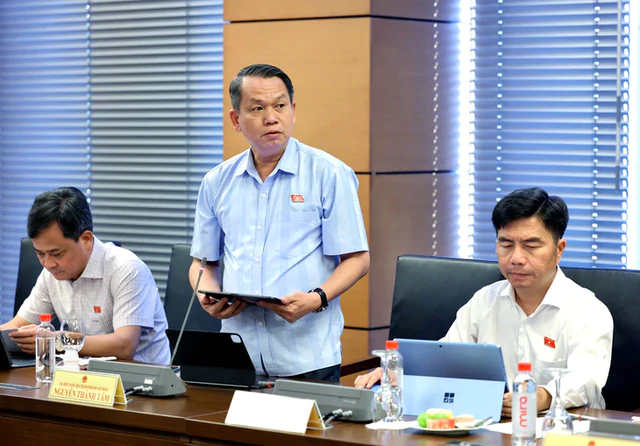
National Assembly Deputy Nguyen Thanh Tam (standing) speaks at the discussion. Photo: Quang Phuc
Tam said foreign ownership limits were not merely a real estate market issue but also concerned population management, territorial administration, national defense, and security, particularly in border areas, coastal areas, islands, and locations near key facilities and strategic sites.
“Higher ownership ratios should not automatically be considered security risks, but any adjustments must be based on clear grounds and accompanied by clear control mechanisms,” he noted.
Also commenting on property ownership rights for foreign organizations and individuals, deputy Tran Anh Tuan, who also represents Ho Chi Minh City, called for careful consideration of a proposal allowing foreigners to buy or lease-purchase floor space in construction projects before the relevant legal grounds have been clarified.
The draft law states that foreign organizations and individuals would be allowed to buy or lease-purchase floor space in construction projects while also stipulating that property sales and lease-purchases must, in principle, be associated with land use rights. Where a construction project has multiple owners, they must jointly hold the land use rights.
The draft law also requires the land use rights associated with the floor space to be identified.
However, current land legislation does not recognize foreign individuals as land users.

National Assembly Deputy Tran Anh Tuan (standing) speaks at the discussion. Photo: Quang Phuc
Tuan said failure to clarify the distinction between ownership of construction works and rights to the underlying land could create difficulties in ensuring consistency in property registration, the issuance of ownership certificates, and the handling of issues.
He suggested carefully considering the expansion of the rights of foreign organizations and individuals to buy or lease-purchase floor space in construction projects before the relevant legal grounds, policy impacts, and opinions of competent authorities have been clarified.
According to Tuan, Vietnam does not allow foreigners to acquire land use rights through any form of transfer.
Therefore, if the law continues to allow foreigners to purchase floor space in construction projects, it must clearly define the scope of ownership rights, their relationship with land use rights, ownership duration and limits, restricted areas, registration and certification procedures, and how ownership should be handled when the permitted period expires or ownership is transferred.
Thanh Ha - Tien Long - Thanh Chung / Tuoi Tre News