


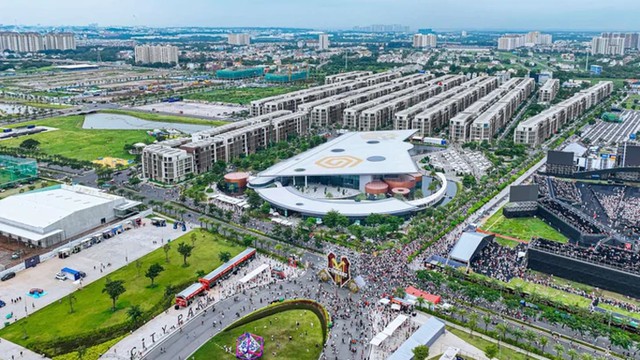
An artist’s impression of the Saigon Binh An urban area project, one of five housing projects where foreign ownership is permitted, as recently announced by the Ho Chi Minh City administration. Photo: Supplied
In the latest draft of the amended Housing Law, the Ministry of Construction has finalized and supplemented regulations governing home ownership in Vietnam by foreign organizations and individuals.
It proposes removing provisions that allow foreign organizations and individuals to own individual houses. Their right to own condominium apartments, however, would be retained, subject to certain limits.
Specifically, foreign organizations and individuals would be allowed to buy, lease-purchase, receive as gifts or inheritance, and own no more than 30 percent of the total number of apartments in a condominium building.
For projects with multiple buildings, the limit would apply separately to each building.
The draft would also retain the requirement that homes owned by foreign organizations and individuals be located in projects outside areas subject to national defense and security restrictions.
The government would be tasked with issuing detailed regulations on such areas.
The proposed change does not mean foreigners would be excluded from Vietnam’s housing market altogether.
It follows Resolution No. 21-NQ/TW, issued by the Party Central Committee on July 28, 2026, which sets out directions for amending the Land Law and related legislation.
The resolution emphasizes that land must not be privatized and states that foreigners should not be allowed to receive transfers of land-use rights in any form, except in certain cases involving people of Vietnamese origin residing abroad.
Removing their right to own individual houses could prevent situations in which ownership of a house is directly associated with rights over a separate residential land parcel.
If such ownership were retained, the law would also have to address the relationship between ownership of the building and land-use rights over the land beneath and surrounding it.
Condominium apartments are treated differently because ownership is associated with shared land-use rights rather than a separate residential land parcel.
Existing owners raise transitional questions
A major question, however, is what would happen to individual houses already legally owned by foreigners.
If the amended law ends such ownership, transitional provisions would be needed to clarify the status of homes previously purchased and legally recognized under the 2023 Housing Law and related regulations.
The new rules would need to specify whether existing foreign owners could continue to own, transfer, gift, bequeath, mortgage, or otherwise dispose of their properties, ensuring legal certainty and protecting property rights already recognized by the state.
The legislation would also need to clearly distinguish among foreign nationals, Vietnamese citizens residing abroad, people of Vietnamese origin residing abroad, and Vietnamese citizens who also hold foreign nationality to ensure consistent implementation.
The proposed changes therefore seek to redefine the legal boundary between home ownership and land-use rights, while allowing foreigners to retain access to Vietnam’s condominium market under specified conditions.
Under the 2023 Housing Law, eligible foreign organizations and individuals may buy, lease-purchase, receive as gifts or inheritance, and own homes in Vietnam, subject to certain conditions and limits.
For individual houses, including villas and townhouses, foreign ownership is capped at 250 homes in an area with a population equivalent to that of a ward.
Foreigners may only own homes in eligible housing projects outside areas subject to national defense and security restrictions.
Since the 2023 Housing Law took effect, foreign organizations and individuals have newly acquired more than 1,500 homes, bringing the cumulative number under foreign ownership to more than 6,000.
The proposed revision, however, is not simply about the number of homes owned by foreigners. A key issue is the relationship between ownership of an individual house and land-use rights over the land on which it stands.








Max: 1500 characters
There are no comments yet. Be the first to comment.