
Vietnamese preservationist races to revive disappearing craft villages
In Hue City, central Vietnam, 40-year-old Ngo Quy Duc spends his days moving between workshops, archives, and traditional craft villages, trying to keep fading folk traditions alive before they disappear entirely.
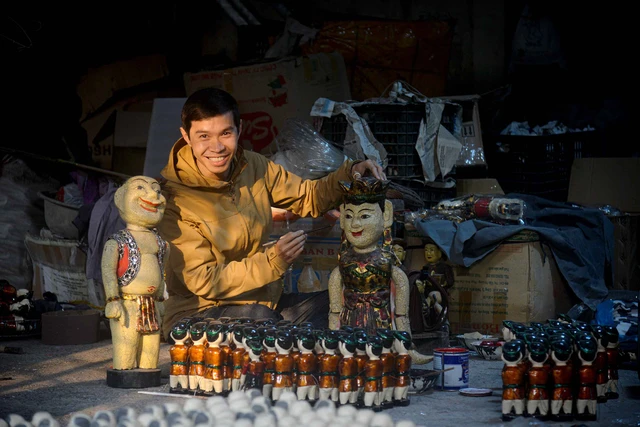
Vietnamese cultural preservationist Ngo Quy Duc poses with traditional water puppets in Hue City, central Vietnam.
Inside Ngu Ha Vien on Xuan 68 Street in Hue, Duc regularly exchanges messages with young woodblock artisans in Thanh Lieu Village, Hai Phong City, northern Vietnam as they refine details for one of his latest restoration projects.
The project centers on reviving ‘lien lang Chuon’ (Chuon Village woodblocks), a once-prominent Hue folk print tradition that vanished over time.
In January, a restored set of Chuon Village woodblocks was officially unveiled before cultural researchers, local authorities, and residents of Chuon Village, where the folk art form had originated, flourished, and eventually disappeared.
The launch marked another milestone in Duc’s nearly-two-decade journey to restore and preserve Vietnam’s traditional craft villages.
Building trust
Duc graduated in 2006 with a university degree in information technology, a field seemingly unrelated to cultural heritage.
But he said the technical skills later proved essential in digitizing archives, restoring damaged images, and recreating missing details from old craft traditions.
As a child, Duc remembered touching and admiring handmade products crafted by traditional artisans.
He became fascinated not only by the objects themselves but also by how they were made.
The curiosity stayed with him into adulthood.
After graduating, Duc briefly worked for a friend before quitting after about three months.
His first independent project was building an online information library about Hanoi that collected materials on culture, history, geography, festivals, and local communities.
While visiting craft villages during that project, he encountered products he had remembered from childhood.
But he soon realized many villages had few successors, shrinking markets, and fading traditions.
When Duc left his job to pursue cultural preservation work, his family was uneasy, though nobody openly opposed him.
He chose not to explain his plans, believing success would eventually speak for itself.
In many traditional villages, residents became accustomed to seeing a slight young man carrying a shoulder bag, wandering around and constantly taking notes without fully understanding what he was doing.
Duc has spent nearly 20 years traveling through traditional craft villages across Vietnam.
Several years ago, he approached a papier-mache mask-making village in Hanoi.
Like many traditional craft communities, the artisans were reluctant to teach outsiders.
If no family member wished to continue the trade, some preferred to let the craft disappear altogether.
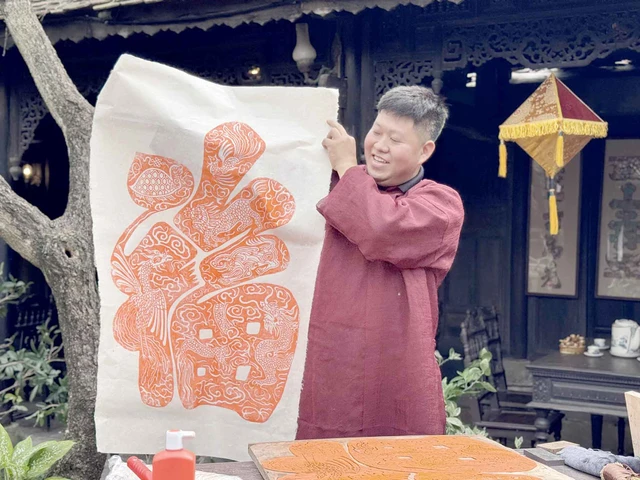
A restored Chuon Village folk print is displayed during an event in Hue City, central Vietnam.
Realizing he could not approach artisans directly as an apprentice, Duc instead immersed himself in their daily lives before discussing the craft itself.
He said he wanted the artisans to see him as part of the family.
“Once the connection is there, sharing becomes easy,” Duc said.
“They begin talking about daily life, livelihoods, the craft itself, and the lack of successors.
“That’s when I can understand what direction to take.”
Instead of explicitly asking artisans to teach him, Duc worked alongside them and shared their concern for preserving traditional handicrafts.
He wanted them to understand that if the craft disappeared, generations of dedication would also be lost.
“Only when people truly understand that will they genuinely want to pass the craft on,” he said.
Duc spent seven years traveling back and forth, living and speaking with the last two remaining papier-mache mask artisans before they eventually agreed to pass their knowledge to him.
“When they finally decided to teach me, I couldn’t hold back my emotions,” he said.
“Even their children were happy that someone would continue the craft.”
Reviving crafts on brink of disappearance
In 2025, Duc moved to Hue to begin restoring Chuon Village folk prints.
Very little documentation remained.
In Chuon Village itself, nobody still practiced the craft.
Most residents no longer knew about it, while elderly villagers only vaguely remembered that the village had once produced such prints.
The Chuon prints traditionally featured a large central character such as ‘Phuc,’ ‘Loc,’ or ‘Tho’ -- symbols of blessing, prosperity, and longevity -- accompanied by paired calligraphy panels decorated with traditional motifs including dragons, unicorns, turtles, and phoenixes.
The only surviving traces were found in the ancestral hall of the Doan family.
Even those pieces had not been produced by descendants but had simply been purchased long ago.
The original woodblocks had disappeared entirely.
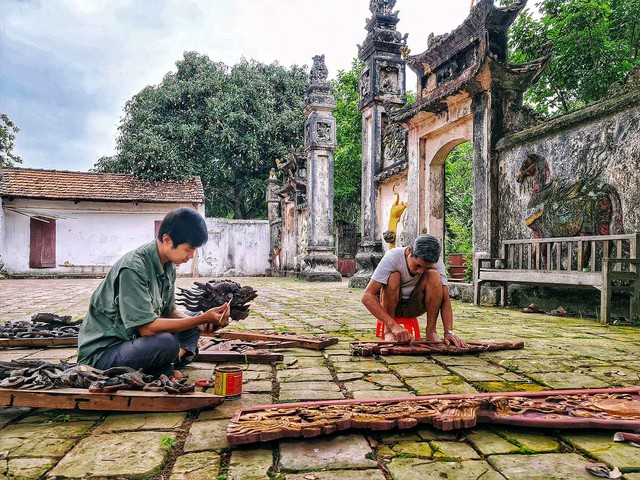
Vietnamese cultural preservationist Ngo Quy Duc (L) works alongside an artisan at a traditional craft village in Vietnam.
Duc searched online archives and found several old newspaper articles, though the accompanying images were badly faded.
Using digital restoration techniques, he reconstructed missing details and enhanced the quality of the surviving visuals.
Having worked with woodblock print artisans throughout Vietnam, Duc said he understood that Chuon Village prints would likely share stylistic similarities with other traditional print forms.
After recreating the lettering and decorative details digitally and comparing them with the surviving prints he had previously examined, Duc felt more confident in the restoration work.
The images were then sent to Thanh Lieu Woodblock Village, where young artisans carved them onto ‘thi’ wood panels.
When the restored Chuon Village woodblocks successfully produced sharp prints on paper, Hue cultural researcher Nguyen Xuan Hoa said he was surprised by the result.
“This line of folk prints had disappeared, and I never thought it could be restored,” Hoa said.
“I also didn’t expect the team to accomplish this in such a short time.”
Hoa recalled that the original prints were simple and affordable decorations often purchased by poorer families during the Lunar New Year holiday.
“People used to paste them onto bamboo walls in the middle of their ancestral altars,” he said.
“They were not elaborate works like the restored versions today.”
Duc believes the Chuon folk prints possess unique cultural value and could eventually become recognized cultural products rather than museum pieces alone.
“These prints are meaningful because the couplets talk about education, morality, springtime beauty, and family traditions,” he said.
“For now, the important thing is helping people understand the values left behind by previous generations.
“Once they understand, perhaps someone will return to the craft.”
The papier-mache mask tradition also continues today with support from Duc and the two remaining artisans.
He said demand for traditional toys and handicrafts has become more favorable in recent years as schools increasingly organize workshops connected to traditional crafts.
Over nearly two decades, Duc said he has visited close to 1,000 traditional craft villages across Vietnam.
Some disappearing crafts have already been successfully revived, while many more restoration projects remain in development.
Asked why so many Vietnamese traditional craft villages continue to fade away, Duc pointed to economic pressures.
“Livelihoods are difficult,” he said.
“People have to leave the craft behind and find other work to survive.”
Bao Anh - Nguyen Dac Thanh / Tuoi Tre News
Link nội dung: https://news.tuoitre.vn/vietnamese-preservationist-races-to-revive-disappearing-craft-villages-103260527121144735.htm