
Vietnamese textile-garment firms post strong Q2 growth as 12.5% US tariff weighs on outlook
Vietnam’s major textile and garment exporters reported higher revenue in the second quarter of 2026 as orders increased and customers brought forward deliveries before a 12.5 percent U.S. tariff took effect on July 24, with the tariff expected to weigh on the sector in the coming months, according to companies' reports.
Financial reports showed that all major listed textile and garment exporters recorded higher second-quarter revenue year on year, with several companies posting growth of more than 10 percent.
Vietnam National Textile and Garment Group (Vinatex) recorded the highest revenue at VND5.008 trillion (US$$192.5 million), up 13.1 percent, while Damsan JSC posted the strongest growth at 39.2 percent, according to the companies’ financial reports.
Vinatex said its member companies accelerated production and deliveries as many customers sought to receive goods earlier than scheduled before the new U.S. tariff policy took effect.
The move helped boost the number of orders completed during the quarter compared with the same period last year, Vinatex said.
At TNG Investment and Trading JSC (TNG), second-quarter revenue rose 15.3 percent after increasing 29.2 percent in the first quarter.
TNG attributed its first-half growth partly to expanded production capacity, an increase in workers on sewing lines and faster delivery of export orders.
Song Hong Garment JSC reported 13 percent revenue growth in the second quarter, saying the hike was driven by a larger number of orders.
Meanwhile, Viet Tien Garment Corporation recorded a revenue expansion of 1.9 percent, while Viet Thang Corporation posted a 0.6-percent jump.
Higher U.S. tariff puts Vietnam at disadvantage
Vietnamese goods entering the U.S. were subject to a temporary 10 percent tariff from February 24 to July 23 before the U.S. began imposing a 12.5-percent tariff on Vietnamese goods on July 24.
Meanwhile, 17 other economies face a 10-percent rate, 2.5 percentage points lower than Vietnam’s, according to the U.S. Department of Commerce.
Vietnam remained the largest supplier of apparel to the U.S. in the first seven months of the year, with exports worth $9.37 billion.
Bangladesh ranked second at $4.66 billion and is among the economies subject to the 10 percent tariff.
Indonesia, Cambodia, and India also face the 10-percent rate, with each exporting more than $2.4 billion worth of apparel to the U.S. during the period.
Ho Chi Minh City-based ACB Securities (ACBS) said the new tariff would place a greater direct burden on textiles and garments, footwear, handbags, toys, seafood, and some consumer goods, as many major technology product categories are exempt.
The securities firm said Vietnam’s position is relatively less advantageous than that of competitors facing a 10-percent tariff, particularly in labor-intensive industries.
However, Vietcombank Securities Limited Company (VCBS) said textile and garment exports may slow but they are unlikely to be significantly affected in the short term because the tariff gap is only 2.5 percentage points.
VCBS said Vietnam has a relatively complete apparel manufacturing ecosystem, including synthetic fibers and more complex product lines, as well as quick access to raw materials and auxiliary materials from China.
Customers would also need time to inspect products and establish relationships with new suppliers, meaning the relatively small tariff difference is unlikely to cause orders to immediately leave Vietnam, VCBS said.
In the longer term, however, VCBS warned that pressure could increase as competing countries expand into higher-value products.
Vietnam’s inability to access the lower tariff rate could then put its products at a greater price disadvantage.
August exports still resilient, Q4 orders slowing
The full impact of the 12.5-percent tariff on export value is expected to become visible from September because of lags in contracts and shipping, according to Viet Dragon Securities Corporation.
Product categories that compete directly with Ecuador, India, and Indonesia, which face a 10-percent tariff, are likely to face pressure to renegotiate prices, the brokerage said.
Despite the tariff pressure, textile and garment exports continued to grow in August. Data from Vietnam Customs showed exports rose 3.2 percent year on year to nearly $4 billion.
TNG’s revenue reached VND1.252 trillion ($48.3 million) in July, up 29.2 percent year on year, and VND1.114 trillion ($42.8 million) in August, up 22.1 percent.
At Hoa Tho Textile-Garment JSC, CEO Nguyen Ngoc Binh said in late August that the company’s garment division had secured orders through October.
However, orders for the fourth quarter have been finalized more slowly as many customers continue to monitor U.S. tariff developments before signing contracts, he said.
Vinatex CEO Cao Huu Hieu recently said the group’s consolidated revenue for the first eight months was expected to rise 8.3 percent.
Garment revenue rose 3.9 percent, while yarn revenue grew 18.8 percent.
Vinatex’s garment division has basically secured orders through the fourth quarter, Hieu said, but it is facing increasing price competition, smaller orders, and shorter delivery times.
In addition, the new tariff could affect not only finished garments but also the movement of orders and supply chains involving yarn, fabric, and other raw materials, according to Vinatex.
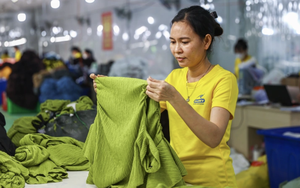


Vinh Tho - Quan Nguyen / Tuoi Tre News