
Vietnam–EU tie upgrade signals strategic intent beyond symbolism
The elevation of Vietnam–European Union relations to a comprehensive strategic partnership carries both symbolic and practical significance, signaling deeper political trust and expanded scope for economic and technological cooperation, according to analysts.
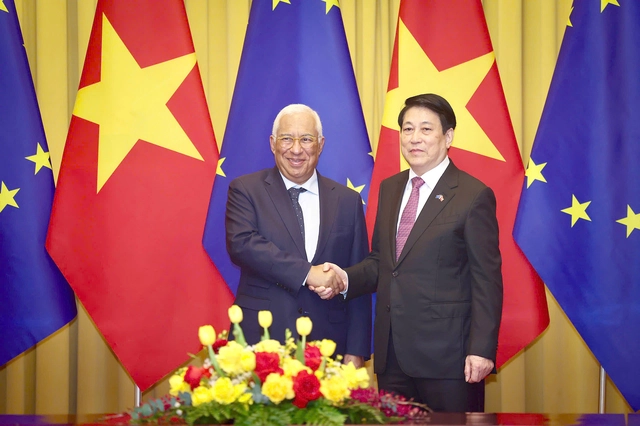
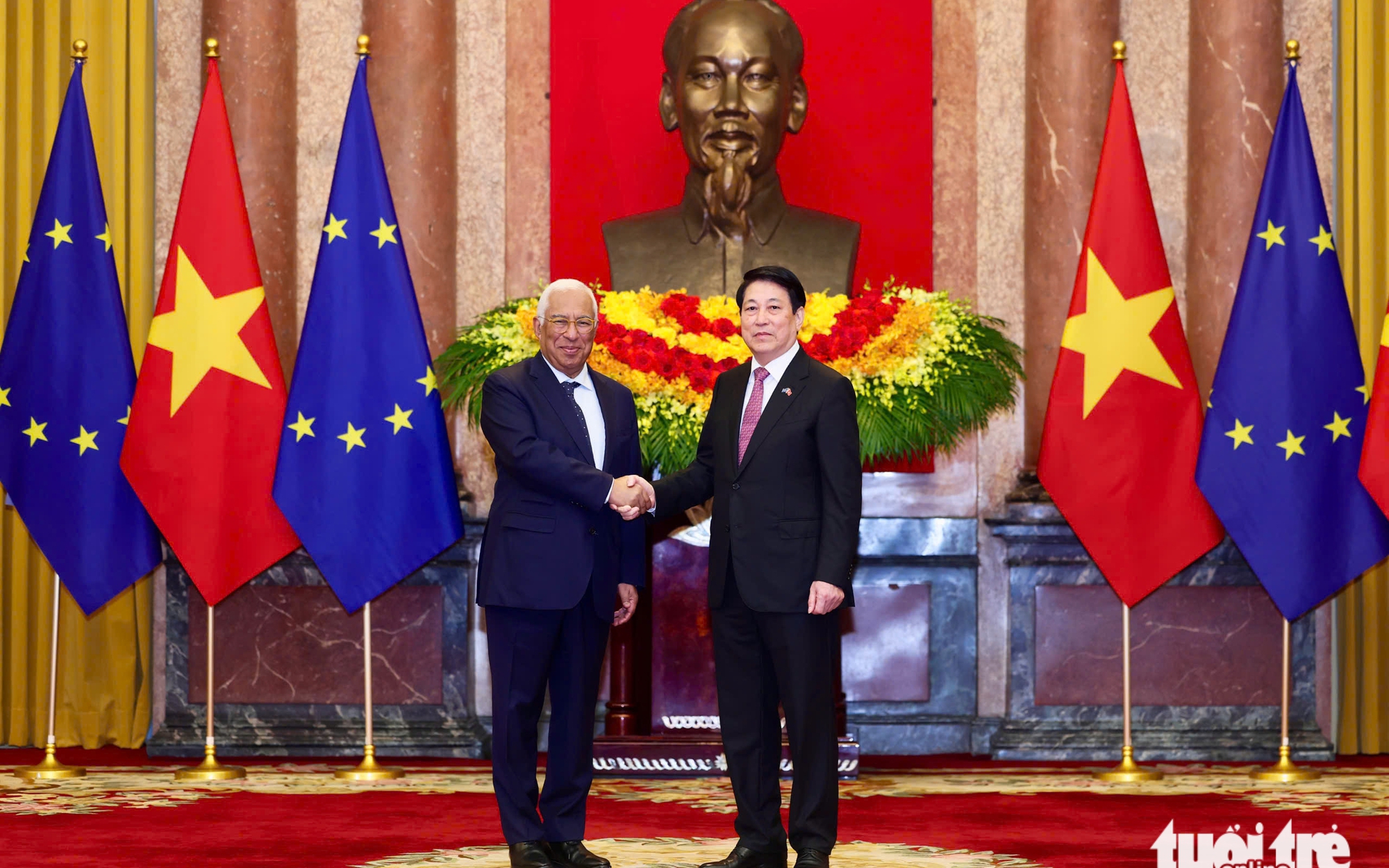
Vietnam’s State President Luong Cuong (R) and European Council President António Costa shake hands ahead of their talks in Hanoi, Vietnam, January 29, 2026. Photo: Nguyen Khanh / Tuoi Tre
The upgrade, agreed during a visit by European Council President António Costa on Thursday, places Vietnam at the highest level of the EU’s external partnership framework.
It also makes Vietnam the only ASEAN country to hold a comprehensive strategic partnership with the EU as a bloc, rather than through bilateral ties with individual member states.
Analysts say the timing of the move carries political and economic weight.
“The timing is right, just after the 14th Central Party Committee meeting, helping to reinforce Vietnam’s political and economic direction for the next five years,” said Ye Xuan, chair of talent development at the Vietnam Private Capital Agency.
He described the upgrade as “both symbolic and substantial.”
It is symbolic, Ye said, because it aligns with Vietnam’s longer-term development strategy.
It is substantial because of its regional significance.
“Vietnam is now the only ASEAN country to have signed a comprehensive strategic partnership with the EU as a bloc,” he said.
“This signals that the EU sees Vietnam as a preferred partner for deeper trade and investment cooperation in ASEAN.”
From the European perspective, the partnership comes as the EU accelerates efforts to diversify trade and investment links amid geopolitical disruption, including the impact of the Russia-Ukraine conflict and mounting global trade pressures.
“With a population of around 450 million and GDP of about US$20 trillion, the EU is a market with strong purchasing power and attraction,” said Bui The Giang, former director of the Western Europe–North America department at the Communist Party of Vietnam’s Commission for External Relations.
He said the bloc is increasingly seeking partners that combine economic potential with political reliability, “and Vietnam is among them.”
Over more than 35 years of diplomatic relations, the nature of Vietnam–EU ties has shifted markedly.
“The relationship has changed in quality,” Giang said.
“From a small-scale, give-and-take relationship, the two sides have become more equal partners.”
Trade has been central to that shift.
The EU-Vietnam Free Trade Agreement, approved by all 27 EU member states, has helped drive a roughly-40-percent increase in bilateral trade after five years in force.
European companies now form the largest group of foreign firms operating in Vietnam, which Giang said reflects confidence in the country’s political stability and investment environment.
The partnership upgrade also widens the scope of cooperation beyond trade volumes.
Europe holds advantages in areas such as artificial intelligence, energy efficiency, waste-to-energy technology, climate adaptation, robotics, semiconductors, and critical minerals -- all sectors where Vietnam has growing demand.
To capitalize on those strengths, Vietnam needs a more targeted approach, Giang said.
He argued that Hanoi should clearly articulate its scientific and technological needs to the EU and to individual member states, given the differing strengths of each, and identify specific pathways to European firms and markets.
Despite the momentum, practical barriers remain.
Ye said many European companies still struggle to identify suitable partners in Vietnam, while administrative uncertainty and slow procedures reduce investment incentives.
“In reality, countries are competing for technology and foreign direct investment,” he said.
According to Ye, the comprehensive strategic partnership could help address these frictions by expanding dialogue mechanisms and people-to-people exchanges.
“This would make it easier for European technology and Vietnamese innovation capacity to connect and deliver shared economic benefits,” he said.
Tough EU rules sharpen Vietnam’s competitiveness
Regulation is another defining feature of the Vietnam–EU economic relationship.
The EU is known for stringent standards on product quality, transparency, and sustainability, including measures such as the Carbon Border Adjustment Mechanism (CBAM) and the EU Deforestation Regulation (EUDR).
Giang said Vietnam has tended to treat such challenges as opportunities for internal reform.
He cited Vietnam’s efforts to address the EU’s warning over illegal, unreported, and unregulated fishing, noting that while the measures were driven by European requirements, they also promoted more sustainable fishing practices domestically.
“This approach can extend beyond fisheries to areas such as forestry and environmental protection,” he said.
Ye noted that the EU itself has begun to reassess the impact of regulatory complexity.
“The EU has recognized that its complex regulatory system is strangling private-sector initiatives and has started to address this issue,” he said.
For Vietnamese businesses, Ye said compliance with EU rules such as CBAM and EUDR may raise short-term costs but could strengthen competitiveness over time by encouraging upgrades in products and production processes.
“With the comprehensive strategic partnership in place, I hope there will be stronger dialogue platforms to support this transition and reduce adjustment costs,” he said.
Education and human capital development are also expected to play a role.
As Vietnam prioritizes science, technology, and innovation as a core development breakthrough, Giang said cooperation with European universities and research institutions could be particularly valuable if training focuses on specific sectors and skills.
In deepening ties with one of the world’s most demanding markets, Vietnam is making a strategic bet that higher standards will strengthen its competitiveness over time, both analysts argue.
The analysts say the partnership reflects Vietnam’s view that long-term competitiveness will depend not on avoiding global standards, but on meeting them, and using that discipline to underpin the country’s next phase of growth.
Thanh Hien - Bao Anh / Tuoi Tre News
Link nội dung: https://news.tuoitre.vn/vietnameu-tie-upgrade-signals-strategic-intent-beyond-symbolism-103260130180550309.htm