


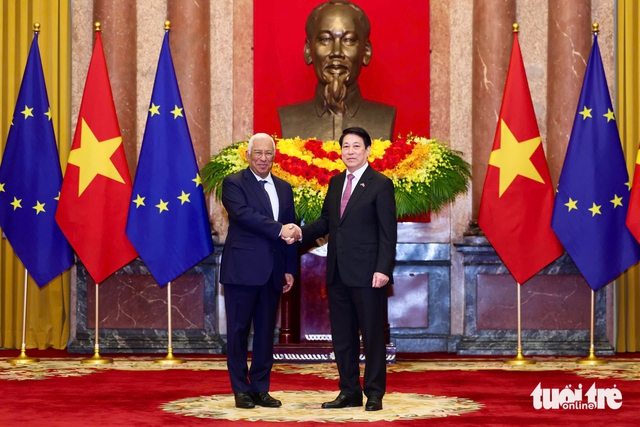
Vietnamese State President Luong Cuong (R) holds talks with European Council President António Costa in Hanoi, January 29, 2026. Photo: Nguyen Khanh / Tuoi Tre
Vietnam has become the first ASEAN country to establish a comprehensive strategic partnership with the EU, and this also marks the first time Vietnam has achieved this level of relations with a bloc of nations.
According to the Ministry of Foreign Affairs, the announcement followed a formal welcome ceremony and talks at the Presidential Palace in Hanoi on the same day.
During the talks, Cuong, on behalf of the Vietnamese state and people, warmly welcomed Costa on his official visit to Vietnam from Wednesday to Thursday, describing it as historically significant.
It was the first visit to Vietnam by a European Council president since 2012, and the first visit by a European leader following the country’s 14th National Party Congress held last week.
President Cuong said the visit opened a new chapter in Vietnam-EU relations, with both sides agreeing to elevate ties to a comprehensive strategic partnership.
He reaffirmed that Vietnam consistently views the EU as one of its most important partners, and expressed Vietnam’s desire to deepen comprehensive cooperation with the bloc while strengthening relations with EU member states.
Briefing Costa on the outcomes of the 14th National Party Congress, Cuong highlighted Vietnam’s two long-term goals: becoming a developing country with modern industry and upper-middle income by 2030, and a developed, high-income country by 2045.
He stressed Vietnam’s readiness to work closely with the EU in a new era of development.
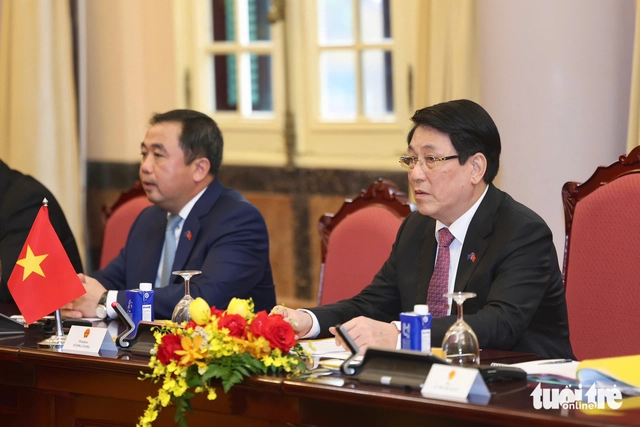
Vietnamese State President Luong Cuong speaks at the talks in Hanoi, January 29, 2026. Photo: Nguyen Khanh / Tuoi Tre
Cuong proposed close coordination to implement the joint declaration upgrading Vietnam-EU relations, outlining six priorities, including strengthening political trust through high-level exchanges, effectively implementing existing cooperation mechanisms, and expanding new ones.
Economic cooperation was identified as a key driver of bilateral relations, with science, technology, and innovation to become a core pillar of cooperation.
President Cuong also urged the EU to promote cooperation in the maritime economy, support Vietnam’s efforts to build sustainable fisheries, and lift the EU’s illegal, unreported, and unregulated fishing ‘yellow card’ warning on Vietnamese seafood.
He reaffirmed Vietnam’s support for strengthening ASEAN-EU relations, expressing readiness to serve as a bridge to promote more substantive cooperation ahead of the 50th anniversary of ASEAN-EU relations in 2027.
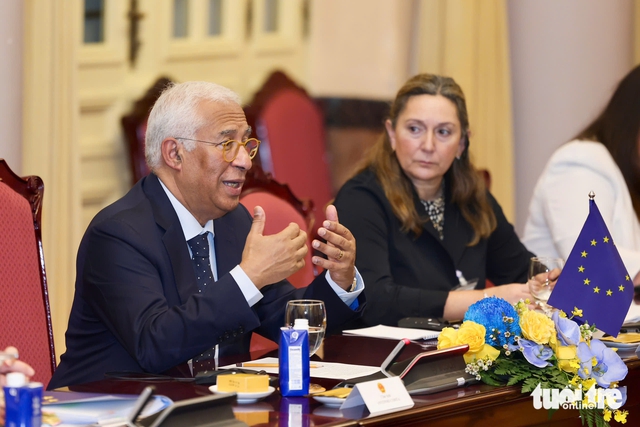
European Council President António Costa speaks at the talks in Hanoi, January 29, 2026. Photo: Nguyen Khanh / Tuoi Tre
Costa said he was honored to be the first European guest to visit Vietnam following the 14th National Party Congress.
He thanked Vietnam for the warm reception, congratulated the country on the congress’ success, and expressed strong admiration for Vietnam’s comprehensive socio-economic achievements after 40 years of its Doi Moi (Renovation) journey.
He affirmed that the EU considers Vietnam a key partner in ASEAN and in its Indo-Pacific strategy, sharing common values such as respect for international law, support for free trade, and freedom of navigation.
Costa said the two sides have significant cooperation potential in trade, sustainable development, innovation, maritime economy, governance, security, and people-to-people exchanges.
The EU, he added, seeks to strengthen cooperation in traditional areas such as trade, investment, and agriculture, while expanding into new areas including green transition, digital transformation, just energy transition, infrastructure, and transport connectivity.
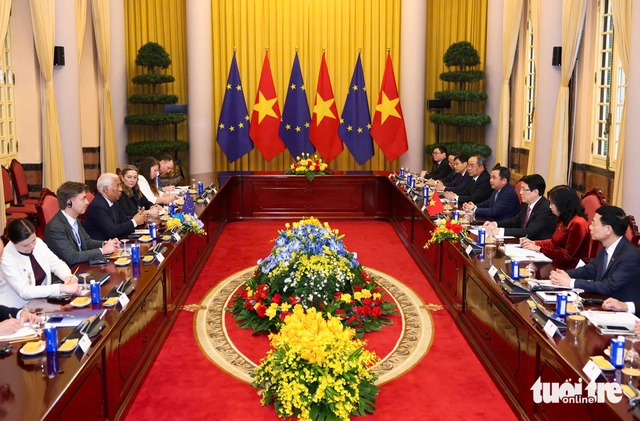
An overview of the talks between Vietnamese State President Luong Cuong and European Council President António Costa in Hanoi, January 29, 2026. Photo: Nguyen Khanh / Tuoi Tre
The two leaders formally announced the partnership upgrade and agreed to develop an action plan to effectively implement the joint declaration in the coming period.
They agreed to enhance cooperation in science, technology, and innovation, making it a new pillar of bilateral relations, particularly in areas where Europe has strengths, including digital transformation and connectivity.
Both sides also agreed to fully and effectively implement the EU-Vietnam Free Trade Agreement; accelerate ratification of the EU-Vietnam Investment Protection Agreement; strengthen defense and security dialogue, UN peacekeeping cooperation, and collaboration in maritime security, cybersecurity, and crisis management; and boost cooperation in environmental protection, climate change response, green and circular economy, and clean energy.
On regional and international issues, both sides reaffirmed their commitment to multilateralism, respect for international law, and peaceful settlement of disputes in accordance with the UN Charter.
They emphasized the importance of maintaining peace, stability, freedom of navigation and overflight, and the rule of law in seas and oceans, including the East Vietnam Sea, as well as in the Indo-Pacific and Atlantic regions.
As of January 2026, Vietnam has established 15 comprehensive strategic partnerships across Asia, Europe, and the Americas, including with China (2008), Russia (2012), India (2016), South Korea (2022), the United States (September 2023), Japan (November 2023), Australia (March 2024), France (October 2024), Malaysia (November 2024), New Zealand (February 2025), Indonesia (March 2025), Singapore (March 2025), Thailand (May 2025), the United Kingdom (October 2025), and the EU (January 29, 2026).








Max: 1500 characters
There are no comments yet. Be the first to comment.