
Vietnam’s $20.5bn trade deficit: Bad news or sign of investment boom?
Vietnam posted a trade deficit of US$20.46 billion in the first eight months of 2026 after years of strong surpluses, but economists say the headline number may look more worrying than the underlying picture.
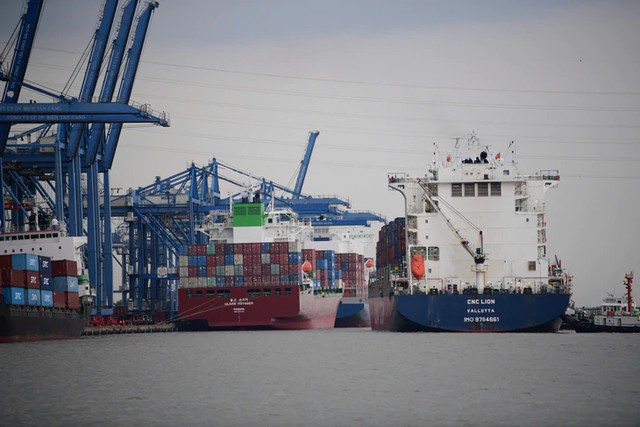
A cargo ship carries export goods at Cat Lai Port in Ho Chi Minh City. Photo: Quang Dinh / Tuoi Tre
Trade deficit persists
The country exported $374.8 billion worth of goods during the period, up 22.4 percent year on year, while imports surged 35.3 percent to $395.3 billion.
That pushed its total trade to a record $770.14 billion, according to the National Statistics Office.
With imports growing much faster than exports, Vietnam logged a goods trade deficit of $20.46 billion, a sharp reversal from a $14.02-billion surplus in the same period last year.
The result was somewhat unexpected, according to Dr. Dinh The Hien, an economist and director of the Institute for Informatics and Business Research.
He said the figure had understandably raised concerns after Vietnam had recorded trade surpluses for many consecutive years.
The first month in which the trade balance slipped into deficit was December 2025, when the shortfall stood at $554 million, according to Vietnam Customs data. Through the end of August 2026, the country had yet to record another monthly trade surplus.
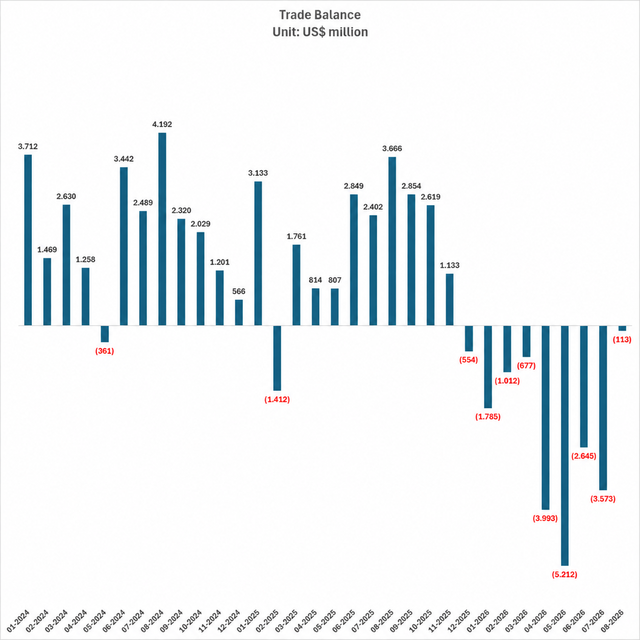
Vietnam has recorded a trade deficit for nine consecutive months. Photo: Quan Nguyen
Phan Quoc Buu, director of the BIDV Securities Company (BSC) Research Center, attributed the trade deficit to three main factors.
First, Vietnam is going through a strong cycle of production and investment expansion in high-tech industries.
Second, electronics supply chains are continuing to shift toward Vietnam.
Third, the country’s production structure remains heavily dependent on imported raw materials and components.
As a result, much of the recent increase in imports is linked to machinery, equipment, and intermediate goods used for production rather than final consumption.
That means a widening trade deficit can, to some extent, reflect stronger investment and future export capacity rather than simply weaker trade performance.
Domestic firms remain heavily in deficit
The figures also reveal a growing gap between foreign-invested and domestic companies.
According to the National Statistics Office, the foreign-invested sector still recorded a trade surplus of $10.13 billion in the first eight months, but that was sharply lower than the $29.61-billion surplus recorded in the same period last year.
Meanwhile, the domestic economic sector posted a trade deficit of $30.60 billion, nearly double the $15.58-billion deficit in the first eight months of 2025.
Economist Bui Trinh said Vietnam’s overall trade balance has long depended heavily on foreign-invested companies, while the domestic sector has consistently run trade deficits.
He said foreign-invested firms accounted for around 80 percent of Vietnam’s exports this year, up from about 70-71 percent in previous years.
Exports by domestic companies increased only 7.4 percent in the first eight months, compared with 26.9 percent growth among foreign-invested firms.
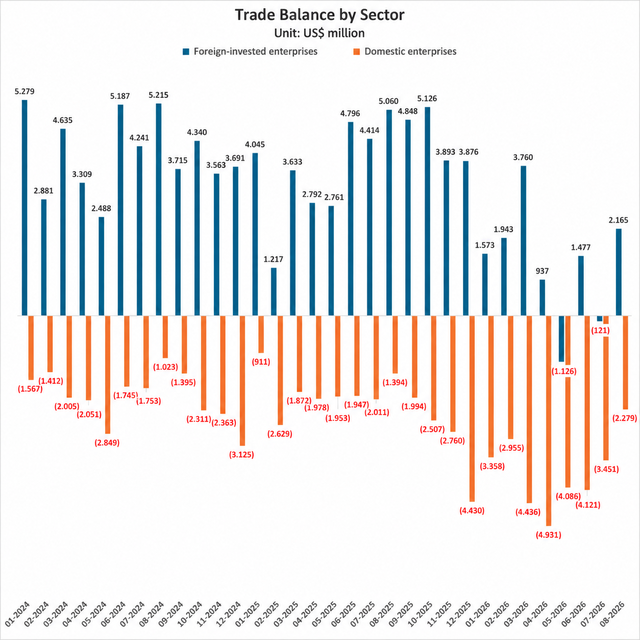
Vietnam’s trade surplus continues to be driven by the foreign-invested sector, while domestic businesses consistently run a trade deficit. Photo: Quan Nguyen
Rong Viet Securities said in a macroeconomic report released on Friday that the trend reflected not only changes in the trade balance but also limitations in the production and export capacity of Vietnamese businesses.
Vietcombank Securities, meanwhile, linked the deficit partly to stronger domestic investment demand, particularly imports of machinery, equipment, raw materials, and other production inputs as public investment accelerates.
Electronics explain much of reversal
The biggest driver of Vietnam’s trade deficit is one product group: computers, electronic products, and components.
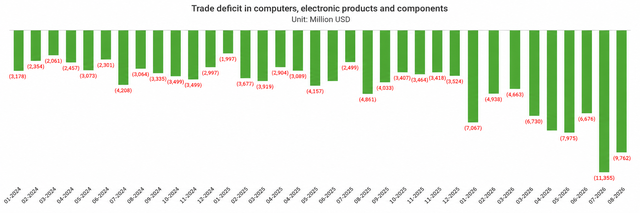
The trade deficit in computers, electronic products, and components has surged in recent months. Photo: Quan Nguyen
Exports in the category surged 51.1 percent to $101.06 billion in the first eight months. Imports, however, rose even faster, jumping 68.3 percent to $161.63 billion.
The category therefore posted a trade deficit of $60.57 billion, nearly three times the deficit of the economy as a whole.
Other product groups effectively offset more than $40 billion of that shortfall. Agriculture and fisheries alone posted a trade surplus of around $14.5 billion, according to Dr. Hien.
Electronics represent nearly 30 percent of Vietnam’s export turnover and are growing at twice the overall pace, making the sector one of the country’s most important export drivers, he said. The industry is also dominated by foreign-invested companies.
Explaining the surge in electronics imports, director Buu said much of the increase was driven by higher input prices rather than by import volumes alone.
Prices of key electronic inputs such as DRAM memory, chips and high-bandwidth memory, or HBM, have risen sharply from a year earlier, pushing up Vietnam’s import bill, according to data tracked by BSC.
One reason is booming demand from artificial intelligence data centers, which has encouraged chipmakers to prioritize higher-value memory products over components for consumer electronics.
Bigger question: How much value stays in Vietnam?
Combining electronics with telephones, Vietnam’s electronics assembly chain still recorded a trade deficit of $21.85 billion, compared with a $2.06-billion surplus in the same period last year.
Economist Trinh said the figures underline a long-standing characteristic of Vietnam’s electronics industry: much of its activity remains focused on assembly using imported components.
For computers and electronics alone, imports increased by $65.6 billion from a year earlier, while exports rose by $34.2 billion.
That means every additional $1 in imports corresponded to around $0.52 in additional exports. Including telephones and components, the figure rises to $0.63.
Buu also pointed to the issue of value added, saying that most electronics imports are inputs for production and export. As those components are turned into finished goods, the trade deficit associated with them should gradually narrow along the export chain.
“The more important question in the long term is not the scale of electronics imports, but how much value added Vietnam retains from every dollar of exports,” he said.
In its August 2026 strategy report, An Binh Securities flagged another risk stemming from the surge in electronics imports.
The brokerage said the rapid increase could prompt Vietnam’s trading partners to scrutinize the country’s role in global supply chains more closely, particularly over rules of origin, local content ratios, and trade circumvention.
According to An Binh Securities, the risk is shifting from a shortage of orders to trade compliance.
Ngoc Nguyen - Quan Nguyen / Tuoi Tre News
Link nội dung: https://news.tuoitre.vn/vietnams-205bn-trade-deficit-bad-news-or-sign-of-investment-boom-103260913144011449.htm