


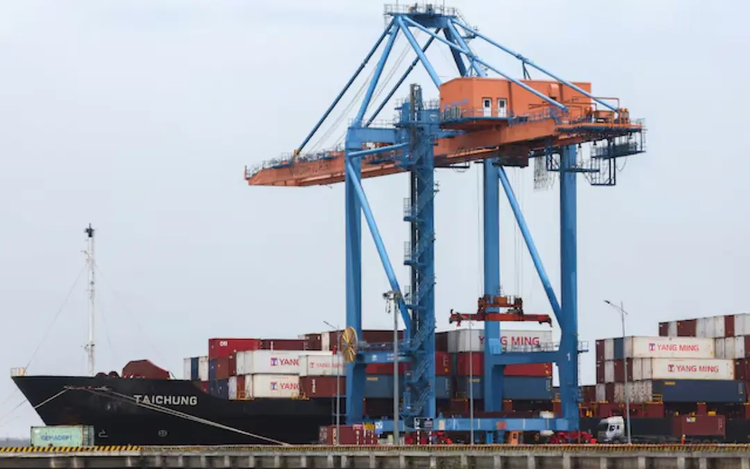
A container is loaded onto a cargo ship while docked at Hai Phong port, in Hai Phong, Vietnam, on April 16, 2025. Photo: Athit Perawongmetha/Reuters
This commentary by Associate Professor Ho Quoc Tuan from the University of Bristol (UK) offers an analytical perspective on Vietnam's large trade deficit in the first seven months of 2026.
In 2025, the country recorded its tenth consecutive annual trade surplus. Yet only seven months into 2026, the picture has changed sharply.
Vietnam exported about US$320 billion of goods but imported roughly $340 billion, leading to a trade deficit of around $20.5 billion.
Imports surged by nearly 35 percent year on year, far outpacing export growth of about 22 percent.
The abrupt reversal naturally raises an unsettling question: Has Vietnam's export-driven growth model begun to run into trouble, or is the deficit a consequence of the growth model that aims for double-digit growth?
It would be tempting to interpret this as evidence that Vietnam's export-driven growth model is running into trouble. That conclusion would be premature.
The important feature of the current deficit is not that Vietnamese consumers have suddenly developed an appetite for foreign goods.
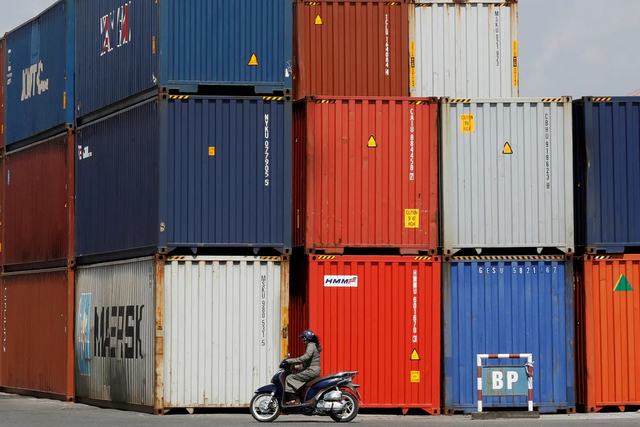
More than 94 percent of Vietnamese imports during the first seven months actually consist of capital goods and materials for production. Photo: Reuters
More than 94 percent of imports during the first seven months actually consist of capital goods and materials for production such as computers, electronic components, machinery, chemicals, metals, fuels and other industrial inputs.
Consumer goods accounted for less than 6 percent. Computers, electronic products and components alone reached almost $136 billion, rising remarkably by about $54 billion from a year earlier. Machinery and equipment added another $41 billion. Together, electronics and machinery explain more than 70 percent of the increase in Vietnam's import share.
That makes Vietnam's deficit less a story about excessive consumption than about an economy trying to grow quickly.
Up-front cost of faster economic growth
Trade statistics mask an important underlying movement. A company building a new factory may spend heavily on imported machinery today, purchase components next month and export finished goods only several months later.
Imports therefore appear immediately in the trade balance, whereas the exports they may eventually generate arrive with a lag.
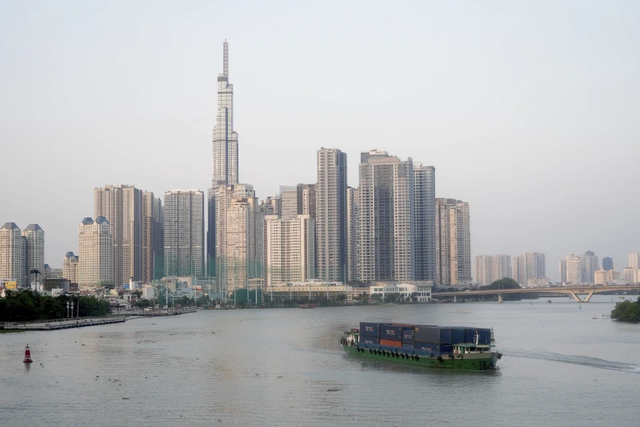
A cargo ship sails on Saigon river in Ho Chi Minh city, Vietnam on April 28, 2025. Photo: AP
This matters particularly in Vietnam in 2026. The government is pursuing an extraordinarily ambitious growth agenda, with economic growth targeted at around 10 percent.
Factories are expanding capacity, industrial parks are attracting new projects, and multinational companies are increasing their investments.
Foreign direct-investment inflows reached $15.2 billion in the first seven months, nearly 12 percent more than a year earlier. Industrial production was still expanding by 14.5 percent year on year in July. Rapid growth requires imports before it generates output.
Seen this way, at least part of the trade deficit may represent the up-front cost of faster economic growth based on industrial expansion.
The chip rush
Something else has happened this year: the global electronics cycle has become unusually import-intensive.
Investment in artificial intelligence and data centres has accelerated demand for advanced chips. According to the Vietnam Electronic Industries Association, stronger demand has tightened supplies for other industries and pushed some semiconductor prices up by 5-20 percent.
Vietnamese manufacturers responded by purchasing chips and electronic components earlier than usual, building inventories to protect themselves against shortages and further price increases.
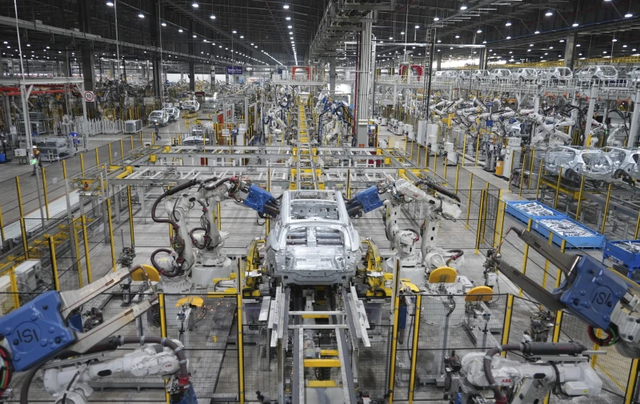
A car frame is being welded by robots at a Vinfast factory in Hai Phong, Vietnam on Sept. 29, 2023. Photo: AP / Hau Dinh
That means part of the jump in imports represents not merely greater quantities but higher prices and precautionary stockpiling.
This distinction is easily lost when attention focuses on the headline trade balance.
Suppose a manufacturer expects to require $10 billion of components between August and December. If it fears shortages and imports most of them in June and July instead, the trade deficit deteriorates immediately even though underlying annual production has changed little.
The same timing effect may work in reverse later in the year. Electronics manufacturers expect stronger shipments ahead of the American and European year-end shopping season.
If inventories accumulated during the first half are converted into smartphones, computers and other export products during the autumn, part of today's deficit could subsequently unwind.
That remains a forecast rather than a certainty. But it is why seven months of trade statistics should not be interpreted as though they represented a permanent structural shift.
The oil twist
Electronics are not the entire explanation. Energy has made the import bill heavier as well.
Higher global fuel prices related to conflict in the Middle East have raised the cost of Vietnam's energy imports.
During the first seven months, the volume of crude-oil imports actually fell by nearly 12 percent; however, their value increased by 18 percent. Imports of refined petroleum products grew only around 6 percent in volume but nearly 68 percent in value.
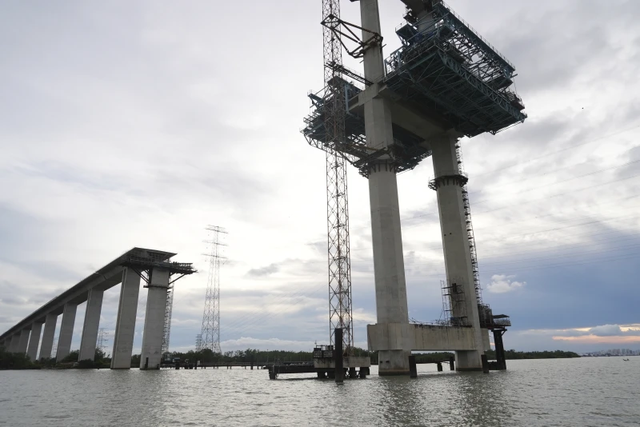
A bridge is seen under construction in Ho Chi Minh city, Vietnam, May 3, 2025. Photo: AP / Hau Dinh
That is an important reminder of how trade deficits can deteriorate without households or firms importing substantially more physical goods. When the price of an essential imported commodity rises, the country simply pays more dollars for roughly the same import volumes.
The government had already identified higher fuel costs as an important contributor when the trade deficit widened sharply during the first half of the year.
Other industrial inputs have moved in the same direction. Imports of coal, chemicals, metals, iron and steel products, automobile components and other manufacturing materials have risen strongly.
The breadth of these increases reinforces the interpretation that Vietnam is experiencing something closer to an investment-and-production import boom than a conventional consumption boom.
The China factor
Chinese imports inevitably feature prominently in many analysts' reports as the northern neighbour continued to be Vietnam's largest source of imports, supplying goods worth $138.6 billion.
Some of this reflects the familiar "China+1" phenomenon, which implies that multinational companies may shift assembly lines to Vietnam without shifting their entire supplier networks.
A factory can stay in Bac Ninh or Hai Phong while its machinery, chemicals and intermediate components continue to arrive from China.
But Vietnam's 2026 trade figures should not be reduced to this explanation only. Chinese imports were already deeply embedded in Vietnam's manufacturing system.
What has changed this year is the combination of faster production, new investment, electronics demand, inventory accumulation and higher commodity prices.
China's imports magnify these forces because it is Vietnam's largest supplier, but it does not by itself explain why imports suddenly accelerated so sharply in 2026.
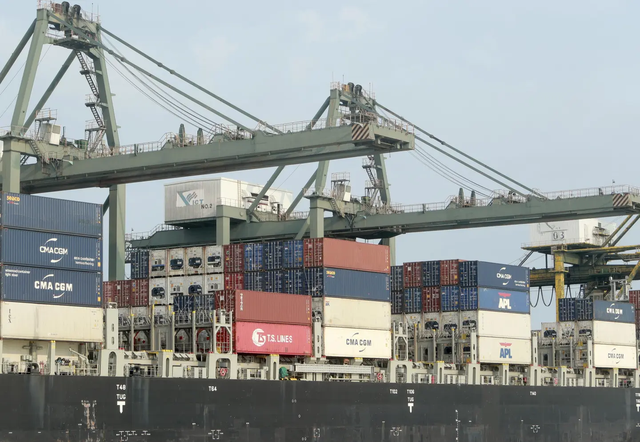
Containers are loaded on a ship at the Saigon port in Ho Chi Minh City. Photo: AP
Beneath the headline
None of this means Vietnam should ignore the trade deficit.
The more revealing numbers concern who is creating value inside Vietnam. Foreign-invested companies accounted for more than 80 percent of exports in the first seven months and still generated a trade surplus of nearly $8 billion. Domestic companies, by contrast, exported about $64 billion but ran a deficit of roughly $28.5 billion.
Vietnamese companies remain heavily dependent on imported machinery, materials and components. Many multinationals also bring established global suppliers with them.
Local firms often struggle to enter higher-value positions in those networks because becoming a serious industrial supplier requires far more than cheap labour or inexpensive factory space.
Firms must meet demanding standards on quality control, technical documentation, cost management and traceability, often before receiving any guarantee of an order.
Here lies the more consequential policy question.
Imports are not undesirable if they generate greater productive capacity. A country that imports a $100- million production line and subsequently produces $500 million of sophisticated goods has little reason to worry about the current trade deficits.
Likewise, importing components is perfectly sensible if domestic firms add substantial engineering, design, logistics and manufacturing value before the final product is exported.
The danger arises when imported value is large but domestic value added remains thin.
That distinction is also at the heart of the government's present scrutiny: the issue is whether imported machinery and components are genuinely being transformed into productive capacity and future exports.
Vietnam should therefore resist the easy solution of trying simply to suppress imports. Restrictions on components, machinery or raw materials could easily reduce exports as well. The better objective is to extract more Vietnamese value from every dollar imported.
That means helping domestic companies become industrial suppliers of key FDI exporters - by upgrading technical standards, encouraging foreign investors to build local vendor networks, and incentivizing domestic firms to manufacture higher-value components rather than remaining confined to low-margin final assembly.
It also means the country needs to watch the macroeconomic risks. A temporary deficit caused by investment is manageable. A persistent one can put pressure on foreign-exchange demand, the domestic currency and inflation, particularly when higher energy prices are already squeezing the global economy.
Vietnam's $20 billion trade deficit therefore deserves neither panic nor complacency. Part of it may prove to be the bill for faster growth: factories under construction, machines being installed, chips being accumulated and production being prepared for future export orders.
The important test will come later. If today's imports become tomorrow's higher-value exports and stronger domestic industrial capacity, the deficit will look less like a warning sign than an investment in growth.
But if imports keep climbing while local value added remains stubbornly low, the numbers will reveal a more uncomfortable truth. For Vietnam's next stage of development, the question is no longer simply how much the country can export.
It is how much value Vietnam can create between the moment an imported component enters its ports and the moment a finished product leaves them.








Max: 1500 characters
There are no comments yet. Be the first to comment.