
Vietnam’s ban on filming, sharing school violence videos raises legal, ethical questions
The Vietnamese Ministry of Education and Training’s recent directive calling for an absolute ban on filming, photographing, and distributing footage of school violence has raised questions about whether the education sector wants students to put their phones away, or to learn when recording is appropriate and when sharing should stop.
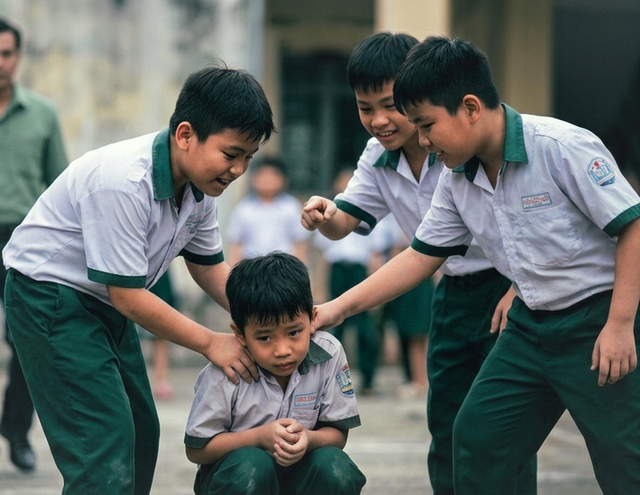
School violence is increasingly recorded and shared online, raising concerns about privacy and accountability. Photo: AI-generated
In the digital era, scenes of school violence are often recorded and shared online.
When students witness a classmate being assaulted, many instinctively reach for their phones. That reaction may seem indifferent, but it may also be the only way they know to preserve evidence of what happened.
If we look back to a time before every child carries a smartphone, one enduring question remains: Why does violence continue to occur in schools?
Rather than debating whether the directive is right or wrong, it is worth asking what it seeks to protect and whether it could unintentionally undermine something else.
The rationale behind such a requirement is understandable.
Once a video of violence spreads online, it becomes more than a news item. It prolongs the suffering of those involved.
Images of a child being beaten or humiliated can be shared thousands of times and remain online long after physical injuries have healed.
Article 21 of Vietnam’s 2016 Law on Children recognizes a child’s right to privacy, including the protection of honor and dignity. Uploading images of a child victim simply to attract views violates that right. Preventing such harm is a legitimate goal.
However, the directive grouping filming, photographing and sharing into one prohibition creates complications. These three actions differ in nature.
Sharing clips to ridicule victims is clearly harmful, but filming violent incidents often provides the only evidence that such acts occurred.
Recent cases in provinces such as Ninh Binh and Lao Cai were investigated only after videos surfaced online.
Without recordings, many incidents might have gone unnoticed.
Vietnamese law protects personal images but allows exceptions for public interest.
Article 32 of the 2015 Civil Code states that images may be used without consent if they serve the public good and do not harm dignity.
This distinction suggests that filming to expose wrongdoing differs from posting clips for entertainment.
The directive is not a law but an internal guideline.
As per Article 14 of the 2013 Constitution, human rights can only be restricted by legislation, not administrative orders.
The phrase ‘absolute ban’ should be interpreted as a reminder about responsible behavior rather than a binding prohibition.
Education authorities should not teach students never to record incidents.
Instead, they should teach them the difference between documenting evidence and spreading harmful content.
Students need to know when to preserve information and send it to responsible authorities and when to stop before pressing the share button.
The education sector’s concern over viral videos is understandable, but one question remains.
When footage of school violence circulates online, what truly disturbs people: the video itself, or the violence it reveals?
If the answer is the violence, then the focus should not be on the phone.
Videos do not create punches, they reveal them. The ultimate goal should be a school environment where there is nothing left to record.
* This article was originally written in Vietnamese by lawyer Hoang Ha.

Tuoi Tre News
Link nội dung: https://news.tuoitre.vn/vietnams-ban-on-filming-sharing-school-violence-videos-raises-legal-ethical-questions-103260607170331769.htm