
Vietnam’s rapid, sustainable growth to reinforce strategic autonomy: PM Le Minh Hung
Vietnam is seeking to build greater autonomy and self-reliance on the strength of its domestic economy while encouraging international partners to move beyond investment toward deeper development cooperation, Prime Minister Le Minh Hung said on Wednesday.
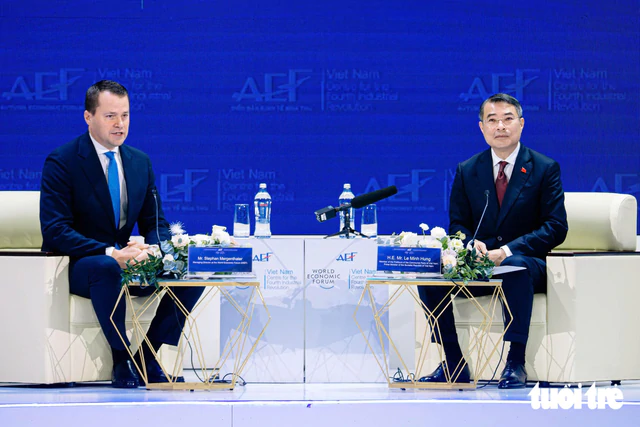
Prime Minister Le Minh Hung (R) holds a 60-minute dialogue with World Economic Forum (WEF) Managing Director Stephan Mergenthaler. Photo: Thanh Hiep / Tuoi Tre
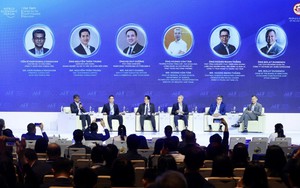
Prime Minister Hung joined World Economic Forum (WEF) Managing Director Stephan Mergenthaler for an onstage dialogue at the Autumn Economic Forum 2026 (AEF 2026) in Ho Chi Minh City on Wednesday morning.
The dialogue was a key highlight of the forum, with the two discussing Vietnam's strategic position and development prospects amid the restructuring of the global economy.
Building economic resilience amid global uncertainty
PM Hung said Vietnam must strengthen its economic resilience and adapt its growth model to navigate an increasingly uncertain global environment.
He noted that the global balance of power is shifting toward a more multipolar world, with intensifying competition among major powers extending into economics, data, energy, trade, investment, and governance.
Globalization is also becoming more fragmented, while rapid advances in science, technology, and artificial intelligence are transforming how economies operate.
These changes, PM Hung said, present three major challenges for Vietnam and other countries.
International institutions and rules are struggling to keep pace with global developments, while traditional growth models are reaching their limits, particularly in developing economies.
At the same time, growing competition is eroding strategic trust, making it harder for countries to cooperate and highlighting the need for new approaches to international partnerships.
"Development and cooperation are impossible without strengthening strategic trust," he stressed.
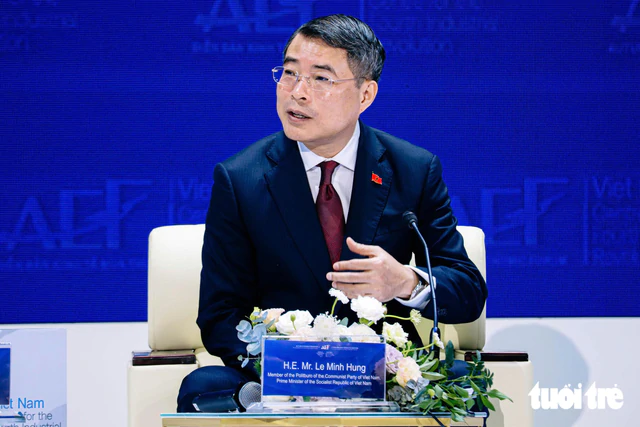
Prime Minister Le Minh Hung. Photo: Thanh Hiep / Tuoi Tre
WEF Managing Director Mergenthaler expressed admiration for Vietnam's efforts to build resilience and self-reliance amid external disruptions.
He asked PM Hung how the country is strengthening its economic, human resource, and institutional foundations to withstand shocks and build national resilience.
In response, PM Hung said resilience is not simply about weathering crises but also about adapting, recovering, innovating, and emerging stronger.
As a highly open economy, Vietnam is particularly exposed to global disruptions, making long-term economic resilience a key priority.
To achieve this, the government is focusing on five areas: maintaining political and macroeconomic stability, reforming institutions, developing infrastructure and technology, improving education and workforce training, and expanding international partnerships.
Macroeconomic stability remains a top priority, with Vietnam's public debt currently at around 34-35 percent of its GDP, providing fiscal room to support households and businesses during crises while maintaining investment in strategic infrastructure.
Institutional reform is another focus, with the government seeking to improve the business environment and reduce administrative burdens.
According to the Vietnam Chamber of Commerce and Industry, reforms in the first nine months of 2026 reduced administrative compliance time by 53 percent and costs by 55 percent.
Vietnam is also accelerating investment in transport, seaports, energy, and other essential infrastructure, alongside efforts to promote science, technology, innovation, and digital and green transformation.
The government is prioritizing support for small- and medium-sized enterprises and private businesses to improve their financial, management, and technological capabilities.
Stronger cooperation between domestic and foreign-invested companies, particularly through technology transfer and workforce training, is expected to help Vietnamese businesses become more competitive and participate more deeply in global value chains.
Meanwhile, reforms in higher education and vocational training aim to equip workers with skills needed in a changing labor market.
Vietnam will also continue diversifying its international partnerships to expand development opportunities and strengthen its ability to respond to external disruptions.
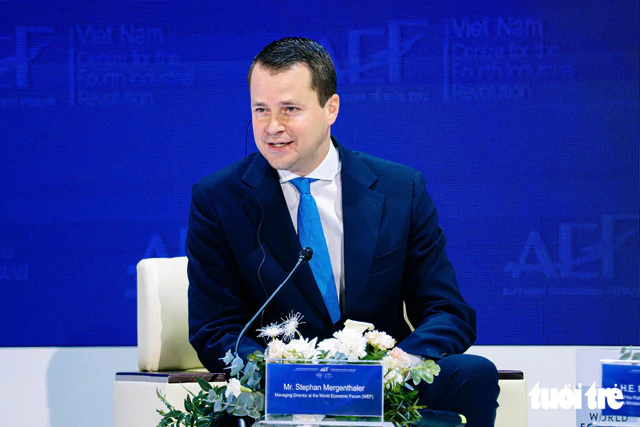
WEF Managing Director Stephan Mergenthaler. Photo: Thanh Hiep / Tuoi Tre
Self-reliance does not mean isolation
The prime minister stressed that Vietnam's pursuit of self-reliance does not mean isolation, but rather strengthening its ability to make independent decisions while expanding development opportunities through proactive, extensive, and effective international integration.
Vietnam will continue diversifying its markets, investment partners, energy sources, technologies, and supply chains to reduce exposure to external risks.
The country has signed 18 free trade agreements, helping expand market access and attract capital, technology, and knowledge.
PM Hung said the goal is not merely to participate more deeply in global value chains but also to develop domestic capabilities, master technologies, and generate greater economic value.
“When we have a rapidly growing, stable, and strong economy, our capacity for autonomy and self-reliance will undoubtedly be strengthened. With greater autonomy and self-reliance, Vietnam will be better positioned to proactively contribute to peace and stability in the region and around the world,” the government leader emphasized.
Stronger economic foundations would also allow Vietnam to contribute more actively to regional and global peace and stability, he added.
Shift in approach to international cooperation
Profound changes across all sectors call for a new approach to cooperation, one that moves beyond implementing joint initiatives toward building strategic partnerships, creating opportunities, sharing responsibilities, and shaping the future together.
Responding to a question from Mergenthaler, PM Hung said profound global changes require countries to rethink how they work together.
Vietnam hopes its partners will go beyond simply seeking opportunities in the country and work together to develop plans, turn ideas, solutions, and new growth drivers into concrete projects and products, and see them through to completion, he said.
For foreign governments and international partners, PM Hung called for closer cooperation to maintain peace and stability, develop new growth drivers, and align long-term strategic interests.
He also urged countries to establish open, fair, and sustainable cooperation frameworks in trade, investment, infrastructure, and science and technology, ensuring that economic progress translates into better living standards.
For businesses, particularly foreign investors, the prime minister stressed that cooperation should go beyond capital investment to include technology transfer, knowledge sharing, management expertise, workforce training, and innovation.
He encouraged multinational corporations to strengthen ties with Vietnamese businesses, helping them improve productivity, develop industrial ecosystems, and participate more deeply in global value chains.
The government leader also called on domestic and foreign companies to uphold social responsibility, protect the environment, and contribute to improving people's quality of life so that business success goes hand in hand with Vietnam's sustainable development.
Looking ahead, he outlined three priorities for Vietnam's position in the global economy: becoming a hub for digital technology, clean energy, and green agriculture; establishing itself as a reliable link in regional and global supply chains; and contributing more to global growth through modern governance, stronger competitiveness, and a highly skilled workforce.
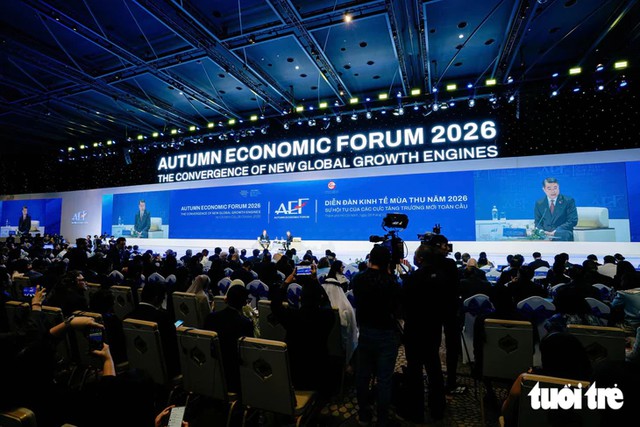
An overview of the dialogue between Prime Minister Le Minh Hung and World Economic Forum (WEF) Managing Director Stephan Mergenthaler. Photo: Thanh Hiep / Tuoi Tre
From 'investing in' to 'investing with' Vietnam
In his closing message to the international community, PM Hung called for a fundamental shift in how foreign partners engage with Vietnam.
Instead of viewing the country simply as a destination for investment and market expansion, international businesses should regard it as a long-term development partner, he said.
The prime minister encouraged stronger cooperation between multinational corporations and Vietnamese businesses, universities, and research institutions to jointly develop technology, train workers, and strengthen supply networks.
Foreign investors should contribute not only capital but also expertise, innovation, and management capabilities, helping domestic companies participate more deeply in global value chains.
PM Hung urged businesses to integrate environmental protection and social responsibility into their operations so that commercial success goes hand in hand with Vietnam's sustainable development.
He reaffirmed the government's commitment to maintaining macroeconomic stability, improving the investment environment, developing infrastructure, and protecting the legitimate rights and interests of investors.
The government would continue listening to businesses and working to promptly resolve their difficulties, he said.
"Vietnam sincerely hopes that your success, and that of the broader investor community, will go hand in hand with our country's development," PM Hung concluded.
AEF 2026 is taking place in Ho Chi Minh City from October 26 to 29 under the theme 'Collaboration in a New Era.'
For the first time in AEF's history, the forum's two main days, Tuesday and Wednesday, are co-branded with WEF.
The event brings together leaders of ministries, government agencies, and local authorities, alongside representatives of foreign governments, international organizations, diplomatic missions, research institutes, universities, innovation centers, and businesses.
Organizers have recorded 1,800 participants, including 24 international VIP delegations representing governments, ministries, local authorities, and organizations.
Tuoi Tre News
Link nội dung: https://news.tuoitre.vn/vietnams-rapid-sustainable-growth-to-reinforce-strategic-autonomy-pm-le-minh-hung-10326102814142297.htm