
WEF expert urges Vietnam to encourage global tech giants to co-develop products
Vietnam should encourage global technology companies to work with local partners to develop products tailored to the domestic market, rather than simply selling technology to Vietnamese businesses, Dr. Sandy Chong, Director of Regional Initiatives, Asia Pacific, at the World Economic Forum (WEF), has advised.

Experts speak at the discussion panel titled "Tech diplomacy for megacities: How cities transform technology partnerships into growth engines" during AEF 2026 in Ho Chi Minh City on October 27, 2026. Photo: Binh An / Tuoi Tre
On Tuesday, as part of the 2026 Autumn Economic Forum - The Convergence of New Global Growth Poles, experts at the discussion panel titled "Tech diplomacy for megacities: How cities transform technology partnerships into growth engines."
Tech diplomacy involves leveraging diplomatic activities to foster international dialogue and cooperation in technology, connecting governments, businesses, and researchers to attract resources, drive innovation, and support development goals.
On the sidelines of the event, Tuoi Tre News spoke with Dr. Sandy Chong, Director of Regional Initiatives, Asia-Pacific, at the World Economic Forum (WEF), about how technology diplomacy can help Vietnamese businesses build long-term capabilities.
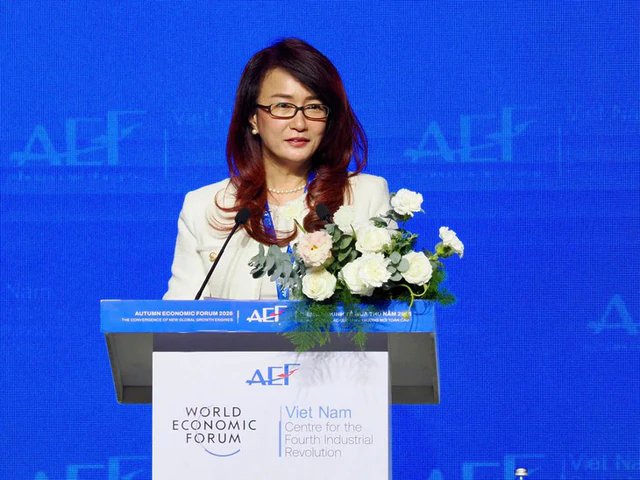
Dr. Sandy Chong, Director of Regional Initiatives, Asia Pacific, at the World Economic Forum (WEF). Photo: AEF
* How can Ho Chi Minh City ensure that partnerships with global technology companies help Vietnamese businesses build their own technological capabilities, rather than simply becoming customers of imported technologies? What practical policies would you recommend?
Dr. Sandy Chong: When major technology companies come to Vietnam, they need to engage with the entire ecosystem, including the government, universities, small and medium-sized enterprises (SMEs), chambers of commerce, and industry sectors. They should not work only with the government while ignoring the private sector, or partner with businesses without helping educate the next generation.
The government needs policies to ensure this happens. If companies want to access data in Vietnam, they should give something back to the country. They could help build SME capacity, organize hackathons at universities, or develop solutions that benefit older people, people with disabilities, rural residents, and farming communities.
These commitments should be part of a systematic policy framework, rather than simply public relations or corporate social responsibility initiatives. Companies need to understand local people's actual needs instead of focusing solely on their own commercial interests.
* For a rapidly growing megacity like Ho Chi Minh City, challenges such as traffic congestion, flooding, and rising energy demand are becoming increasingly pressing. Which international technology partnerships should the city prioritize to address these problems, and how can it scale successful solutions across the city?
- The city should work with international organizations such as the World Bank and the United Nations. The UN Sustainable Development Goals, comprising 17 goals for 2030, are important. Through its extensive international network, the UN works with partners including Microsoft and Google on solutions such as urban mapping, traffic management, and air quality monitoring.
Ho Chi Minh City's size makes it challenging to manage, but it also creates opportunities to scale up successful solutions. Achieving this requires trust, speed, and scale, along with cooperation among the city government, technology companies, and universities. Appropriate policies, regulations, and legal frameworks can help accelerate implementation.
The city does not have to solve every problem alone. ASEAN's Digital Economy Framework Agreement could help harmonize standards and facilitate cross-border trade. Vietnam's population of around 100 million also offers a substantial market for developing and scaling technology solutions, although the challenge is deciding which problems to address first.

* How can the city ensure technology solutions meet residents' diverse needs and deliver long-term benefits?
- Policymakers and technology developers need to listen to people at the grassroots level. Those who work directly with older people, children, people with disabilities, and low-income groups often understand their challenges best. Their perspectives should be included in discussions and decision-making.
Diversity should not be a box-ticking exercise. People from different backgrounds can bring new ideas and perspectives, helping identify solutions that might otherwise be overlooked. Ensuring no one is left behind is not only socially important; it can also improve the quality and effectiveness of solutions.
* From Vietnam’s perspective, how can technology diplomacy help Vietnamese businesses build long-term partnerships with international technology providers, gain access to advanced technologies, and develop the capabilities needed to move up global value chains, rather than simply adopting technologies developed elsewhere?
- Co-creation is key to maintaining competitiveness. If large companies simply sell technology and Vietnamese businesses buy it, innovation will be limited. Companies should instead be encouraged to develop products with local partners that reflect Vietnam's cultural and linguistic characteristics.
Co-creation can generate new ideas and give Vietnamese businesses greater opportunities to participate in related intellectual property ownership. Protectionism may offer short-term benefits, but long-term competitiveness cannot be built by excluding partners.
Importantly, co-creation does not necessarily mean developing technology together. Partners can work together to solve specific problems. Combining innovation, technology, and social solutions could produce even better results.
Binh An / Tuoi Tre News
Link nội dung: https://news.tuoitre.vn/wef-expert-urges-vietnam-to-encourage-global-tech-giants-to-co-develop-products-103261027205146618.htm