
What are investors looking for in Ho Chi Minh City’s 100-year master plan?
Businesses and investment funds are looking to Ho Chi Minh City’s 100-year master plan for new opportunities in infrastructure, high-tech industries and long-term investment, while expecting clearer policies and effective implementation to turn the ambitious vision into reality.
As Ho Chi Minh City unveiled its master plan for the 2025-50 period with a 100-year vision, representatives of several investors that have recently joined the Vietnam International Financial Center in Ho Chi Minh City (VIFC-HCMC) spoke to Tuoi Tre (Youth) online newspaper about their business strategies, fundraising plans and policy proposals to help turn the city's vision into reality. Investment opportunities in polycentric megacity
Among the seven new members of VIFC-HCMC, Charming Land Vietnam Co. Ltd. is exploring investment in integrated urban-industrial projects in Ho Chi Minh City.
Ben Ding, general director of Charming Land Vietnam, said the polycentric megacity model would create investment opportunities in areas beyond the urban core while accelerating a shift from traditional real estate development toward integrated urban-industrial complexes, where people can live, work and study close to home.
According to Ding, the group's initial projects in Vietnam are expected to require around US$2.1 billion in investment in the first phase, with a goal of attracting more than $20 billion in subsequent phases.
Its investment proposals will be considered by competent authorities in accordance with regulations.
"We follow the principle of industry first, jobs first and housing later, developing in line with the actual pace of urbanization to avoid oversupply," Ding said.
From the perspective of an investment fund manager, Chad Ovel, CEO of Mekong Capital, said the company wanted to align its fundraising activities with the government's strategic priorities.
Ovel identified healthcare, education, logistics and high-quality, innovation-driven industrial manufacturing as sectors with potential to benefit from Ho Chi Minh City's new master plan.
Meanwhile, Le Ba Nam Anh, CEO of 3V Partners, said 3V Advisors International, a legal entity owned by 3V Partners that has recently joined VIFC-HCMC, manages the Vietnam Go Global Fund I, which has a target size of $300 million.
The fund targets medium-sized Vietnamese businesses in sectors where the country has strengths and growth opportunities, including agriculture, processing and manufacturing, tourism, consumer goods, healthcare, education and the digital economy.
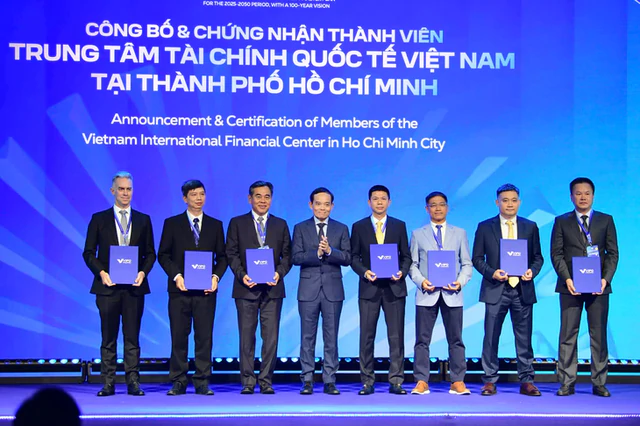
Secretary of the Ho Chi Minh City Party Committee Tran Luu Quang (fourth from left) presents certificates to seven new members of the Vietnam International Financial Center in Ho Chi Minh City. Photo: Quang Dinh / Tuoi Tre
Expectations for unlocking long-term investment
Ovel said Vietnam's ability to formulate long-term plans and effectively implement development strategies was among the factors making the country attractive to foreign investors.
"Over the past two years, we have witnessed a strong capacity for execution, with tangible results delivered against set plans. This has given foreign investors the confidence to continue coming to this market," he said.
Ovel also called for more favorable conditions for initial public offerings (IPOs), particularly for fast-growing, dynamic businesses with innovative technologies.
From the perspective of Vietnamese businesses, Nam Anh said the master plan had established a clear development direction for Ho Chi Minh City. The next crucial step was to ensure effective implementation and create conditions for businesses to participate.
He called for mechanisms allowing investment funds to join VIFC-HCMC, thereby providing businesses with additional sources of long-term capital.
Ho Chi Minh City’s 5 growth poles
Under Decision No. 7308 dated October 31, issued by the Ho Chi Minh City People's Committee approving the city's master plan for the 2025-50 period with a 100-year vision, the planning area covers the entire administrative territory of the city, spanning approximately 6,772.59 square kilometers and comprising 168 commune-level administrative units.
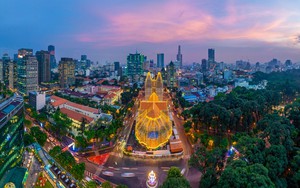
The plan aims to shift the city's growth model away from heavy reliance on capital, land and labor toward productivity, science, technology, innovation and high-value services.
For the 2026-30 period, the city will focus on four pillars: breakthrough technologies, innovation, strategic infrastructure and urban services.
It has identified five major growth poles:
- The central international finance and services hub: Covering the historic urban core, including Saigon, Cho Lon, Thu Thiem and the central areas along both banks of the Saigon River.
- The eastern innovation hub: Encompassing Thu Duc, Thuan An, Di An and Tan Uyen, with connections to Long Thanh International Airport and a focus on high-tech industries, artificial intelligence, semiconductors, and research and development.
- The northern industrial and logistics hub: Centered on Thu Dau Mot, Ben Cat, Bau Bang and surrounding areas.
- The southern seaport, free trade and energy industry hub: Stretching from Chau Duc and Phu My to Long Son, Ba Ria and the Can Gio seaport area.
- The western urban, education and healthcare hub: Focused on developing urban areas linked to education, training and specialized healthcare.
Thanh Ha - Nghi Vu / Tuoi Tre News
Link nội dung: https://news.tuoitre.vn/what-are-investors-looking-for-in-ho-chi-minh-citys-100-year-master-plan-103261126102412697.htm