
What awaits Vietnam’s shrimp exports in 2027 as global competition intensifies?
Vietnam’s shrimp export revenue could decline in 2027 amid abundant global supplies, fierce price competition, and mounting tariff barriers, but higher-value products and shifting consumer demand could offer new avenues for growth.
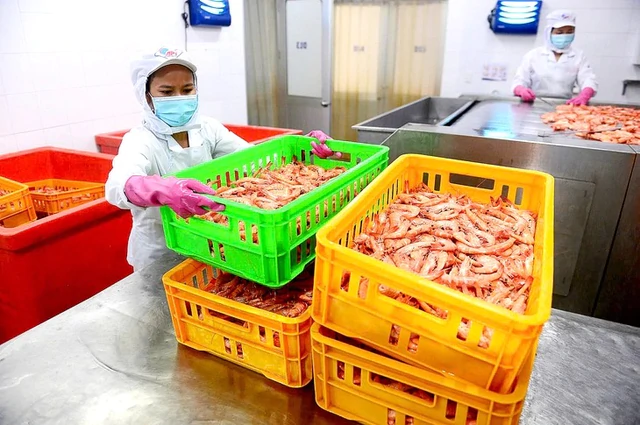
Workers process shrimp for export in Vietnam. Photo: Quang Dinh / Tuoi Tre
Le Hang, deputy secretary-general of the Vietnam Association of Seafood Exporters and Producers (VASEP), said Vietnam's shrimp exports reached US$4.2 billion in the first 10 months of 2026, up nearly nine percent year on year.
However, Vietnam’s shrimp exports showed mixed performance across markets.
While China, Japan, Australia, and Canada increased their imports of Vietnamese shrimp, shipments to the U.S. and EU showed a downward trend.
Intensifying competition, shifting consumer demand
Based on recent market developments, Hang identified five major trends expected to shape the global shrimp market in 2027 that Vietnam’s shrimp industry should closely monitor.
First, global shrimp supplies are expected to remain abundant, intensifying price competition.
Ecuador and India will continue to dominate global supplies, putting pressure on exporters with higher production costs.
Supply growth could outpace consumption in some markets, limiting a recovery in prices of raw and conventional frozen shrimp and making it increasingly difficult for Vietnamese whiteleg shrimp to compete on price.
Second, consumer demand will vary considerably across markets and product segments.
While the U.S. remains a major market sensitive to prices and inventory levels, China has diverse demand ranging from conventional frozen shrimp to live shrimp, lobster, and premium products.
Japan favors processed and convenience products, demand in the EU varies among member states, and South Korea's demand remains relatively stable.
Third, global shrimp trade flows will continue to shift in response to tariff policies and import barriers.
U.S. tariff policies, anti-dumping and countervailing duty cases, and differences in preferential tariff treatment among exporting countries will make post-tariff price competitiveness increasingly important.
Fourth, value-added, convenience, and premium products will become increasingly important.
The U.S. favors peeled shrimp, frozen shrimp, and convenience products, while Japan prioritizes cooked shrimp, sushi shrimp, straightened shrimp, and products processed to specific requirements.
The EU favors cooked, peeled, and certified shrimp products, while China offers opportunities for conventional whiteleg shrimp, large-sized black tiger shrimp, live lobster, and premium products.
South Korea has demand for whole shrimp, peeled shrimp, and convenient processed products.
Fifth, production costs, traceability, and sustainability will become key competitive factors.
Hang stressed that efficiency across the entire supply chain, from farming and procurement to processing and exports, would be critical to the competitiveness of Vietnam’s shrimp industry.
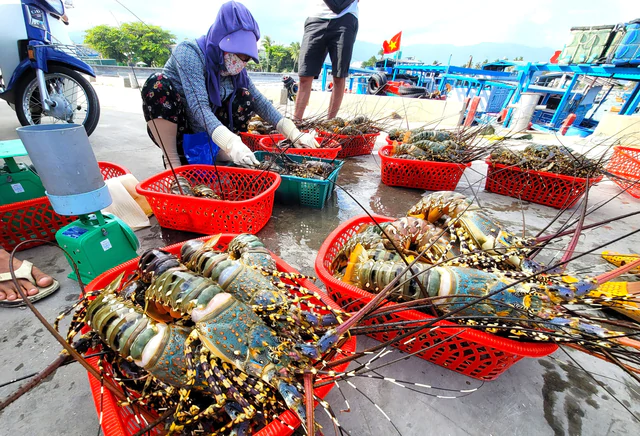
Freshly harvested lobsters are prepared for sale in Khanh Hoa Province, Vietnam. Photo: Nguyen Hoang / Tuoi Tre
Opportunities in value-added products
VASEP forecasts Vietnam's shrimp exports could fall by 2.2 percent to around $4.4 billion in 2027, citing difficulties in the U.S. market and a sluggish recovery in the EU, where inventories remain high.
Vietnamese shrimp faces multiple tariff barriers in the U.S., including anti-dumping duties ranging from more than six percent to nearly 26 percent, countervailing duties, and an additional 12.5-percent tariff under Section 301 of the Trade Act of 1974.
Vietnam's shrimp production costs are also 20-30 percent higher than those in Ecuador and India, particularly in the frozen whiteleg shrimp segment.
Despite these challenges, Hang said Vietnam still has considerable room for growth in value-added products.
In the U.S., opportunities lie in cooked and breaded shrimp, sushi shrimp, convenience products, and private-label products.
In China, growth potential remains for green spiny lobster, frozen whiteleg shrimp, and black tiger shrimp, particularly in higher-quality segments.
Vietnamese exporters should also capitalize on their strengths in higher-value processed products in Japan and leverage free trade agreements to expand shipments to Australia, the UK, and Canada.
Vietnam targets up to $4.7 billion in shrimp exports
Despite VASEP's cautious outlook, Vietnam's fisheries sector has set a target of producing around 1.5 million metric tons of shrimp and generating $4.6-4.7 billion in export revenue in 2027.
The Department of Fisheries and Fisheries Surveillance under the Ministry of Agriculture and Environment said the industry has further growth potential thanks to its production, processing, and export capabilities.
However, it faces intensifying international competition, increasingly stringent quality, traceability, and sustainability requirements, and potential disruptions to shrimp farming caused by El Niño during the 2026-27 dry season.
To achieve its targets, the sector will strengthen controls over shrimp seed quality and origin, improve disease prevention, develop disease-free seed stock, and expand broodstock production capacity.
Other priorities include improving access to market information, standardizing quality, food safety, and traceability requirements, assessing production costs and profitability across farming methods, and strengthening links between farmers, processors, and exporters.
Ngoc Nguyen - Chi Cong / Tuoi Tre News
Link nội dung: https://news.tuoitre.vn/what-awaits-vietnams-shrimp-exports-in-2027-as-global-competition-intensifies-103261125113342327.htm