
Why do people keep littering in this canal in Ho Chi Minh City?
Editor’s note: The following opinion piece is authored by Thuy Chi, a reader of Tuoi Tre (Youth) online newspaper. The piece was originally published in Vietnamese and has been translated into English and edited by Tuoi Tre News for clarity, consistency, and coherence.
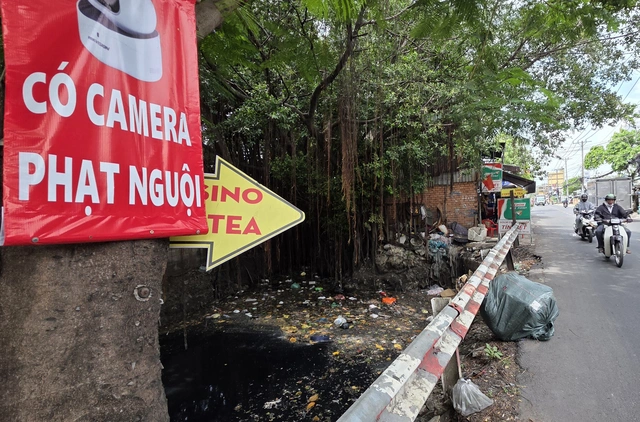
Garbage is dumped into a canal along To Hieu Street in Ho Chi Minh City, including a large trash bag left beneath a sign warning that the area is under camera surveillance. Photo: Thuy Chi
For more than a decade, I have walked along the heavily polluted black-water canal beside To Hieu Street in Phu Thanh Ward, Ho Chi Minh City at least twice a day.
Over the years, I have watched the area change in ways that have brought both joy and sadness, as people continue to dump trash into the canal.
The longer section of the canal has been transformed into a clean, modern road.
Yet people seem to be making up for it by dumping even more waste into the remaining stretch that has not been upgraded.
Authorities have worked hard to improve the environment, but many residents continue to carelessly throw garbage into the canal.
How did it come to this?
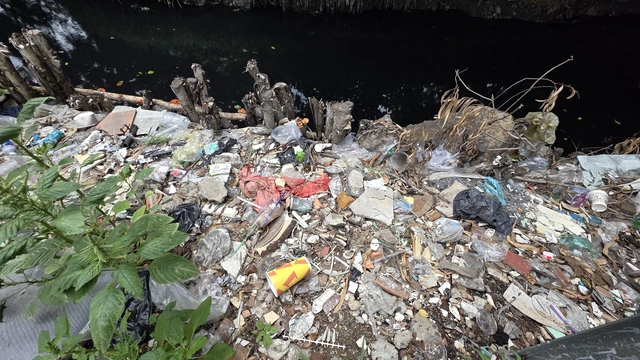
Garbage again lines the bank of a canal along To Hieu Street in Ho Chi Minh City shortly after sanitation workers cleared the area. Photo: Thuy Chi
The sadness of trash dumped into a black-water canal
My eight-year-old niece has asked me more than once, "Why do people keep littering? Why won't they stop?"
I can only sigh because I do not know how to answer her.
More than 10 years ago, this roughly two-kilometer open canal, stretching from a section of Phan Anh Street to the end of To Hieu Street in what was then Tan Phu District, was one of the city's worst pollution hotspots.
Whether in the dry season or the rainy season, it was always filled with a foul stench, pitch-black water, and so much garbage that the canal appeared almost solid enough to walk across.
I cannot count the number of times I have watched people casually throw anything they no longer wanted into the canal.
Household garbage bags, industrial waste, broken glass, dead rats, dead dogs, damaged tables and chairs, and even broken bathroom sinks all ended up in the water.
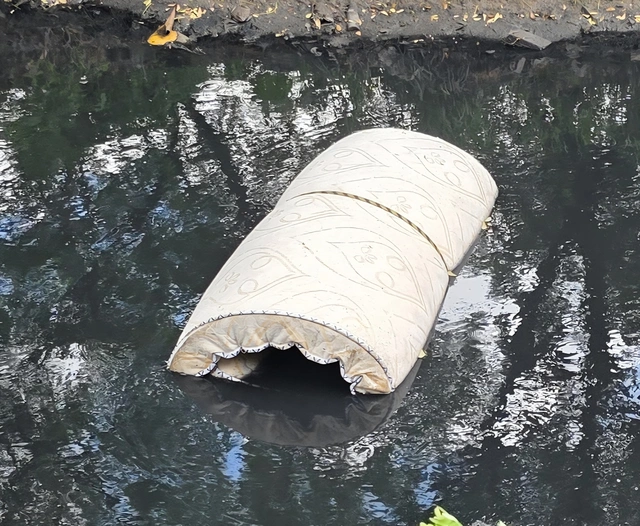
A large rolled-up mattress floats in a polluted canal along To Hieu Street in Ho Chi Minh City. Photo: Thuy Chi
Some manufacturing facilities also secretly discharged untreated wastewater directly into the canal, making the already black water even darker and the already unbearable smell even worse.
People dumped waste into the canal day and night, often in plain sight.
They paid little attention to no-dumping signs, banners urging people to protect the environment, or even surveillance cameras.
Once, while riding my motorbike to school, I was struck by a bag of garbage that someone threw into the canal from the front of a nearby house.
The household trash bag had not been tied properly, and leftover food, dirty soup, and rotting vegetable scraps spilled onto my motorbike and all over my clothes.
I still remember that day vividly.
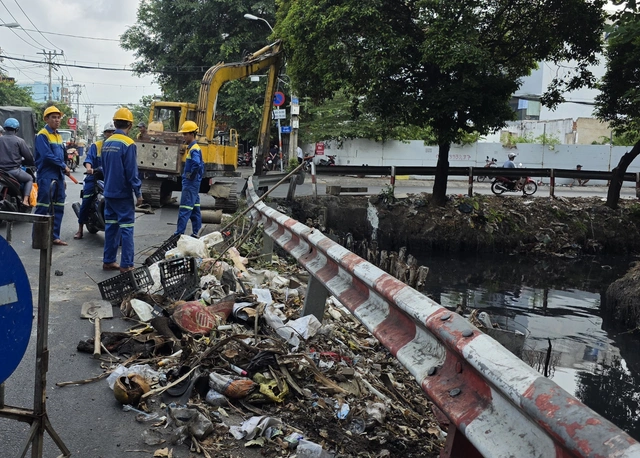
Sanitation workers use a crane to remove garbage from a polluted canal along To Hieu Street in Ho Chi Minh City, but the waste returns within days. Photo: Thuy Chi
I could not hold back my tears, not because I had been covered in filth, but because I was overwhelmed by the carelessness of the person who threw the garbage.
My niece has been taught carefully at school about protecting the environment.
Whenever she is outside, she puts trash only into designated bins.
If there is no bin nearby, she wraps the trash carefully until she finds one.
If she still cannot find one, she brings it home and throws it away there.
Whenever she sees people dumping trash into the canal, she asks, "Why can grown-ups do that? I'm just a child, but I know how to throw my trash away properly."
Joy arrived, but the sadness continued
In 2016, authorities upgraded about 1.5 kilometers of this canal by installing twin box culverts.
After years of construction, the project was finally completed.
The polluted canal that people once avoided became a wide, clean road.
Life for residents on both sides changed dramatically.
If anything, they had a chance to move forward, as businesses, shops, and restaurants flourished once the pollution was gone.
Yet the joy did not last long, and the sadness has continued ever since.
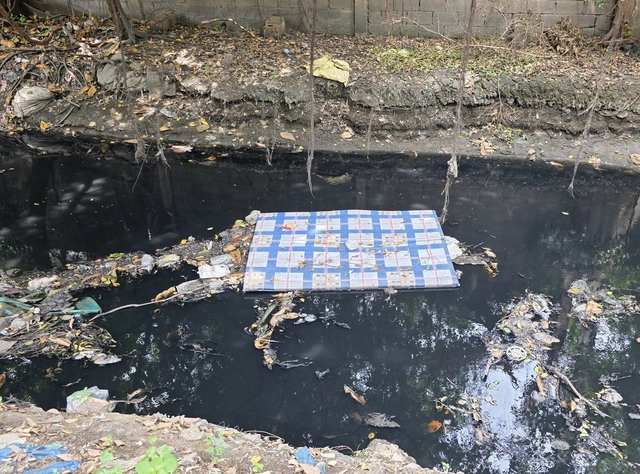
A discarded mattress lies in a polluted canal along To Hieu Street in Ho Chi Minh City, where it could obstruct the flow of water. Photo: Thuy Chi
The remaining half-kilometer stretch of the canal leading toward Phan Anh Street was left untouched.
It soon became another pollution hotspot, despite the constant efforts of sanitation workers to clean it.
Every day as I pass the canal, I continue to see the same contrast.
Some people work tirelessly to remove the garbage, while others continue to throw it into the water without concern.
On some mornings, it is painful to watch sanitation workers wade into the black, trash-filled water in an effort to clean the canal.
The filth and stench are so overwhelming that many passers-by try to get away as quickly as possible, yet these workers spend hours standing waist-deep in the polluted water.
That garbage did not appear there on its own. It came only from human hands.
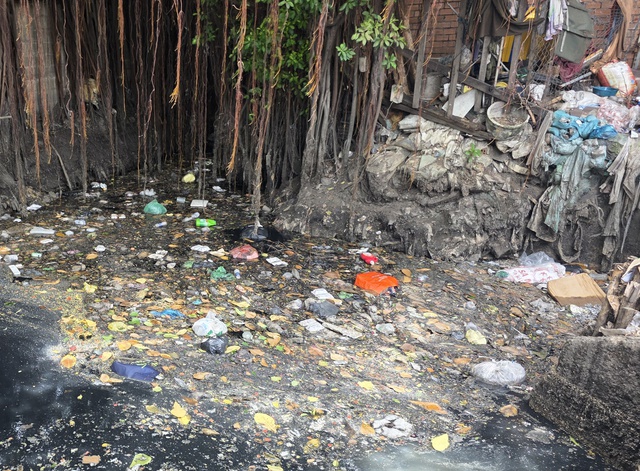
Garbage of various kinds clogs the flow of water in a polluted canal along To Hieu Street in Ho Chi Minh City. Photo: Thuy Chi
Hai, who has lived beside the canal for decades in an alley off To Hieu Street, told me that residents were delighted when authorities transformed the longer stretch of the canal into a road.
They believed it offered them a chance to improve their lives.
Homes that once faced a polluted black-water canal suddenly became properties along a modern street.
Even so, people continued dumping garbage into the remaining section of the canal.
When will this canal become clean again?
That question belongs to all of us, and to every person who continues to poison its waters each day.
Tuoi Tre News
Link nội dung: https://news.tuoitre.vn/why-do-people-keep-littering-in-this-canal-in-ho-chi-minh-city-103260711144148522.htm