
Wood industry enters new race in Vietnam: Competing through knowledge, operational capabilities
After years of focusing on scaling up, Vietnam’s wood industry is entering a new phase of competition, where operational knowledge and adaptability are increasingly becoming critical factors enabling businesses to operate more efficiently and better respond to evolving market requirements.
Vietnam's wood industry faces imperative of higher-value growth
Over the past two decades, Vietnam's wood industry has established a strong presence on the global trade map.
Vietnam is now among the world's top five exporters of wood and wood products, while ranking second globally, after China, in exports of furniture and processed wood products.
Its production organization capabilities, capacity to fulfill large-scale orders, and growing community of wood-processing enterprises have made Vietnam an important link in the global furniture supply chain.
However, as scale is no longer the greatest constraint, the key question facing the wood industry is no longer simply how to export more.
More importantly, it is how Vietnamese enterprises can generate greater value from the value chains in which they participate.
This is also the development direction set by the Vietnam Timber and Forest Product Association (VIFOREST) for the industry's new phase of growth.
At its 2025-2030 term congress, the association identified priorities that go beyond export growth, focusing instead on strengthening brand value, developing higher-value products, and promoting deeper processing to enhance the competitiveness of Vietnamese enterprises in international markets.
This signals that the demands placed on businesses today extend beyond product quality and production scale to include supply chain management, data governance, and compliance with international standards.
As markets increasingly compete not only on cost but also on value, the question is no longer simply what a business produces, but how it manages its value chain.
Need for knowledge exchange, international experience
This is also why, in recent years, alongside investments in technology and production lines, many businesses in the wood industry have begun paying greater attention to modern management practices.
These are not merely technical tools, but rather foundational capabilities that enable businesses to integrate data, align functions across departments, and make informed, data-driven decisions rather than relying solely on experience.
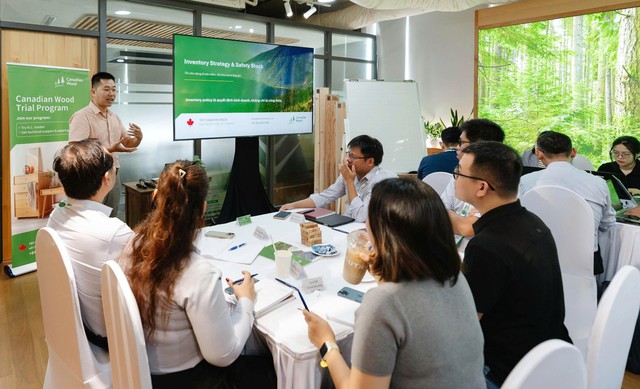
Canadian Wood helps bring international knowledge and expertise closer to Vietnamese wood manufacturers through workshops and training.
As market requirements extend beyond materials and technology, the role of organizations within the wood industry ecosystem is also evolving.
In addition to trade promotion, connecting businesses with knowledge, experts, and international experience has become another way to support enterprises in adapting to market changes.
As furniture manufacturers look to diversify materials, develop new products, and meet increasingly demanding export market requirements, the successful adoption of a new wood species often depends on more than material availability alone.
Strong planning systems, product development capabilities, and access to technical knowledge are all important factors that help manufacturers evaluate and integrate new materials into their operations.
Canadian Wood Vietnam is one of the organizations pursuing this approach. Alongside promoting the use of wood from British Columbia's sustainable managed forests, Canadian Wood has organized workshops for businesses in the wood industry, focusing on practical challenges such as inventory and supply planning.
Building on its existing programs for the business community, Canadian Wood continues to develop more specialized programs based on the needs and challenges of individual businesses.
Sharing this vision, Vince Tran, country director, said that Canadian Wood Vietnam goes beyond simply introducing Canadian wood species such as Hemlock, Douglas Fir, and Spruce-Pine-Fir (SPF).
Instead, it aims to work alongside businesses in product development, strengthening operational capabilities, and connecting them with international supply chains.
According to him, achieving sustainable and long-term growth requires businesses to gradually build their teams, strengthen their capabilities, and continuously test and refine their processes toward greater efficiency, optimization, and alignment with their development goals.
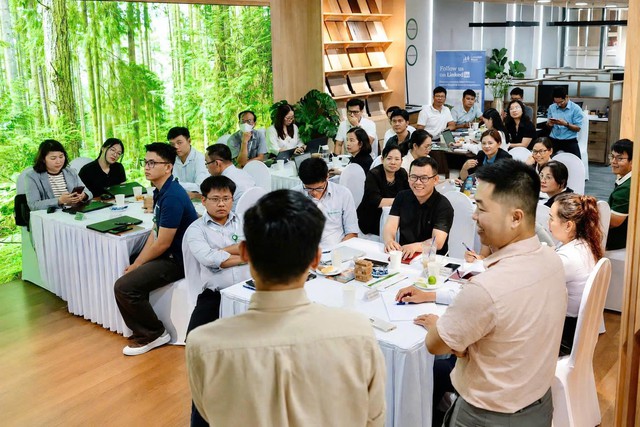
The inventory and supply planning workshop was jointly organized by Canadian Wood Vietnam and HAWA for HAWA members.
"Canadian Wood's seminar provided practical and valuable insights into planning, from contingency planning and forecasting to order placement and inventory management," said Thuong Nguyen from the purchasing department at Truong Thanh Furniture Corporation.
"It also helped clarify how multidimensional data can be used as a basis for cross-functional discussion and coordination, enabling teams to develop more appropriate proposals."
Through the continued engagement with the industry, Canadian Wood can work with businesses across a range of practical needs from testing Canadian wood and connecting with suppliers in British Columbia to showcasing products at international trade fairs to create new opportunities to reach customers and markets.
One practical example is Canadian Wood Trial Program, through which manufacturers can evaluate selected B.C. softwood species within their own production environments.
The program allows companies to assess material performance, manufacturing suitability, and product applications before considering larger commercial purchases.
For businesses looking to go further, the program can be expanded to include ODM product development and connections to relevant business opportunities.
Beyond training and knowledge-sharing programs for the wider business community, some initiatives can also be tailored to specific business needs, allowing shared knowledge and expertise to be applied more directly to each company's practical challenges.
In addition, with people at the heart of its long-term development strategy, Canadian Wood is developing the 'Developing Talent to Elevate Vietnam's Furniture Industry' program.
The initiative connects young professionals with experienced industry experts in Vietnam and internationally, contributing to the development of capabilities and organizational systems for businesses over the long term.
In a constantly changing market environment, sustainable development depends not only on materials and technology, but also on the ability to learn, adapt, and improve operational efficiency.
From knowledge sharing and material support to product development and market connections, Canadian Wood's programs are expanding in response to businesses' practical needs, contributing to the long-term development of Vietnam's wood industry.

Yen Viet / Tuoi Tre News