


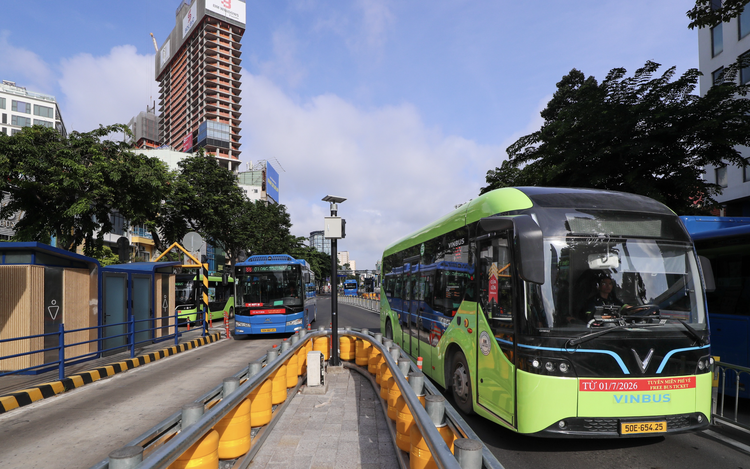
Buses travel on a street in Ho Chi Minh City. Photo: Hoang Trieu / Tuoi Tre
The ministry said the decision was made after reviewing recommendations from the Civil Aviation Authority of Vietnam and consulting relevant agencies and stakeholders.
The proposed bus network is intended to meet growing travel demand while strengthening transport connectivity between the two airports, as well as neighboring localities linked through Ho Chi Minh City.
To ensure the services are readily operational as soon as Long Thanh International Airport opens, the ministry has requested the Ho Chi Minh City administration to direct the municipal Department of Construction to finalize key operational details, including routes, service frequency, and operating models.
The department has also been instructed to determine suitable locations for bus terminals at Tan Son Nhat International Airport and Long Thanh International Airport to provide convenient transfer points for passengers and better accommodate public travel needs.
The department should also coordinate with airport operators to designate dedicated pick-up and drop-off areas, as well as install clear signage throughout the terminals to improve passenger access while ensuring security, safety, and efficient traffic flow.
13 new bus routes planned
Ho Chi Minh City authorities have previously announced their plans to introduce 13 new bus routes providing direct connections to Long Thanh International Airport.
The routes will operate under a premium airport bus model designed to offer faster and more comfortable travel than conventional urban bus services.
The network will connect major transportation hubs, including airports, interprovincial coach stations, urban centers, expressways, and national highways.
Most routes will pass through key arterial roads, densely populated areas, and popular tourist destinations to maximize operational efficiency.
Unlike traditional bus services, several of the new airport routes will stop only at major transit points rather than allowing frequent roadside boarding, reducing travel times between destinations.
Vehicles will range in capacity from 9 to 80 seats, while buses operating on expressways will provide seating only, with no standing passengers permitted.
In parallel, four existing bus routes along National Highway 51, numbered 60-3, 72-1, 72-2B and 172, will have their itineraries adjusted to improve connectivity to the airport.
Long Thanh International Airport in southern Vietnam is expected to start commercial operations on December 1, with international flights gradually shifted from Tan Son Nhat International Airport.
The Airports Corporation of Vietnam has proposed offering airlines discounts of 20-50 percent on aviation service fees to encourage early operations at the new airport.
The airport, which broke ground on January 5, 2021, is forecast to serve around 350,000 passengers in December 2026, with annual passenger traffic projected to reach 8.76 million in 2027 and more than 26.2 million by 2030.
Ho Chi Minh City offers free bus services
Starting July 1, all passengers on 134 bus routes currently operating in Ho Chi Minh City can travel free of charge, with the program set to run through December 31.
During the first phase, from July 1 to September 30, passengers are able to ride buses free of charge without any identification or verification requirements.
During this period, the city is set to focus on public awareness campaigns, encourage residents to use buses, and complete the development of databases, technological infrastructure, and an electronic ticketing system.
In the second phase, from October 1 to December 31, the 100-percent fare subsidy will be linked to passenger verification or identification through methods such as citizen identification cards, the VNeID digital identity platform, bank cards, e-wallets, the MultiGo application, or other legally recognized electronic forms.
International tourists can enjoy free bus services by validating their trips when boarding with an EMV chip-enabled bank card or through contactless payment methods using the card reader on buses.
The validation process does not involve any fare collection. Instead, it allows transport authorities to collect passenger data to better assess travel demand, identify routes experiencing increased ridership, adjust service frequency, allocate buses more efficiently, and continue improving service quality.








Max: 1500 characters
There are no comments yet. Be the first to comment.