


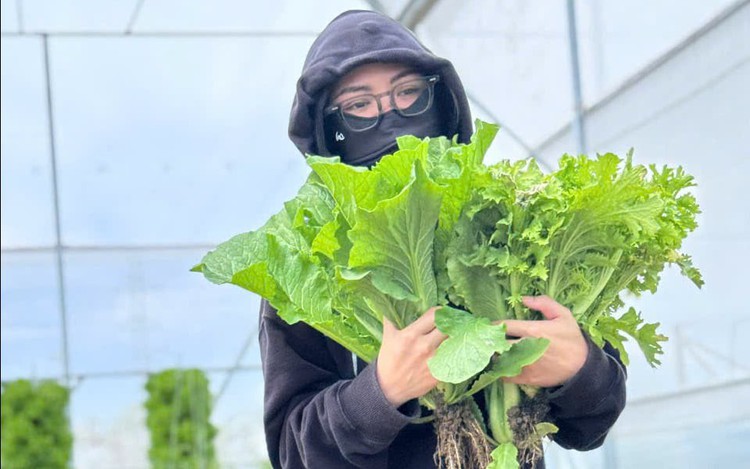
A worker harvests vegetables at a clean farming garden in former Da Lat City, now part of Lam Dong Province, Vietnam. Photo: Supplied
PwC’s 'Voice of the Consumer 2025' report shows that 74 percent of Vietnamese consumers “are extremely concerned about ultra-processed foods and pesticides,” higher than the Asia Pacific average of 68 percent.
In addition, 69 percent say they are willing to pay more for food to support the environment, while 54 percent would buy pesticide-free products and 41 percent are willing to pay a premium for locally produced foods.
These figures show that the demand for safe and verifiable food sources remains a top priority.
These factors are also the core criteria of clean agriculture products with traceability, which current clean vegetable models are aiming to deliver.
Remote vegetable growing services
Across social media platforms, advertisements for monthly land rental services for vegetable farming are on the rise.
Consumers can rent a ten-square-meter plot in the suburbs for about VND160,000 (US$6.07).
Besides the rental fee, customers pay for labor at around VND400,000 ($15.17) per ten square meters, for seeds from VND20,000 ($0.76) per type, as well as fertilizer, packaging, and delivery costs.
With the rented land, customers can have five to seven types of vegetables of their choice.
During harvest, the vegetables are sorted, packed, and delivered weekly.
Customers are provided with clear information on each vegetable, including the seeding to harvest timeline, number of harvests, and expected yield.
For many, this model is not only about buying vegetables but also about the feeling of owning a patch of green.
After COVID-19, the shift toward health-focused consumption has become more evident.
Consumers not only look for convenience but also expect higher quality, transparency, and environmental responsibility.
N.L.H., 28, a customer using a remote vegetable growing service, said she follows a green and clean lifestyle and a macrobiotic diet, making input quality her biggest daily concern.
“One factor that gives me confidence is transparency," she said.
“This service lets me monitor farm activities through cameras installed in the garden and see the cultivation and harvest process.”
For her, being able to 'see' the origin of the food before it reaches the table turns this model into an experience-based service rather than a simple vegetable purchase.
Clean vegetable subscription boxes
Alongside land rental services, many consumers opt for clean vegetable subscription boxes, where produce grown in Lam Dong Province is shipped directly to Ho Chi Minh City in weekly, recurring packages.
In this model, households typically subscribe for a month at an average price of VND 1 million ($38) per box per week.
This volume of vegetables usually meets the weekly needs of a family of four to five people.
For Le Thi Sang, 31, ordering a weekly clean vegetable box is a practical and stable solution, especially with a young child and daily cooking needs.
“I buy it because I trust it, not because it is cheap,” she said. “The price is higher but I do not have to worry about chemicals or sprayed vegetables.”
With this subscription model, customers often pay two to three times the usual price.
Luong Thi Dao, 30, said she also chooses these products regularly but notes the limited variety.
“The products depend on the season and each harvest, so some months we eat the same five types of vegetables over and over,” Dao explained.
“It gets repetitive but we stick with it because it is clean.”
Dang Xuan Canh, founder of Lado Farm, which provides weekly clean vegetable deliveries, said each vegetable variety can take months of research and development under traditional farming methods.
The hardest part is not growing clean vegetables but convincing buyers to return weekly, he added.
"Growing without pesticides is already difficult, and transporting produce nearly 300 kilometers while keeping customers coming back the next week is even harder," Canh said.
“Just one mistake and customer trust is lost.”
His farm spans 1.7 hectares with 2,500 greenhouses and total investment of around VND 2 billion ($75,872). All vegetables are grown traditionally without pesticides.
“Natural disasters, pests, and weather changes can wipe out an entire crop,” Canh said.
“That is why our range is not as diverse as in a supermarket.
“Customers who accept that tend to stay for the long term, and it has become a lifestyle choice for many.”
To advance the goal of making Ho Chi Minh City a creative urban hub and one of the world’s top 100 most livable cities by 2030, Tuoi Tre (Youth) newspaper is collaborating with the Ho Chi Minh City Department of Industry and Trade to host the forum 'Lifestyle Economy – A New Growth Driver for Ho Chi Minh City.'
Tuoi Tre welcomes contributions and recommendations from readers, experts, and businesses in Vietnam and abroad.
Readers can send submissions for the forum to bandoc@tuoitre.com.vn from now until the end of December 2025.
Outstanding articles and perspectives will be edited, selected for publication by Tuoi Tre and receive an honorarium.








Max: 1500 characters
There are no comments yet. Be the first to comment.