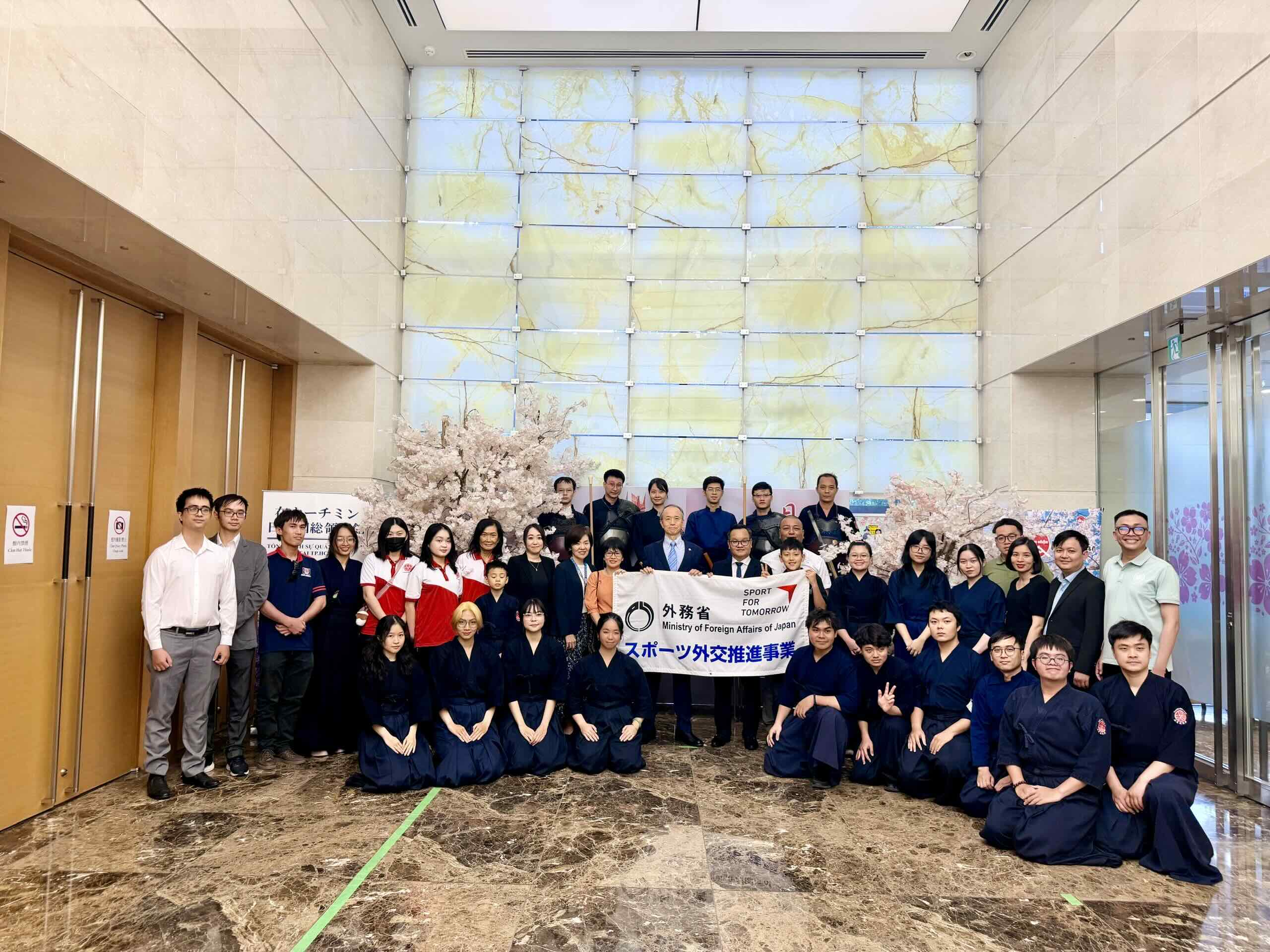
HCMC - Japan on June 18 donated 20 sets of Jukendo training equipment to the HCMC Kendo Federation under the Japanese Foreign Ministry’s 2025 Sports Diplomacy Promotion Program, aiming to support the development of Japanese martial arts and people-to-people exchanges between Japan and Vietnam.
More than a century ago, a physicist was astonished to see a private individual funding basic scientific research. The story remains strikingly relevant today, as an increasing number of businesses face a fundamental question: what role can they play in supporting the fields that shape a nation’s future?
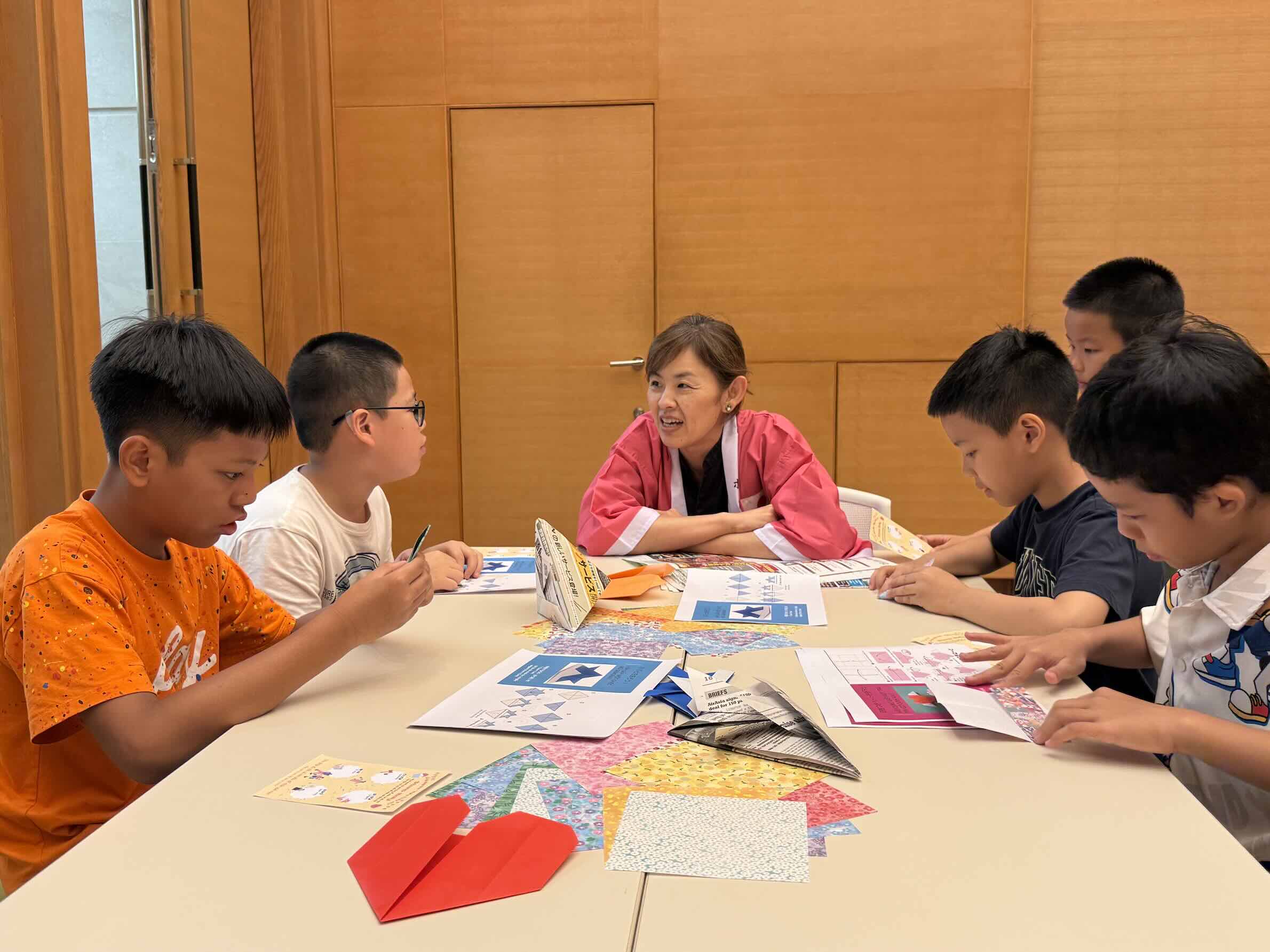
HCMC – Japan's Consulate General in HCMC on June 5 promoted traditional cultural activities among Vietnamese children as part of efforts to strengthen long-term people-to-people ties between Japan and Vietnam.
More than a century ago, a physicist was astonished to see a private individual funding basic scientific research. The story remains strikingly relevant today, as an increasing number of businesses face a fundamental question: what role can they play in supporting the fields that shape a nation’s future?
In the summer of 1905, Austrian physicist Ludwig Boltzmann arrived in California and was taken to Mount Hamilton near San Jose, home to the Lick Observatory. The facility had been built through a donation from James Lick, an American real estate magnate.
Standing beneath its great dome, what impressed Boltzmann was not the size of the telescope itself, but the fact that a private individual had chosen to invest in basic science — a field that offered little direct financial return. Inspired by that vision, he famously remarked: "Happy is the country where millionaires are idealists, and idealists are millionaires."
More than a century later, the example of James Lick still raises a timeless question: what can businesses contribute to the long-term foundations of a nation?
That was also the theme explored by Dr. Nguyen Xuan Xanh during the Space Economy Dialogue, the first forum on the space economy held as part of Vietnam Space Week 2026 in Ho Chi Minh City in late May. Dr. Xanh, who studied and taught in Germany, is the author of Einstein, The University, and numerous other scholarly works.
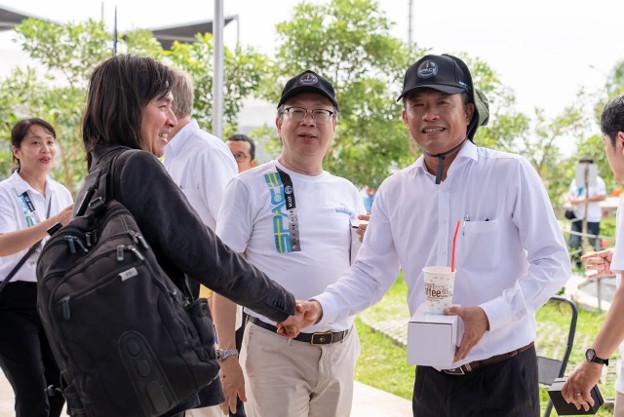
(L-R) Dr. Nguyen Luong Quang, an astronomer at CEA Saclay (France); Vu Quang Lam, chairman of the Board of Directors of SAIGONBANK; and Nguyen Van Khoi, vice chairman of the Can Tho City People's Committee, prepare to welcome former NASA astronaut Michael A. Baker and thousands of students participating in Vietnam Space Week 2026 activities at the Innovation Services Center (ISC) in Vi Tan Ward, Can Tho CityReaching for the “Higher Fruit” of a nation
The Lick Observatory was not an isolated case. Since the late nineteenth century, many of America’s most iconic scientific institutions have been built with private support.
Mount Wilson Observatory — where Edwin Hubble discovered the expansion of the universe and which welcomed Albert Einstein in 1931 — was funded by the Carnegie Institution. The Palomar Observatory was supported by the Rockefeller Foundation. The Keck Observatories atop Hawaii’s Mauna Kea bear the name of the W.M. Keck Foundation. Intel co-founder Gordon Moore later contributed hundreds of millions of dollars to the Thirty Meter Telescope project.
These investments were not charity in the traditional sense.
If charity addresses immediate needs, philanthropy is an investment in society’s future capabilities: education, scientific research, healthcare, and knowledge infrastructure capable of generating impact for decades.
According to Dr. Xanh, this philosophy stems from a simple realization: the low-hanging fruit – or the easiest opportunities – has already been picked. For future generations to continue advancing, societies must invest in what he calls the “higher fruit” — areas that require knowledge, research, and innovation.
The United States did not build observatories solely through private funding. Many of the world’s leading universities, including Stanford, Johns Hopkins, Cornell, Chicago, and MIT, also grew through donations from businesses and wealthy benefactors.
“Higher education and business depend on one another,” Dr. Xanh noted. “One side needs resources to educate talent; the other needs talent to create economic value.”
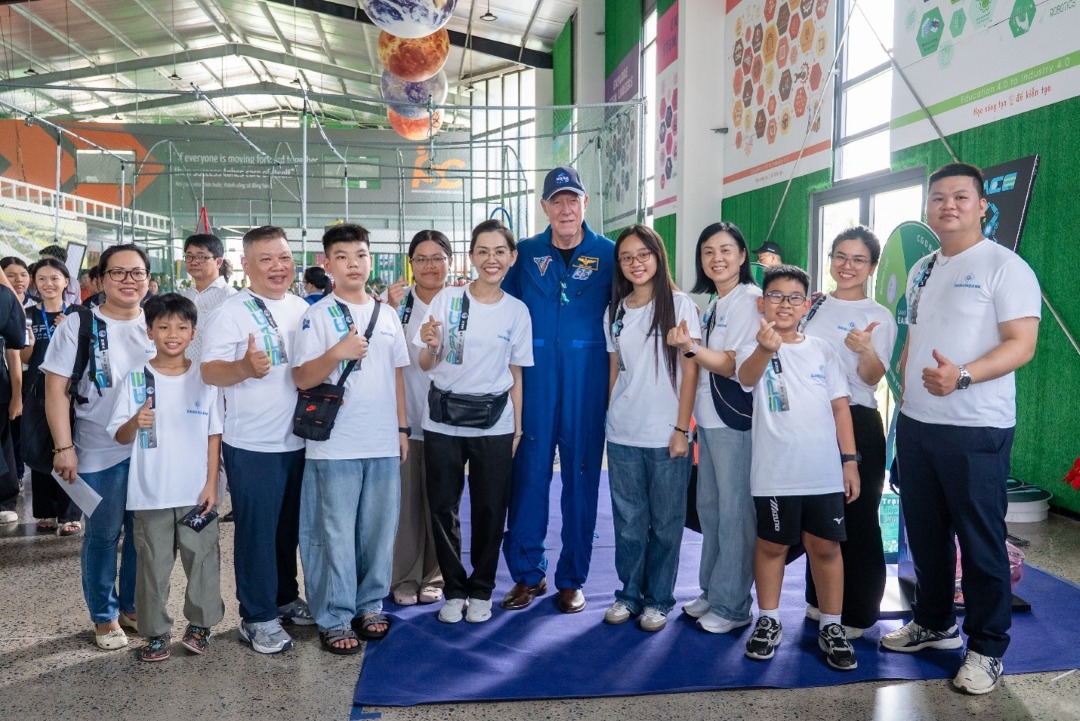
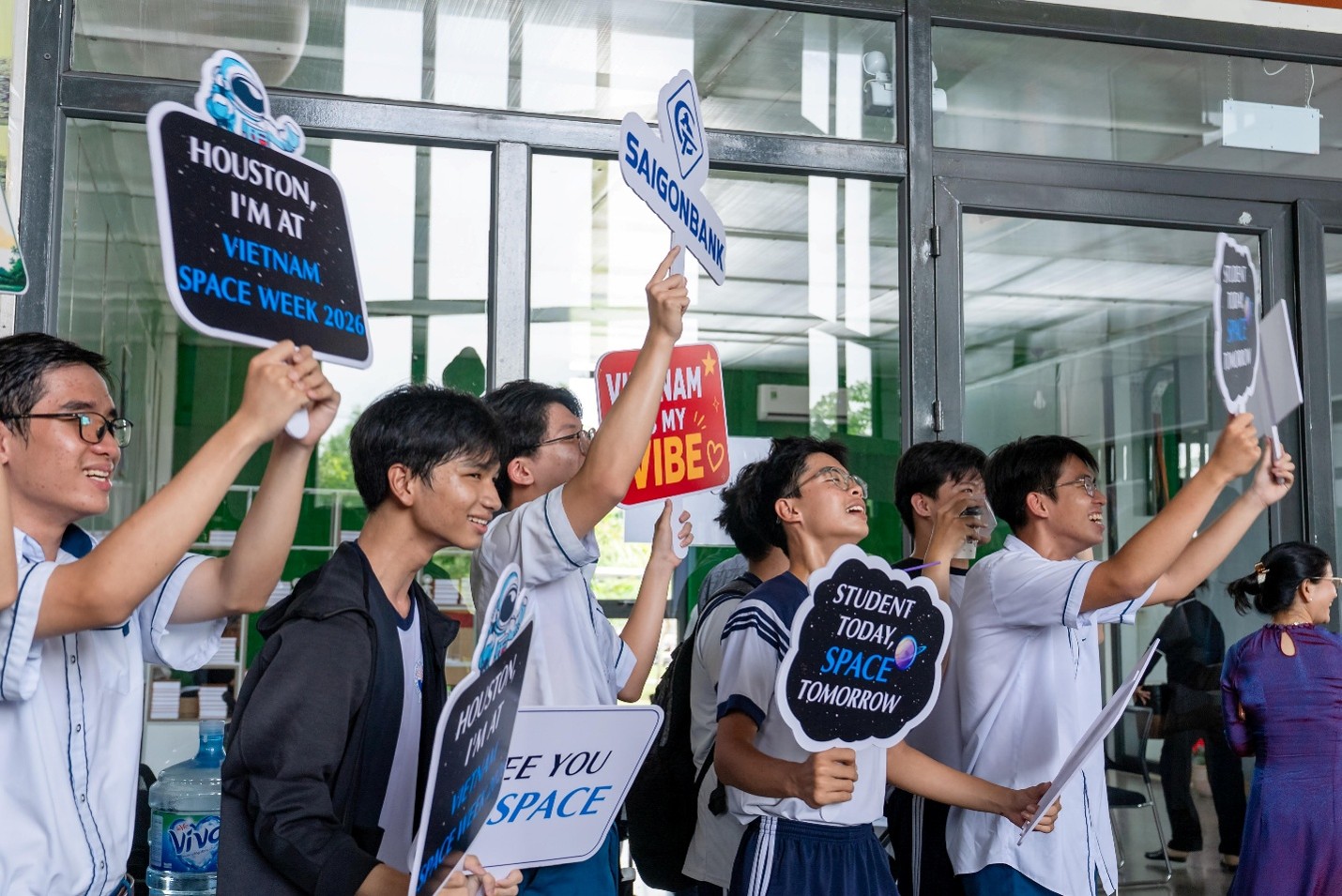
“Houston, I’m at Vietnam Space Week 2026.” Students enthusiastically hold up signs bearing messages associated with Houston, Texas — home to NASA’s Johnson Space Center, which has served as the command hub for U.S. human spaceflight missions for decades. For many young people, Houston has long symbolized the dream of space exploration, while Vietnam Space Week 2026 is helping nurture those dreams in today’s classroomsFrom a question about astronauts to SAIGONBANK’s commitment to community service
In Vietnam, the culture of philanthropy remains relatively young. Corporate social responsibility programs often focus on disaster relief, scholarships, or support for disadvantaged communities — all important initiatives. Long-term investments in science, technology, and future human capital, however, remain less common.
Against this backdrop, the decision of a commercial bank to support Vietnam Space Week 2026 stands out.
When Saigon Industry and Trade Commercial Joint Stock Bank (SAIGONBANK) chose to become a Frontier Partner of the event, it could easily have been viewed as a sponsorship activity. According to the bank, however, the decision reflects a deeper belief in the role of science, technology, and young people in Vietnam’s long-term development.
Vu Quang Lam, Chairman of SAIGONBANK’s Board of Directors, said that supporting Vietnam Space Week represents both an expense and an investment.
“It is an expense because supporting an event like Vietnam Space Week does not generate direct profit for the bank,” he said. “It is also an investment because we believe that the young people sitting in the audience today may become customers, partners, or even founders of technology companies ten or twenty years from now.”
That belief was reinforced through direct interactions with students during Vietnam Space Week.
At two public sessions with former NASA astronaut Michael Baker in Can Tho and Ho Chi Minh City, one question from a student left a particularly strong impression: "Do Vietnamese people have a chance to become astronauts?"
According to SAIGONBANK, the question may sound simple, but it reflects a profound shift in how young people envision their futures. Fields once considered distant or unattainable, such as space technology, are increasingly becoming genuine career aspirations for many Vietnamese students.
“They were not asking out of curiosity,” the bank’s representative said. “They were asking because they were seriously thinking about it as part of their lives.”
For that reason, Lam believes that social responsibility is also a way for SAIGONBANK to define its role within the community.
“A bank does not exist merely to count money and make loans,” he emphasized. “A good bank is one that is willing to be present at important moments, even when the value of that presence cannot yet be measured in numbers.”
More than rockets
Space is often associated with rockets, satellites, and missions to the Moon. Yet the space economy of the twenty-first century is far broader than that. It encompasses satellite data, artificial intelligence, telecommunications, logistics, advanced manufacturing, STEM education, and a growing range of emerging industries.
Under the theme Fly Me to the Moon, Vietnam Space Week 2026 brought together many components of that ecosystem, from students and scientists to businesses and policymakers. The event attracted thousands of young participants to STEM activities while creating a platform for discussions about Vietnam’s opportunities in the global space economy. The program was co-organized by Saigon Times Foundation, Innovation Services Center (ISC) and STEAMZone, taking place at ISC and Vi Thanh Ward People’s Committee in Can Tho City on May 28 and on May 31 in Ho Chi Minh City.
The direct impact of such initiatives can be difficult to measure in terms of revenue or profit. Yet the history of scientific progress shows that many transformative changes begin with pioneering investments.
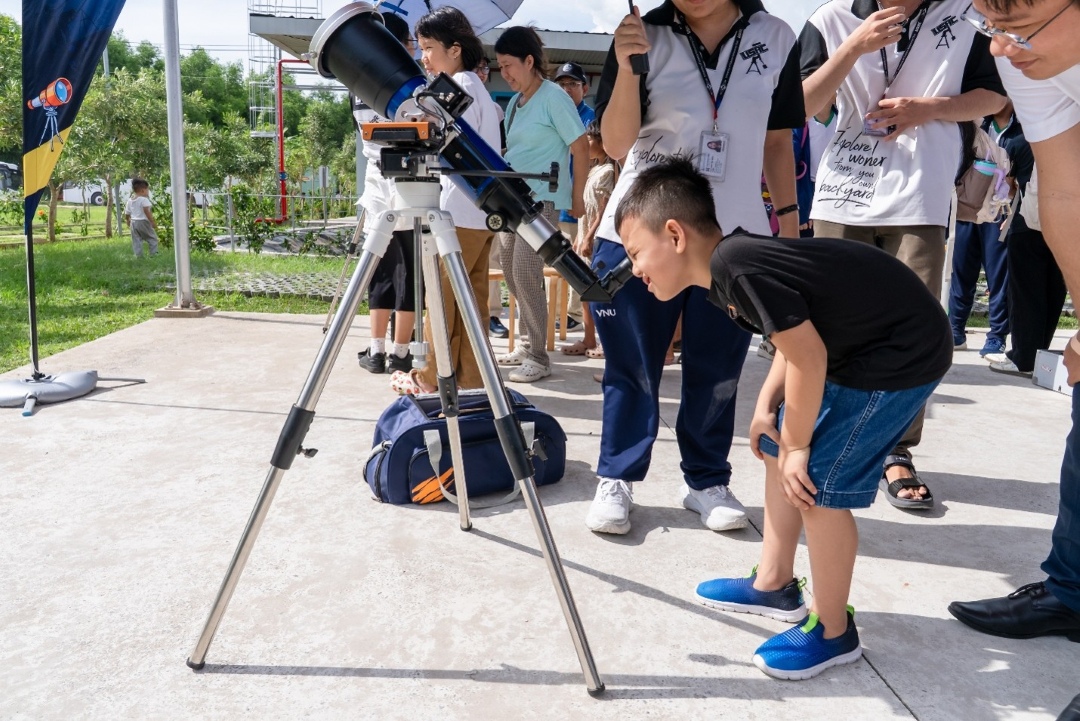
Looking to the sky to learn and understand. A student observes the night sky through a telescope during STEM Day ISC at Vietnam Space Week 2026. Through hands-on experiences like these, science becomes more accessible and engaging, inspiring curiosity and a passion for exploring the universe
A student attending an event today may become a satellite engineer tomorrow. A conversation between a business leader and a scientist may lead to a new technology venture a few years later. An investment in STEM education today may help build the skilled workforce of an entire industry in the future.
Vietnam has set a goal of becoming a high-income country by 2045. Achieving that ambition will require more than economic growth alone; it will also demand greater investment in knowledge, science, and innovation.
The space economy, likewise, cannot rely solely on government funding. In China, major financial institutions such as China Merchants Bank, Shanghai Pudong Development Bank, and Ping An Bank have already participated in projects that apply satellite data and space technologies to risk management, data analytics, and financial services. The government still plays the central role, but experiences from many countries show that the private sector – including financial institutions – can contribute an important part to the emergence of new technologies.
Perhaps that is why the most memorable aspect of this year’s Vietnam Space Week was not only the discussions about the Moon or the space economy. It was also a sign that more Vietnamese businesses are beginning to look beyond short-term results and contribute to building the foundations of the future.
Yet for that cycle to continue, a society cannot rely only on harvesting the “low-hanging fruit.” It must also be willing to invest in the “higher fruit” — where knowledge, science, and even distant dreams such as space exploration await those patient enough to reach for them.
Will Vietnamese people have the opportunity to become astronauts?
The answer to that student’s question does not lie in a promise. It lies in what society is willing to invest in today.
And every great journey begins with a first step.
HCMC - Japan on June 18 donated 20 sets of Jukendo training equipment to the HCMC Kendo Federation under the Japanese Foreign Ministry’s 2025 Sports Diplomacy Promotion Program, aiming to support the development of Japanese martial arts and people-to-people exchanges between Japan and Vietnam.
More than a century ago, a physicist was astonished to see a private individual funding basic scientific research. The story remains strikingly relevant today, as an increasing number of businesses face a fundamental question: what role can they play in supporting the fields that shape a nation’s future?
HCMC – Japan's Consulate General in HCMC on June 5 promoted traditional cultural activities among Vietnamese children as part of efforts to strengthen long-term people-to-people ties between Japan and Vietnam.