


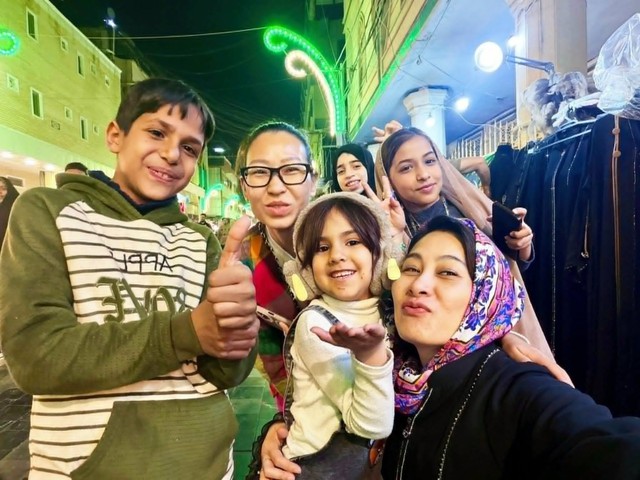
Vietnamese travelers Thanh Thuy and Bich Ngoc pose for a photo with children in Iraq. Photo: Supplied
Tensions in the region have escalated after coordinated air strikes by the U.S. and Israel on Iran last Saturday triggered retaliatory attacks and heightened instability across the Middle East.
Nguyen Thanh Thuy and Vu Phuong Thao from Ho Chi Minh City and Phi Thi Bich Ngoc from Hanoi were in Iraq’s Erbil when they learned that the airspace of Iran, Iraq, Jordan, Qatar, the UAE, and Bahrain had been closed due to the conflicts.
Qatar Airways later announced their ticket cancellations and offered refunds within a week.
As a result, the group had to travel by car to the Duhok border, crossed into Turkey, and then took a domestic flight to Istanbul on Monday. They plan to return to Vietnam this Saturday.
“Fortunately, Turkish airlines were still operating despite the intense situation,” said Thuy from the 1life first aid kit brand. “In the face of this sudden development, we received timely information and strong support from travel partners in Iraq and Turkey, which helped reassure us.”
“We pray for the conflicts to end soon and for peace to return,” added Bich Ngoc from N Plus Adventure travel and trade company limited.
Meanwhile, Nguyen Thu Huong, a Vietnamese digital nomad, said she was in Jordan and had traveled to the Dead Sea, which lies between Jordan and Israel, on February 28.
Her phone, connected to an Israeli e-SIM network, suddenly received emergency alerts urging people to seek shelter.
She also heard fighter jets overhead and warning sirens continuously.
The only way for Huong to leave the Middle East was to secure the earliest possible flight to Turkey.
She later managed to purchase a seat on a Royal Jordanian flight on the evening of March 1, possibly due to a last-minute cancellation, as missile warning sirens continued to sound and fighter jets roared above.
“Even after the plane departed Jordan, I did not feel completely at ease, as the country’s airspace was still within the trajectory of missiles exchanged between Israel and Iran,” Huong recalled.
She noted that daily life in Jordan remained largely normal though.
“The main concern was the airspace closure and the risk of further escalation, so I decided to leave as soon as possible,” she explained.
Huong added that many Vietnamese travelers remain stranded in Jordan and elsewhere in the Middle East.
“I hope they can soon find flights out, and that the situation in the region stabilizes so everyone stays safe,” Huong said.
Vu Anh Duy, a former student of the Diplomatic Academy of Vietnam, and a friend began their Middle East journey on the first day of the Lunar New Year (February 17).
They had planned to spend the entire first lunar month and the Islamic holy month of Ramadan in the region.
On March 1, the two crossed the land border between Homs in Syria and Baalbek in Lebanon to enter Lebanon overland.
“Our journey to explore Lebanon has begun and we do not yet know when we will return,” Duy said.
He admitted that following news about the situation in Iran has stirred mixed emotions.
“For me, the warmth of the Iranian people is a precious treasure, alongside the rich Persian history and culture,” Duy said.
“I only hope that when I return to Iran, Israel or Palestine one day, the wonderful things I once experienced will still be there, despite how turbulent and unpredictable the world may be,” he shared.








Max: 1500 characters
There are no comments yet. Be the first to comment.