


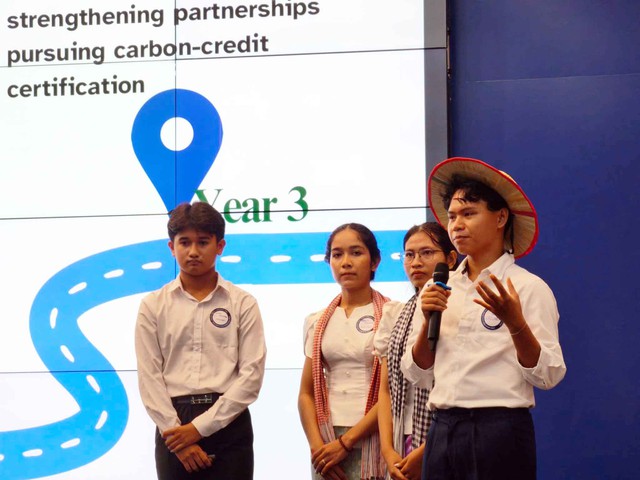
Students from Chea Sim Kamchaymear University present their ChiChet project at the UNIIC Business Challenge 2026. Photo: Trong Nhan / Tuoi Tre
The final round of the UNIIC Business Challenge 2026 was held yesterday at Hung Vuong University in Ho Chi Minh City.
The competition is part of the University Incubation and Innovation Consortium (UNIIC), a network connecting universities across Asia and Africa to promote incubation, entrepreneurship and innovation. It currently connects 25 universities in 11 countries.
Bringing AI to coffee farms
A team from Hung Vuong University presented Agri-iTech, a project designed to support small-scale Robusta coffee farmers in Dak Nong Province in Vietnam's Central Highlands, one of the country's main coffee-growing regions.
The system uses sensors to collect data on soil and environmental conditions and transmit it via fourth-generation mobile network (4G). AI then analyzes the data to help farmers schedule irrigation and fertilizer use, forecast yields and receive alerts on their phones.
The team also plans to build a digital profile for each growing area, recording information on coffee varieties, cultivation history, farm inputs, yields and harvest periods.
Each device is estimated to cost about US$200, while the project's initial investment is projected at $19,400.
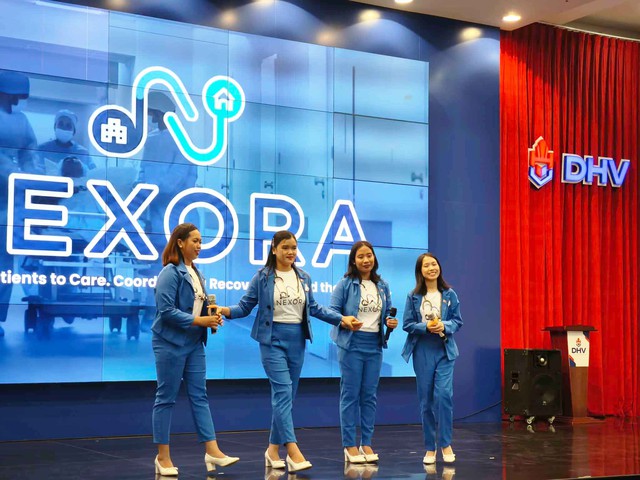
Students from the Philippines present a technology-based project connecting patients with family doctors. Photo: Trong Nhan / Tuoi Tre
Turning rice husks into biochar
The ChiChet team from Chea Sim Kamchaymear University in Cambodia focused on another common agricultural byproduct: rice husks.
Rice husks are the outer layers removed from rice grains during milling and are widely generated in rice-producing countries across Southeast Asia.
The team proposes heating rice husks in a low-oxygen environment to produce biochar, a carbon-rich material that can be added to soil. The material can help improve the soil's ability to retain water and nutrients.
During its first one to two years, the project plans to operate in three Cambodian provinces, namely Prey Veng, Kampong Cham and Battambang, targeting farmers, cooperatives, organic farms and fertilizer companies.
Meanwhile, students from the University of Mpumalanga in South Africa presented HLENGA, an automated food dispenser designed to allow consumers to buy food in smaller quantities instead of having to purchase an entire package.
Users can bring their own containers and purchase rice, maize meal, beans or cooking oil in the amount they need.
Maize meal, a staple food made from ground maize, is widely consumed in parts of southern Africa.
Each machine can hold about 60 kilograms of goods and can be installed at local stores. Store owners hosting the machines can receive a commission of five to ten percent of sales.
"What we want to create is a way to break down purchasing power. A family does not need enough money to buy a whole large package when it can purchase only the amount of food it needs," the team said.
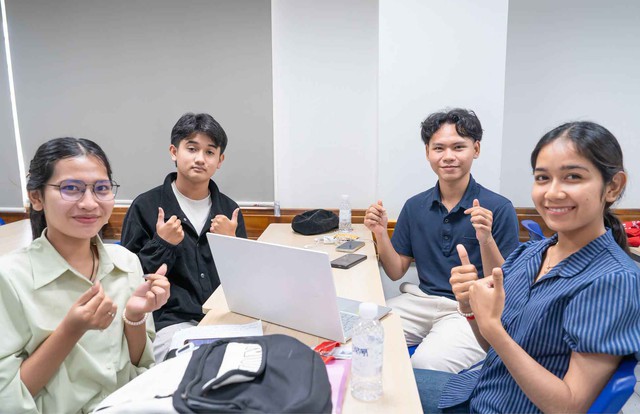
International student teams discuss their projects on the sidelines of the UNIIC Business Challenge 2026. Photo: Hung Vuong University
Turning ideas into practical value
UNIIC currently connects 25 universities in 11 Asian and African countries and promotes incubation programs, entrepreneurship activities, hackathons, joint research and knowledge sharing.
The projects presented at the competition focused on practical problems in agriculture, food access and resource use, rather than purely technology-driven applications.
Speaking at the competition, Nguyen Thi My Dung, vice president of Hung Vuong University, said students need to learn how to solve problems, innovate and collaborate as AI, the green economy and new business models continue to reshape the business environment.
She described each UNIIC challenge as a "laboratory" for business thinking, where students can test ideas, receive feedback and refine their projects.
"The ability to turn ideas into new value determines how far we can go," Dung said.








Max: 1500 characters
There are no comments yet. Be the first to comment.