


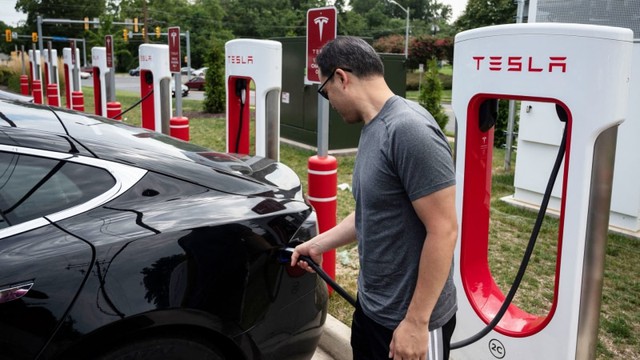
Tesla’s extensive charging network is considered one of the company’s biggest advantages in the global EV market. Photo: Tesla
According to registration documents, Tesla Motors Vietnam is headquartered in Ho Chi Minh City and registered to import, distribute, and retail automobiles and auto parts.
Tesla's potential Vietnam entry draws attention
On September 11, Tesla established Tesla Motors Vietnam Co., Ltd. in Ho Chi Minh City with charter capital of VND77.667 billion ($3 million).
The establishment of the local entity marks an official step by the U.S. electric vehicle maker into the Vietnamese market, although Tesla has not announced specific plans for its operations.
On automotive forums, many said the establishment of the entity could be a preparatory step for Tesla to enter Vietnam.
However, the company has yet to announce when it will begin selling vehicles, which models it will offer, pricing, or plans to develop charging stations.
Charging infrastructure is drawing particular attention as it has been one of Tesla's major advantages globally.
Tesla currently operates more than 80,000 Supercharger stations worldwide.
For example, Tesla's V3 fast chargers can deliver up to 250 kW.
Under suitable conditions, a Model Y can add about 260 kilometers of range in 15 minutes.
Charging speeds decrease as the battery approaches full capacity to protect the battery and improve charger availability.
In addition to its fast-charging network, Tesla has more than 50,000 destination charging stations.
These alternating current (AC) chargers, which offer slower to medium charging speeds, are installed at hotels, restaurants, offices and resorts.
Users can locate chargers, monitor charging and make payments through the Tesla app.
It remains unclear how Tesla plans to operate its business and develop charging infrastructure in Vietnam.
Many EV users, however, believe that in the initial stage, Tesla owners could install home chargers or use open charging networks such as EV One and Charge+, which currently offer Type 2 and CCS2 chargers in several provinces and cities.
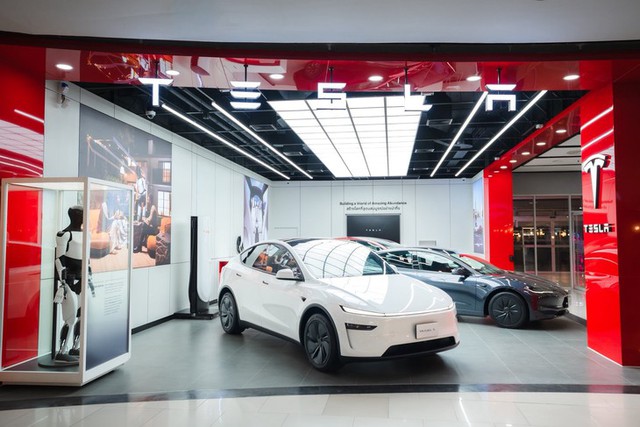
A Tesla Model Y at a showroom inside a shopping mall in Thailand. Photo: TeslaZoa
The ability to use these networks will depend on the vehicle configurations Tesla brings to Vietnam.
If the company sells vehicles using the CCS2 standard found on versions for the European market, they could connect to many open charging stations in Vietnam.
By contrast, versions made for the U.S. or Chinese markets use different standards and may require adapters, with compatibility with fast chargers not guaranteed.
V-Green's network currently serves only VinFast electric vehicles.
According to experts, expanding its charging network may not be a major challenge for Tesla given its global operating experience, technology and financial resources.
The more important questions are the size of the Vietnamese market and the business model Tesla chooses, including whether to work with open charging networks or focus on home charging.
How Tesla organizes after-sales services, maintenance and charging support will also determine its ability to attract customers and could make Vietnam's EV market more competitive.
Three senior executives revealed
According to registration documents, Isabel Ching Fan is the general director of Tesla Motors Vietnam.
Fan has around 25 years of experience in the technology sector, including 19 years at Apple before joining Tesla.
David Jon Feinstein, who has been involved in Tesla's expansion in India, Taiwan, Thailand and Canada, serves as chairman of the company.
Nguyen Manh Hung serves as assistant to the general director.
If brought to Vietnam, the Model 3 could compete with the BYD Seal, while the Model Y could go up against the Ford Mustang Mach-E.
The Model S would enter a segment occupied by vehicles such as the Porsche Taycan.
According to several auto businesses, Tesla's challenge in Vietnam may not be to quickly capture a large share of the market.
Its immediate opportunity could lie among high-income consumers who are interested in technology and value global brands.
However, brand appeal alone will not guarantee success.
Tesla will also have to address pricing after taxes and fees, after-sales services, parts availability and, most importantly, convenient charging.
The company's arrival is unlikely to immediately alter the position of domestic automakers, but it could make Vietnam's EV race increasingly competitive.








Max: 1500 characters
There are no comments yet. Be the first to comment.