



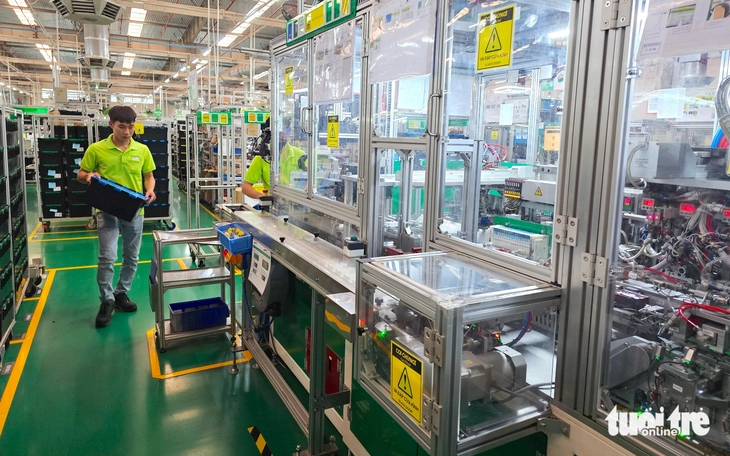
Workers at an electronics factory - Photo: Gia Doan / Tuoi Tre
In early July, a foreign enterprise in Bac Ninh Province, northern Vietnam, was fined VND135 million ($5,094) for allowing 1,763 workers to work overtime exceeding 300 hours a year, Dai Bieu Nhan Dan, the newspaper of Vietnam's National Assembly, reported.
However, the fine was issued under the penalty schedule that applied before Decree 283 took effect.
From September 10, the penalty bracket will be more detailed and stricter, tied to the number of workers affected.
For industries that rely on hundreds of thousands of workers to fulfill peak-season orders, the question is no longer whether they will be fined, but how to avoid it.
Heavier fines, higher risks
Under the new decree, employers who require workers to work overtime without their consent, or who let workers exceed the hours permitted by law, are subject to fines of VND20-25 million ($755-943).
The fine applies to individuals. For enterprises, it doubles to as much as VND50 million ($1,887) per violation under Article 7 of the decree.
The fine also escalates with the scale of the violation.
Mobilizing employees to work overtime beyond the statutory limit or failing to ensure adequate rest between shifts can result in fines ranging from VND5 million ($189) for violations involving a small number of workers to VND75 million ($2,830) when 301 or more workers are affected, according to Vietnam Television (VTV).
Failing to ensure weekly rest days, annual leave or Tet holiday leave carries a fine of VND10-20 million ($377-755).
Failing to notify the provincial Department of Home Affairs when organizing 200-300 hours of overtime a year carries a fine of just VND2-5 million ($75-189), which is a small amount but one that can easily turn into a recurring violation if no one is keeping close track.
Notably, the industries most reliant on unskilled labor, such as textiles, footwear, electronics and seafood processing, are precisely the group permitted to mobilize up to 300 hours of overtime a year.
These are also industries long accustomed to seasonal overtime tied to order cycles, so the higher the cap, the greater the risk of exceeding it during peak periods.
Tighter oversight was already underway before the new decree was issued. Nguyen Nhu Long, deputy head of the Bac Ninh Provincial Industrial Zones Authority, told Tuoi Tre (Youth) online newspaper that in the first six months of 2026, the authority inspected 23 enterprises for compliance with regulations on working hours, rest periods and overtime.
He acknowledged that some enterprises employing large numbers of workers had not fully ensured adequate rest between shifts, or compensatory rest during periods of frequent overtime.
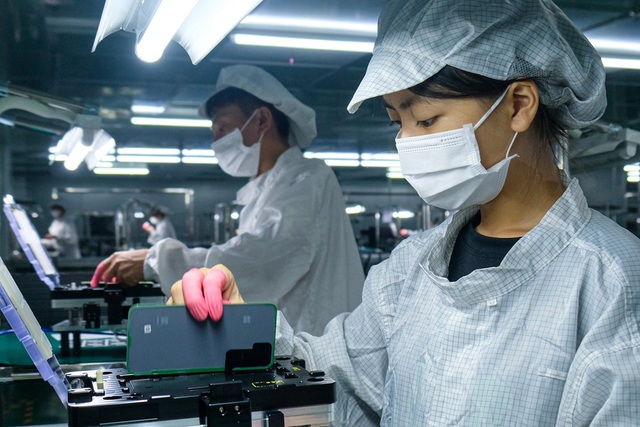
Workers on a factory production line - Photo: Nguyen Bao / Tuoi Tre
Adjusting HR policy
Beyond the fines, the key to avoiding violations in the first place is worker consent.
Except in limited circumstances specified under Article 108 of the 2019 Labor Code, such as mobilization orders to ensure national defense and security or to protect lives and property during responses to disasters, fires, epidemics, and other emergencies, any overtime arrangement requires workers’ consent on three aspects: the timing, location, and nature of the work.
This is where many enterprises, especially large factories with thousands of workers, most often run into trouble in practice.
When orders pile up at quarter's end, properly obtaining each worker's consent through the correct process, rather than simply notifying them of the overtime schedule, requires HR to have documentation procedures, templates and processing time ready well in advance.
Without this step, even if there is no intention to exceed the statutory overtime limit, an enterprise may still be found in violation for requiring employees to work overtime without their consent, facing a fine of VND20-25 million ($755-943) for each violation.
The monitoring model in Bac Ninh points to an approach enterprises could put to proactive use rather than treat merely as external pressure.
Nguyen Nhu Long said the Provincial Management Board of Industrial Zones has assigned labor officials to disseminate information, provide guidance and answer questions on working hours, rest and overtime via phone, messaging platform Zalo or the online portal - a channel FDI HR teams can tap into before planning seasonal overtime.
Ultimately, the new decree is not just about raising fines on paper, it is pushing factories to rethink how they schedule production: distributing their workforce more evenly across months, standardizing the process for obtaining written worker consent, and designating someone to track legal changes.
For FDI HR and legal teams, this is the final stretch for internal review before the new decree takes effect.
The top priority is standardizing worker-consent document templates, rather than simply announcing the schedule unilaterally.
Next, they should review seasonal production schedules to avoid concentrating overtime during peak periods.
Finally, they must proactively connect with local labor authorities by phone, Zalo or the online portal, to get guidance before violations arise.









Max: 1500 characters
There are no comments yet. Be the first to comment.