


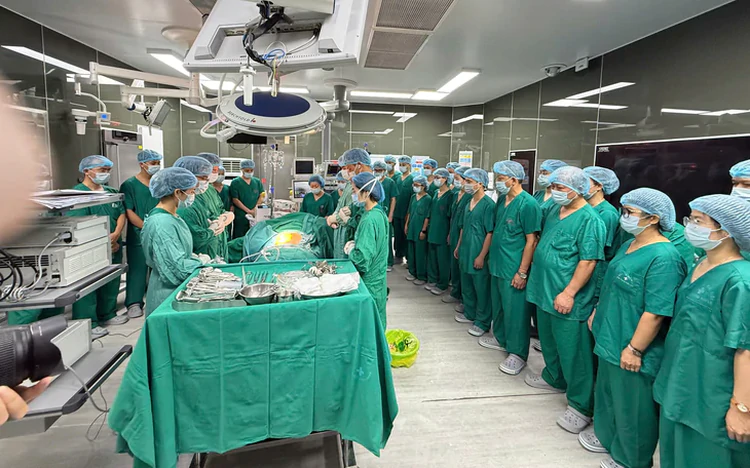
Doctors pay tribute to an organ donor at Thanh Nhan Hospital in Hanoi. Photo: Supplied
In recent days, the proposed consultation has attracted considerable attention on social media.
Some people have questioned whether children of this age have sufficient understanding to express opinions on organ donation, while others have raised concerns that their responses could be influenced by parents, teachers, or the wording of survey questions.
The debate has highlighted broader questions about how the survey is explained, whether participation is voluntary, and how children’s views will be used in developing public policy.
Consulting children on policies that affect them
A representative of the drafting and consultation unit told Tuoi Tre (Youth) online newspaper that the survey aims to ensure that the proposed legislation reflects practical needs, supports the development of organ and tissue donation and transplantation, and encourages public participation in lawmaking.
The consultation is being conducted among the general public, including children aged seven to under 18.
The ministry explained that seeking children’s views is part of the requirement to consider the perspectives of children when developing policies and laws that affect them.
The questionnaire for children focuses on provisions directly related to minors and includes personal information and nine questions about the draft law.
The questions cover proposals allowing people under 18 to register as organ donors with the consent of their legal representatives; permitting those aged 15 to under 18 to donate tissues or organs for transplantation to family members; and allowing children under 15 to donate certain tissues for the treatment of their parents or biological siblings.
Children must receive guidance before participating
One of the main concerns is whether children aged seven can understand concepts related to organ and tissue donation, as well as the implications of the proposed legislation.
The representative said the Department of Medical Services Administration and relevant agencies have conducted public communication activities on organ donation and transplantation.
Explanations of key terms are also included in the survey questionnaire.
The department has asked healthcare facilities and selected educational institutions nationwide to help conduct the consultation.
At healthcare facilities, participants include adults as well as children aged seven to under 18 who are children of staff members, patients, or patients’ relatives.
The department said these children were selected because they may have some relevant understanding or access to explanations of the issues.
Educational institutions have been asked to invite students from middle and high schools and universities to participate.
Elementary school students are not being surveyed through this arrangement.
The department has also instructed that children receive age-appropriate guidance and should not be expected to complete the questionnaire independently without explanation.
Parents, healthcare workers, and communication staff may explain the relevant concepts to help them understand the questions.
In addition to predefined answer choices, the questionnaire provides space for children to express their own thoughts and opinions, allowing them to share perspectives beyond the options presented.
After the consultation ends, the results will be reviewed and considered during revisions to the draft law and the preparation of implementing regulations.
The department said it has not set a specific target for the number of responses, describing the exercise as a broad public consultation intended to inform further policy development.

Vietnamese Minister of Health Dao Hong Lan. Photo: G. Han
Proposal would allow minors to donate organs after death
Minister of Health Dao Hong Lan on Wednesday presented the draft revised Law on Donation, Removal and Transplantation of Human Tissues and Organs and Donation and Recovery of Cadavers to the National Assembly.
A key proposal would expand the pool of potential donors while strengthening eligibility requirements.
It would permit the retrieval of tissues and organs after death when a person has been medically determined to have died following circulatory cessation, in addition to existing provisions concerning brain death.
Under the draft, people under 18 could register as donors and donate organs after brain death or circulatory death, provided that they had registered or expressed their wishes before death and their legal representative had given consent.
To prevent exploitation, the draft would require living organ donors giving to recipients outside their family to be at least 25 years old.
It would also introduce identity and relationship verification procedures, along with independent assessments and counselling concerning donation eligibility, particularly for minors.
In response to diverse public opinions regarding the proposal, the Ministry of Health stated that after nearly 20 years of implementing the 2006 Law on Donation, Removal, and Transplantation of Human Tissues and Body Parts and Donation and Removal of Cadavers, the supply of donations still fails to meet treatment demands.
Many patients, including children, face long wait times to find matching tissues or organs, with some passing away before a suitable donation becomes available.
The draft law is developed to expand donation sources, increase transplantation opportunities for patients, strengthen controls over the trafficking of human tissues and body parts, and enhance protections for donors.
The Ministry of Health clarified that the draft law explicitly distinguishes between two cases of donation by living and deceased individuals under 18 years old, establishing distinct conditions for each:
For living donors under 18, the draft law only permits the donation of regenerative tissues, such as hematopoietic stem cells, for treating relatives when no suitable adult donor is available.
Individuals aged 15 to under 18 may donate to family members, while those under 15 may only donate to their biological parents or siblings.
Donors must meet health requirements, receive independent counseling, and give their own consent alongside the consent of their parents or legal guardians.
The draft law strictly maintains the prohibition against removing kidneys, livers, hearts, lungs, or any healthy body parts from living individuals under 18.
For donors under 18 after death, the draft law stipulates that the donor must be confirmed as brain-dead or circulatory-dead by an independent expert panel, must have registered or expressed the wish to donate prior to passing away, and must have the consent of their parents or legal guardians.
The donation registration can be modified or canceled at any time.
According to the Ministry of Health, these provisions aim to respect the donation wishes of minors and their families while creating additional opportunities to save patients, particularly children who require tissues or body parts with matching sizes and anatomical characteristics that adult donors can rarely fulfill.
The drafting authority emphasized that the draft law does not encourage children to donate. Instead, it seeks to establish a rigorous legal framework to guarantee the safety and rights of children, providing a basis to evaluate suitable cases currently unaddressed by existing legislation.
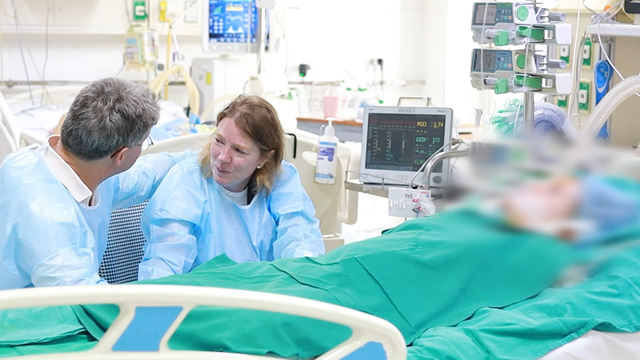
The parents of a British woman who passed away in Vietnam and consented to organ donation after brain death. Photo: Danh Khang / Tuoi Tre
Strengthening oversight to prevent child exploitation
Addressing concerns over the risk of human tissue and organ trafficking involving children, the Ministry of Health noted that the draft law explicitly prohibits buying, selling, coercing, stealing, or brokering human tissues and body parts.
It also bans exploiting guardianship, alternative care, or adoption relationships to harvest tissues and body parts from minors. Violators will face criminal prosecution in accordance with the law.
Additionally, the draft law introduces requirements to verify personal identities and the relationship between donors and recipients. All organ transplantations must be coordinated using a national identification coding system and a central waiting list to ensure equity and fairness.
According to data from the health ministry, from Vietnam's first organ transplant in 1992 through March 2026, the country has performed a total of 11,187 human organ transplants.
Pediatric transplantation needs remain a critical concern.
At the National Children's Hospital, over 20 patients await liver transplants and approximately 40 await kidney transplants each year.
Meanwhile, Children's Hospital 2 in Ho Chi Minh City recorded over 80 pediatric patients with end-stage chronic kidney disease in 2022.
Parliamentary committee calls for stronger safeguards
In its review of the draft legislation, the National Assembly’s Committee for Culture and Social Affairs acknowledged the humanitarian purpose of the policy, noting that it could create additional opportunities to save lives.
It could also respect the donation wishes of minors and their families.
However, the committee stressed that children and other minors require special protection. It called for further assessment of the policy’s potential psychological, ethical, and social consequences.

Particular attention should be paid to the risk of coercion or exploitation arising from dependent relationships.
The committee therefore recommended further research and stricter safeguards to ensure that the policy achieves its humanitarian objectives without compromising children’s rights and welfare.
It also called on the government to establish consistent rules recognizing a person’s expressed wishes before death as the basis for posthumous tissue and organ donation following brain death or circulatory death.
In addition, the committee urged the government to ensure that allocation methods, including any scoring systems or algorithms, are transparent, objective, and fair.
How other countries safeguard children in posthumous organ donation
Other countries generally impose stricter safeguards for organ donation involving children than for adults. Parental or legal guardian consent is required.
In the United States, many states allow teenagers to register as organ, eye, and tissue donors when applying for a learner’s permit or driver’s license, according to the Health Resources and Services Administration.
In the United Kingdom, donation proceeds only with the family’s agreement.
According to NHS Organ Donation, the organ and tissue donation service of the National Health Service (NHS), the deemed consent, or 'opt-out,' system does not apply to children. This means that children are not treated as having consented to donation simply because they did not register an objection.
Meanwhile, Irish law states that if one parent or guardian has consented but another objects before the organ or relevant tissue is removed, the original consent becomes invalid.


Max: 1500 characters
There are no comments yet. Be the first to comment.