


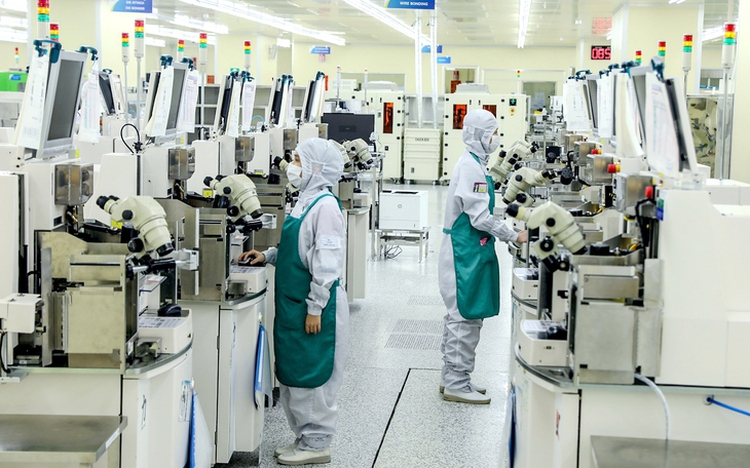
Technical workers on the production line at the Hana Micron Vina semiconductor plant (South Korean investment) in former Bac Giang Province. Photo: Danh Lam
Jointly organized by Nhan Dan newspaper, the Communist Review, the National Economics University, and the University of Economics Ho Chi Minh City, the conference gathered nearly 300 delegates from Party agencies, the National Assembly, government ministries, research institutes, and the business sector to discuss renewing the country's development framework.
Moving beyond traditional growth drivers
Le Quoc Minh, Editor-in-Chief of Nhan Dan, emphasized that after four decades of Doi Moi (Renewal), Vietnam must address structural bottlenecks despite significant economic integration and rising living standards.
He urged a decisive shift toward growth quality, resource efficiency, productivity, and innovation over capital and natural resources.
Minh noted that the country needs to transition from merely participating in global value chains to securing higher positions within them, shifting from receiving technology to mastering it.
Aligning with Resolution 19-NQ/TW, issued on July 28, 2026, the new growth trajectory must balance speed with quality, economic efficiency with social progress, and deeper integration with national economic autonomy.
Presenting economic findings, Prof. Dr. Ngo Thang Loi from the National Economics University highlighted declining growth rates across four consecutive development periods.
Capital growth continues to outpace average GDP expansion, while total factor productivity (TFP) remains low, signaling capital inefficiency.
Furthermore, Vietnam remains heavily reliant on foreign direct investment (FDI). While FDI accounts for a major share of exports and GDP, links to domestic businesses are minimal—only 13 percent of FDI firms maintain local supply connections, and just 2.3 percent conduct local R&D.
Meanwhile, the domestic private sector remains fragmented, with micro and small enterprises accounting for 95 percent of all firms.
Loi also pointed to rising resource inequality, noting high Gini coefficient figures for land and capital access, alongside diminishing returns from traditional poverty reduction efforts.
Prof. Dr. Nguyen Trong Hoai from the University of Economics Ho Chi Minh City noted that structural economic shifts—such as moving labor from agriculture to manufacturing—are no longer generating strong momentum.
Although high-tech exports have surged over the past two decades, most gains remain concentrated within the FDI sector, while the domestic value-added share in exports has declined.
To catch up with emerging economies, Hoai stressed that Vietnam must quadruple its rate of labor quality improvement and increase IT capital investment fivefold.
Two growth paths toward 2045
Outlining future development paths, Hoai presented two scenarios: maintaining the current model, which risks missing high-income targets, or implementing aggressive reforms to reach high-income status around 2045–47.
The reform scenario requires annual TFP growth to rise from 0.2 percent to 2 percent. Hoai proposed shifting from a capital-heavy "1i" model (Investment) to a "3i" framework incorporating Investment, Infusion (technology diffusion), and Innovation.
Additionally, Vietnam holds untapped potential in services exports, which currently make up less than 10 percent of total exports, well below the ASEAN average of 26 percent.
Hoai concluded that future growth policies must remain inclusive, citing the need to support "reverse migration" to rural areas and adapt to an aging population starting in 2036.








Max: 1500 characters
There are no comments yet. Be the first to comment.