


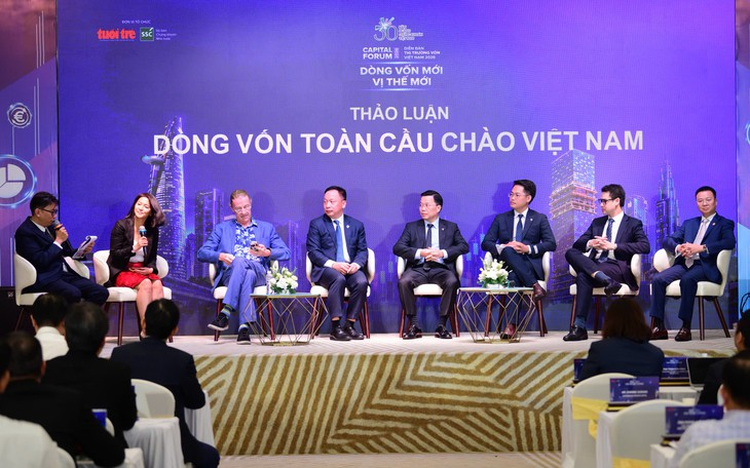
Speakers attend a panel discussion titled “Global Capital Flows Turn to Vietnam.” Photo: Quang Dinh / Tuoi Tre
The 2026 Vietnam Capital Market Forum, themed “New Capital Flows – A New Position for Vietnam’s Stock Market,” was held in Ho Chi Minh City on Friday afternoon by Tuoi Tre (Youth) online newspaper in collaboration with the State Securities Commission of Vietnam.
More quality companies needed to attract international capital
Speaking at a panel discussion during the forum, Wanming Du, director of index policy for Asia-Pacific at FTSE Russell, said Vietnam needs to focus on removing foreign ownership barriers and deepening its market to maintain its appeal to global investors.
She said foreign ownership restrictions were affecting international investors’ access to the market and the weighting of Vietnamese stocks in emerging market portfolios.
In the long term, Vietnam needs to increase the number of high-quality listed companies, diversify the sectors represented by listed companies, and develop a stronger domestic institutional investor base.
Pension funds, insurance companies and savings mechanisms that channel investments into securities could provide stable, long-term capital.
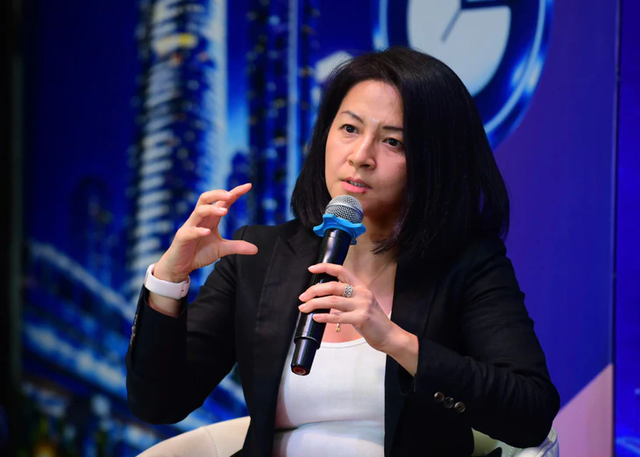
Wanming Du, director of index policy for Asia-Pacific at FTSE Russell. Photo: Quang Dinh / Tuoi Tre
Vietnam also needs to ensure transparent information disclosure, improve regulatory enforcement and make policies more predictable to strengthen investor confidence.
Asked about the prospects for sustaining capital inflows after the market upgrade, Du said passive investment funds allocate capital to Vietnam based on the country's weighting in emerging market indices.
These inflows would continue as long as Vietnam maintains its weighting and the number of companies included in the indices.
To increase its weighting, Vietnam needs more companies to qualify for inclusion in the indices through initial public offerings (IPOs), while expanding the supply of listed shares across different sectors rather than relying mainly on large-cap companies.
“Increasing the number of companies in the indices and addressing foreign ownership restrictions will help improve Vietnam’s weighting in emerging market portfolios, thereby enhancing its ability to attract international capital,” she said.

Choi Sang Ah, financial consul at the Consulate General of the Republic of Korea in Ho Chi Minh City. Photo: Quang Dinh / Tuoi Tre
South Korea offers lessons in attracting long-term capital
Choi Sang Ah, financial consul at the Consulate General of South Korea in Ho Chi Minh City, shared how the South Korean government has helped listed companies improve transparency to attract long-term investment.
The South Korean government has focused on improving the reliability of financial information and strengthening information transparency. This helps foreign investors better understand domestic companies’ business strategies and assess their future growth potential.
South Korea has also sought to reduce potential conflicts of interest between controlling and minority shareholders.
In addition, the government has taken steps to increase transparency and improve shareholder returns, including reforms to dividend payment procedures.
Through these efforts, regulators aim to overcome the country's so-called Korea Discount, in which stocks are undervalued, and usher in a new era known as the Korea Premium.
Previously, many South Korean companies were heavily influenced by controlling shareholders or founding families. This raised concerns that controlling shareholders could enjoy greater benefits than ordinary shareholders.
To address these concerns, South Korea has introduced institutional reforms, including amendments to commercial laws and improvements to information disclosure requirements.
Drawing on South Korea's experience, Choi said Vietnamese companies could face similar challenges and should focus on corporate governance reforms to build trust among foreign investors and institutional funds.
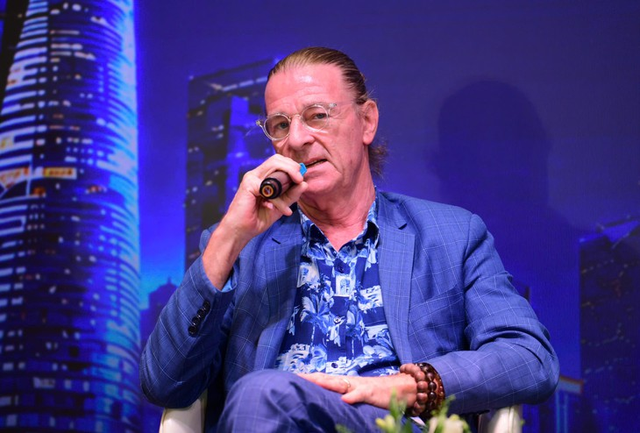
Dominic Scriven, founder and chairman of Dragon Capital. Photo: Quang Dinh / Tuoi Tre
Competition for foreign capital intensifies
Dominic Scriven, founder and chairman of Dragon Capital, said attracting international investors to Vietnam was certainly no easy task under current conditions, while the country still faced numerous challenges in creating favorable conditions for foreign capital.
Vietnam is not alone in facing these difficulties. Competition among emerging markets for international investment is intensifying as global investors have more options for allocating their capital.
Challenges in attracting foreign investment are therefore not unique to Vietnam but are shared by many other emerging markets.
Nevertheless, Scriven said Vietnam's stock market had made stronger progress than some of its counterparts.


Max: 1500 characters
There are no comments yet. Be the first to comment.