


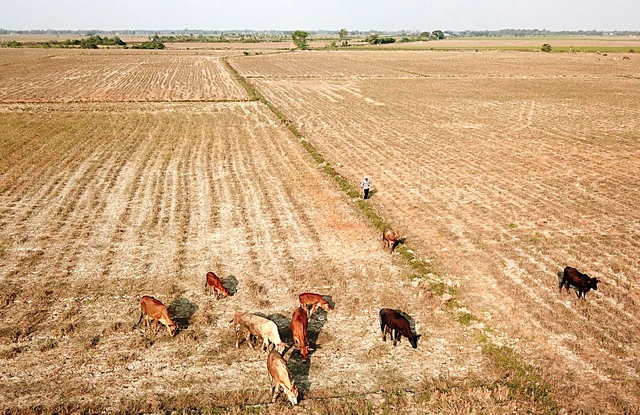
A rice field in Tran De District, Soc Trang Province, during the 2023-24 dry season, when many fields ran out of water for cultivation while others were affected by saltwater intrusion linked to El Nino. Photo: Chi Quoc / Tuoi Tre
The ministry made the request in a document issued on Tuesday on measures to prevent drought, water shortages and saltwater intrusion during the 2026-27 dry season.
El Nino likely to remain strong through early summer 2027
According to the National Center for Hydro-Meteorological Forecasting, the El Nino climate pattern has emerged.
El Nino is forecast to remain strong to very strong from September to November 2026, with a 100 percent probability, including a 93 percent chance of reaching very strong intensity.
From December 2026 to February 2027, the probability of El Nino remaining strong to very strong is 93 percent, with the phenomenon likely to continue into spring and possibly early summer 2027.
Historical data show that El Nino is highly likely to cause an early end to the rainy season and lower rainfall and water supplies, raising the risk of drought, water shortages and saltwater intrusion during the 2026-27 dry season, the ministry said.
The Mekong Delta, north-central, south-central and southeastern regions are most prone to the greatest risks.
El Nino can also bring extreme rainfall and flooding, the ministry warned.
To prepare for the dry season, provinces and cities have been tasked with updating drought, water shortage and saltwater intrusion response plans based on a very high-risk scenario.
Under the very high-risk scenario, saltwater intrusion in the Mekong Delta would be comparable to that recorded in 2019 and 2020, while drought and water shortages in other regions would be comparable to those recorded from 2014 to 2016.
Local authorities have been asked to assess in detail the potential impacts on agricultural production, rural water supplies, forest fires, aquaculture and livestock farming.
They should also align crop schedules and planting times with water availability to avoid periods of peak drought and saltwater intrusion when crops require the most water.
Authorities have been instructed to maximize water storage in irrigation and hydropower reservoirs during the 2026 rainy season while ensuring the safety of dams, reservoirs and downstream areas and preparing for extreme rainfall and flooding.
They should also proactively assess water supplies for households and residential areas in locations that frequently face domestic water shortages.
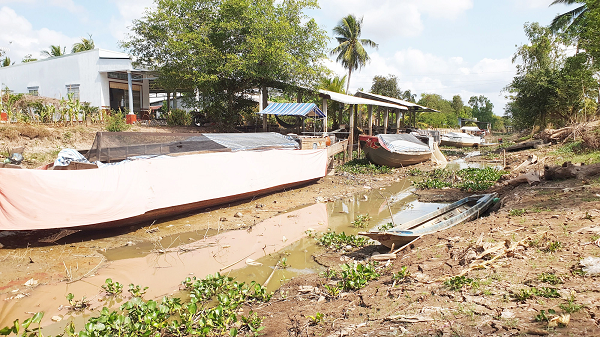
The Mekong Delta is forecast to face severe impacts from El Nino during the 2026-27 dry season. Photo: Thanh Huyen / Tuoi Tre
Nearly 250,000 hectares of crops and more than 100,000 households at risk in Mekong Delta
Nguyen Hong Khanh, deputy head of the Department of Irrigation Infrastructure Management and Construction, said the severity of drought, water shortages and saltwater intrusion in the Mekong Delta during the 2026-27 dry season will depend mainly on upstream flows into the Mekong River system, tidal conditions and saltwater levels at river mouths.
The department has identified two risk scenarios, with impacts expected to begin in late December and peak from January to April.
Under the very high-risk scenario, water flows into the Mekong Delta would be 15-20 percent below the historical average.
Saltwater intrusion could reach levels recorded during the 2015-2016 dry season, with water containing 4 grams of salt per liter reaching 50-70 kilometers inland along the Mekong River estuaries, or 7-13 kilometers farther than the historical average.
Along the Vam Co rivers, the saltwater boundary could extend 110-130 kilometers inland, 30-42 kilometers farther than the historical average.
The scenario could put about 85,800 hectares of winter-spring rice in Tay Ninh, Dong Thap, Vinh Long, Can Tho and Ca Mau at risk, along with around 120,000 hectares of rice-shrimp farming areas in An Giang and Ca Mau that rely mainly on rainwater.
About 45,000 hectares of fruit trees in coastal areas of Tay Ninh, Dong Thap, Vinh Long and Can Tho could also be affected.
An estimated 107,000 households in Vinh Long, An Giang, Ca Mau and Can Tho could face domestic water shortages.
Water flows into the Mekong Delta would be 5-10 percent below the historical average, while saltwater intrusion would remain at or below levels recorded during the 2015-2016 dry season.
The scenario could affect about 160,000 hectares of rice and fruit crops and 55,000 households.








Max: 1500 characters
There are no comments yet. Be the first to comment.