


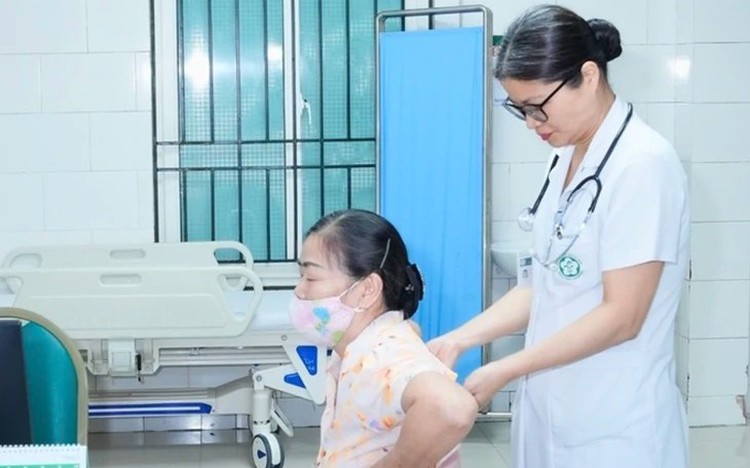
Assoc. Prof. Dr. Pham Cam Phuong, director of the Bach Mai Institute of Nuclear Medicine and Oncology under Bach Mai Hospital in Hanoi, Vietnam, examines a patient at the hospital. Photo: Supplied
The information was recently announced on the official website of the foundation, an international non-profit organization.
The appointment is expected to create more opportunities for professional connections and give Vietnamese cancer patients greater access to advanced cancer treatment therapies, according to Bach Mai Hospital.
The appointment comes after nearly two decades of work by Dr. Phuong in cancer treatment and research.
She graduated from Hanoi Medical University in 2001 and completed her residency in oncology in Vietnam and France.
She received her PhD in 2013 and was appointed an associate professor in 2018.
At Bach Mai Hospital, Phuong and her colleagues have pioneered the use of modern diagnostic and treatment technologies for complex cancers, including PET/CT imaging, targeted therapy, immunotherapy and genetic testing, according to the hospital.
Beyond her clinical work at the hospital, she has also participated in early cancer screening programs for women in disadvantaged areas.
She was previously honored with the Dang Thuy Tram Award by the Ho Chi Minh Communist Youth Union's Hanoi chapter.
Phuong's role as Vietnam's representative in the Oncidium Foundation's ambassador network is expected to promote academic exchange, research cooperation and specialized training, while giving Vietnamese cancer patients more opportunities to benefit from advances in modern nuclear medicine, according to Bach Mai Hospital.
The foundation promotes and expands access to targeted radionuclide therapy and precision nuclear medicine, using radiopharmaceuticals for both diagnosis and treatment through radiotheranostics.
It currently has more than 140 professional ambassadors in 63 countries and connects more than 800 treatment centers worldwide that provide targeted radionuclide therapy, including radiotheranostics and radioligand therapy (RLT).
The approach works on the principle of 'see what you treat and treat what you see,' using radioactive tracers attached to target molecules to precisely locate tumors on PET/CT images while delivering radiopharmaceuticals to destroy cancer cells and optimize the protection of healthy tissue.
Through projects such as RLT-Connect, the foundation also aims to provide resources and donated radiopharmaceuticals to patients in developing countries who do not have sufficient insurance coverage for advanced treatment.



Max: 1500 characters
There are no comments yet. Be the first to comment.