


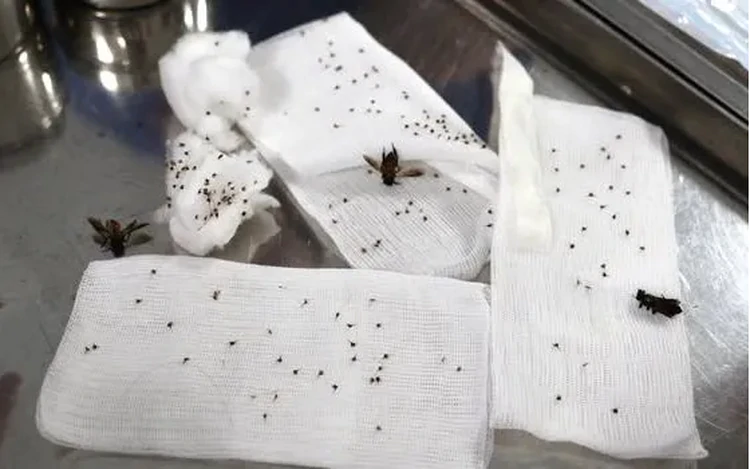
Doctors remove hundreds of bee stingers from the 60-year-old woman's body. Photo: Yen Lap Regional Medical Center
Yen Lap Regional Medical Center in Phu Tho Province recently admitted the woman, a resident of Trung Son Commune, after she was attacked by wild giant honeybees, local media reported.
She had been stung more than 300 times, with numerous stingers remaining in her head, arms, legs and back.
Doctors assessed her as being at high risk of anaphylaxis and bee venom poisoning, requiring emergency treatment and close monitoring.
The emergency, intensive care and toxicology team assessed her airway, breathing, circulation, consciousness and vital signs, while removing the remaining stingers from her skin and providing necessary treatment.
After receiving initial emergency care, the patient was transferred to Phu Tho General Hospital for further monitoring and specialized treatment.
According to Yen Lap Regional Medical Center, her condition has since stabilized.
Doctors said bee venom contains various biologically active substances that can cause local tissue damage and affect multiple organs. The severity of an attack depends on the number of stings, the bee species, the locations of the stings and the individual's physical response.
One of the most serious complications is anaphylaxis, which can develop rapidly and cause breathing difficulties, airway swelling, low blood pressure and circulatory problems, potentially becoming life-threatening.

The woman was attacked by wild giant honeybees. Photo: Yen Lap Regional Medical Center
Multiple bee stings can also lead to acute kidney injury and damage to the liver and muscles. Kidney damage may be associated with rhabdomyolysis or hemolysis caused by the toxic effects of bee venom.
Some systemic complications may not become apparent until hours or even days after an attack.
Therefore, people who have sustained multiple bee stings should seek medical attention and monitoring, even if they initially show no serious symptoms.
Doctors advised people to avoid contact with beehives and never attempt to disturb or drive away a swarm without proper protective equipment. If attacked, they should quickly leave the area to avoid further stings.
If stingers remain embedded in the skin, it can be gently scraped away using a flat-edged object. People should avoid squeezing or pinching the affected area.
The sting site should then be washed, and a cold compress can be applied to relieve pain and swelling.
Anyone who has sustained multiple stings should seek medical attention immediately rather than waiting for symptoms to develop.
If symptoms such as difficulty breathing, dizziness, excessive sweating, vomiting, abdominal pain, widespread rashes or confusion occur, emergency services should be contacted by calling 115.
The case of the woman who was stung more than 300 times by wild giant honeybees highlights the risks of bee venom poisoning and its potentially serious complications.
Proper first aid, timely emergency treatment and medical monitoring are crucial to reducing the risk of life-threatening consequences.


Max: 1500 characters
There are no comments yet. Be the first to comment.