


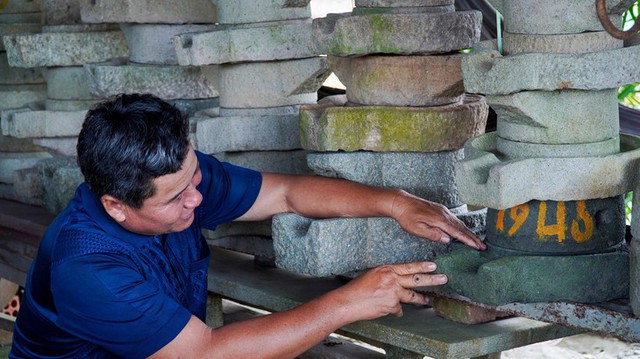
Le Van Dung takes pride in sharing stories of the past with younger generations who stop by his stone mill collection on their way home from the fields. Photo: Thanh Huyen / Tuoi Tre
Beneath a thatched shelter outside his home in Ca Mau Province, Le Van Dung, 54, has carefully arranged hundreds of old stone mills, once essential household tools for grinding rice and making flour.
Though worn by time, each mill holds memories of a bygone era when preparing even a simple meal demanded considerable effort.
Dung's passion for collecting began with two nearly century-old stone mills inherited from his maternal grandfather.
“I remember the days when it could take two days to prepare traditional cakes or a bowl of thick noodle soup. Grinding flour was the hardest part,” he recalled.
“Those memories made me realize how much our grandparents had to struggle just to put food on the table.”
Determined to preserve these reminders of the past, Dung began searching for old mills, hoping they would also teach younger generations to appreciate modern conveniences and the value of hard work.
A decade spent collecting stone mills
Over the past 10 years, Dung has traveled across Ca Mau and other provinces to track down abandoned stone mills once used to grind rice and flour.
Each mill costs between VND300,000 ($11) and more than VND2 million ($76), but the time and effort spent finding them often far exceed their purchase prices.
Many were discovered lying forgotten in gardens, along riverbanks, or even inside chicken coops.
However, many owners were reluctant to part with their mills, as the tools had been passed down through generations.
In one case, Dung spent more than a month making repeated visits to persuade a family to sell him a mill. They finally agreed after he promised to preserve it and put it on display for others to appreciate.
His collection has since grown to hundreds of mills, alongside traditional farming tools such as balance scales, pesticide sprayers, rice-transplanting implements, and harvesting equipment.
All are displayed around a small roadside shelter outside his home, welcoming visitors who wish to learn about traditional rural life or revisit their own memories.
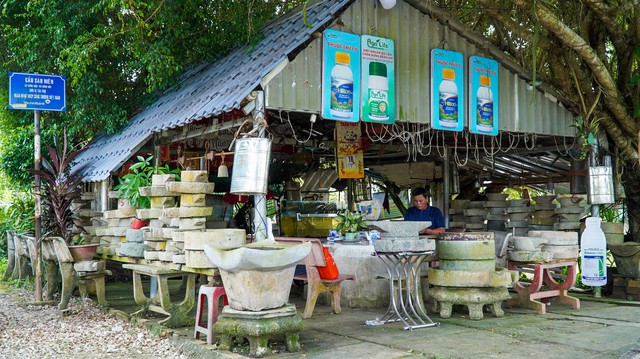
Le Van Dung's roadside shelter houses hundreds of old stone mills and remains open to visitors at all times. Photo: Thanh Huyen / Tuoi Tre
Preserving stories carved in stone
Among the hundreds of mills in Dung's collection are pieces dating back several decades or even centuries, including one that he says is more than 200 years old.
For Dung, these weathered mills are more than old household tools. They bring back memories of his childhood, when he lived with his grandparents and parents.
As a boy, he loved eating traditional cakes but dreaded the exhausting task of grinding flour by hand. Those experiences later inspired his passion for collecting stone mills as reminders of the hardships endured by earlier generations.
Behind their worn surfaces, each mill carries stories of the people who once used it, which Dung eagerly recounts to visitors in vivid detail.
Duong Quoc Hung, 73, a resident of the same hamlet, sees Dung's collection as a 'living archive' of rural life.
He often stops by to admire the old tools, which remind him of the hard work once required to make everyday foods and help him appreciate life today.
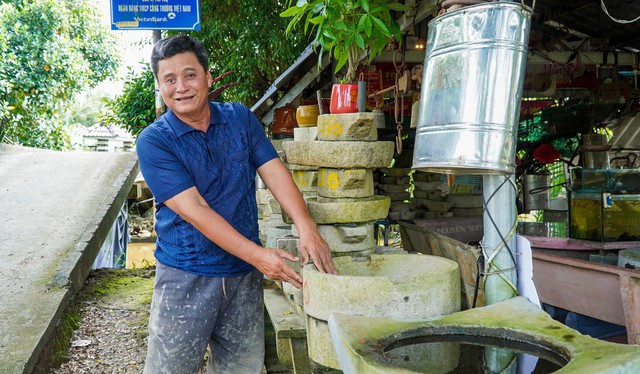
Le Van Dung poses beside a traditional rice mill passed down by his maternal grandfather. Photo: Thanh Huyen / Tuoi Tre
Dung plans to continue expanding his collection and hopes to one day build a fence outside his home using the stone mills he has gathered over nearly a decade.
"One day, young people may no longer know what these mills were used for," Dung said.
"But I hope that when my children and grandchildren see them, they will understand how earlier generations lived and worked."
Traditional stone mills in Vietnamese rural life
Before electric grinders became widely available, stone mills were essential household tools in rural Vietnam, particularly for grinding rice into flour used to make traditional cakes, noodles, and other dishes.
A typical stone mill consists of two heavy circular stones stacked on top of each other. The upper stone is rotated manually using a wooden handle, while the lower stone remains stationary.
The pressure and friction between them gradually grind rice or other grains into flour.
Grinding flour by hand was a labor-intensive process that required considerable time and effort.
As modern machinery became more common, traditional stone mills gradually fell out of everyday use, but they remain reminders of Vietnam's agricultural heritage and the daily lives of earlier generations.









Max: 1500 characters
There are no comments yet. Be the first to comment.