


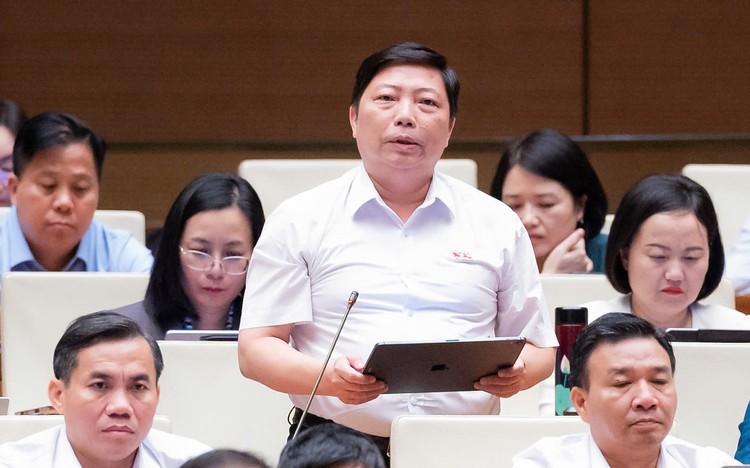
Nguyen Vu Trung, a deputy of Vietnam's law-making National Assembly, speaks at a plenary session on the draft revised Law on Adoption in Hanoi, November 2, 2026. Photo: Vietnam's National Assembly.
Speaking at a plenary session on the draft revised law in Hanoi on Monday afternoon, Nguyen Vu Trung, a deputy representing Ho Chi Minh City, said adoption should provide children with a home and must not become a gateway to human trafficking, the transfer or abuse of children.
Given that adoption directly concerns children's bodies, personal identity and future, the law should establish mechanisms to identify potential risks before children are handed over, taken from their places of residence or placed in the hands of people with unlawful intentions, he said.
Trung stressed that this did not mean every adoption case should be considered at risk of exploitation, but the law must anticipate the worst-case scenarios because the consequences for children could be irreversible.
He proposed requiring a detailed assessment record for each adoption case, covering the child's circumstances, needs and views, verified information about the child's relatives, support provided to the birth family and alternative care arrangements considered before adoption.
For intercountry adoptions, the dossier should also document the results of efforts to find a suitable family in Vietnam and a reasonable period for the search, in line with the principle of prioritizing domestic placements under the Hague Convention.
He also proposed that the prohibited practices under the revised law should include the exploitation of adoption procedures to recruit, transfer, receive, transport or take away children for human trafficking, exploitation or the harvesting of their tissues or body parts.
Adoption must not be made conditional on a requirement that children donate their tissues or body parts, have them removed or transplanted, or undergo unlawful medical interventions, he said.
Trung further called for people previously convicted of human trafficking or trafficking in or appropriating human tissues or body parts to be barred from adopting children.
Screening should cover both spouses in a couple as well as anyone who plays an actual role in caring for the child, he said.
He also proposed verifying a child's origin, identity, relatives and whether the adoption is voluntary in all cases involving signs of irregularities, rather than limiting such checks to cases involving abandoned children.
If an adoption decision must be annulled or revoked after violations are discovered, authorities should ensure that the child is moved to a safe place, placed in someone's care, given psychological support and provided access to an independent review mechanism.
Children should not bear the consequences of adults' misconduct or errors made by authorities handling adoption applications, Trung said.
Lawmakers call for stronger safeguards for adopted children
Also speaking at the session, deputy Cil Bri, representing Lam Dong Province, called for adoption counseling, explanations and consultations to be conducted in a language and manner that those whose views are being sought can understand.
Bri also urged authorities to match children with adoptive families based on their individual needs, particularly by considering families' ability to provide support in terms of language and culture while maintaining appropriate contact with the children's relatives.
Adoption records should be kept complete and truthful so that children can trace their origins when they grow up, Bri said.
Meanwhile, deputy Nguyen Danh Tu, representing An Giang Province, called for a review of eligibility requirements for prospective adoptive parents and proposed additional provisions for people serving educational measures at the commune or ward level, particularly those who have insulted the honor or dignity of, caused injury to, or mistreated family members.
He also proposed clarifying the legal consequences when a stepfather or stepmother adopts their spouse's child, to prevent the biological parents' visitation rights from being completely terminated when doing so would not be in the child's best interests.



Max: 1500 characters
There are no comments yet. Be the first to comment.