


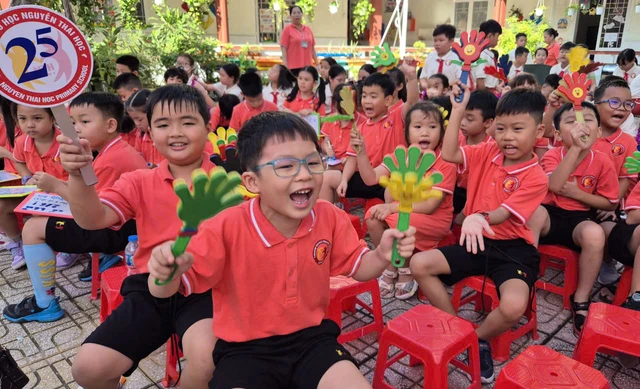
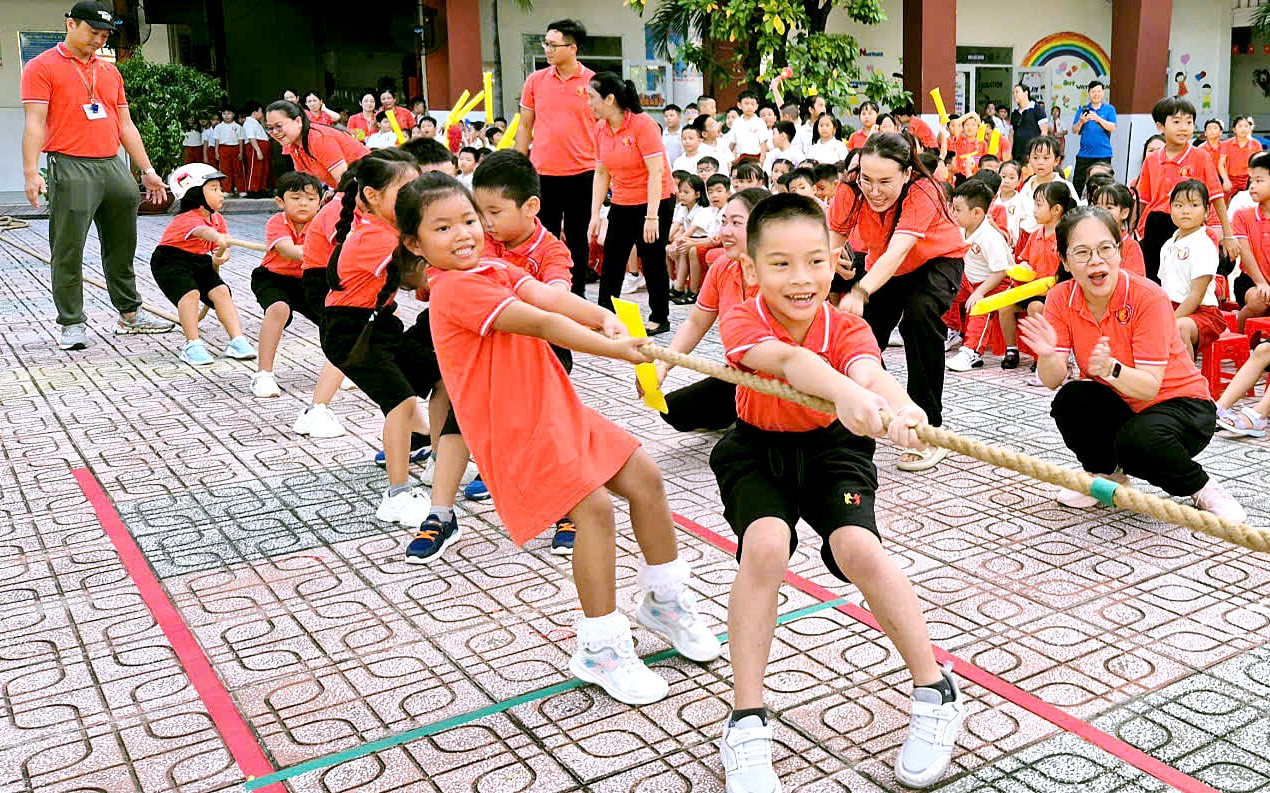
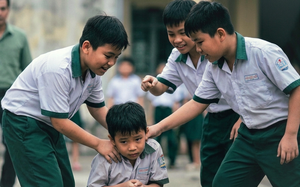
Children cheer on their schoolmates during a tug-of-war game at a physical activity day at a primary school in Ho Chi Minh City. Photo: H.H.
The warning against homeschooling came after some children were homeschooled from Grade 1 through primary school before seeking school admission to Grade 6.
While parents say homeschooling gives their children greater flexibility and helps them avoid academic pressure, experts warn that a lack of peer interaction could affect their social development.
Reasons of homeschooling
L.H. Thuy, who lives in the Phu My Hung area of Ho Chi Minh City, said she began homeschooling her child during the COVID-19 pandemic in 2021.
Had her child followed the public school system, the child would enter Grade 6 this academic year.
Thuy plans to send her child to study in the U.S. later on.
During the homeschooling process, she buys learning materials online, draws on the experience of other parents and hires teachers to assess her child's abilities after each period of study.
The total cost of education is about VND15 million ($573) per month, roughly equivalent to tuition at a private school.
"Basically, I don't want to be tied down by a fixed system. I want my child to become independent in learning and develop creativity," Thuy said, adding homeschooling offers considerable flexibility.
Her child starts studying from 8:00 am to 10:00 am and resumes at 2:00 pm. The child studies for only about four hours a day, mainly using online materials through a registered account.
"My child studies online through question-and-answer and multiple-choice exercises designed for each grade level,” Thuy said.
“Once students register for the corresponding account, they are provided with resources based on a comprehensive, U.S.-standard curriculum covering four main subjects: math, language arts, science and social studies,” she added.
“The system also provides materials linked to well-known math textbooks for parents to refer to at different levels.”
Thuy said her child has mastered hundreds of math skills, organized clearly by topic.
English is also taught using an approach similar to that used for American students.
"Overall, I am confident that after homeschooling, my child's knowledge is equivalent to that of a student who has just completed primary school," Thuy said.
Thuy's case is not unique.
Some parents choose homeschooling because they want their children to avoid academic pressure, grades and achievement-oriented competition, while others are concerned about school violence.
"Thinking about grades, exam results and other issues, I chose homeschooling for my child.” said D.V.K., who lives in the Sala area of An Khanh Ward, Ho Chi Minh City.
“My child has been doing very well over the past two years,” he added. “Although the long-term goal is not yet clear, at least I feel reassured."
On social media, homeschooling groups have attracted millions of members.
There are numerous online classes taught by foreign teachers with Vietnamese teachers serving as teaching assistants, with tuition costing around VND38,000 ($1.45) per hour.
Online learning materials and accounts are available at various prices.
Expert concerned about children's lack of social interaction
Dr. Quang Thuc Hao, a neuropsychology expert at the University of New South Wales in Australia, said students who are homeschooled and later gain admission to good universities often come from families with substantial resources, have well-structured curricula and possess externally verified academic records.
From a brain development perspective, Hao said the key issue is not whether children study at home or at school, but whether they have the experiences necessary for normal development during primary school.
According to her, children aged 6 to 11 are at a stage when the "social brain" network develops rapidly.
During this period, they need to interact with peers in situations that are not arranged in advance.
This is an area where a one-on-one home learning model can hardly provide a full substitute, regardless of how good the teacher is, Hao said.
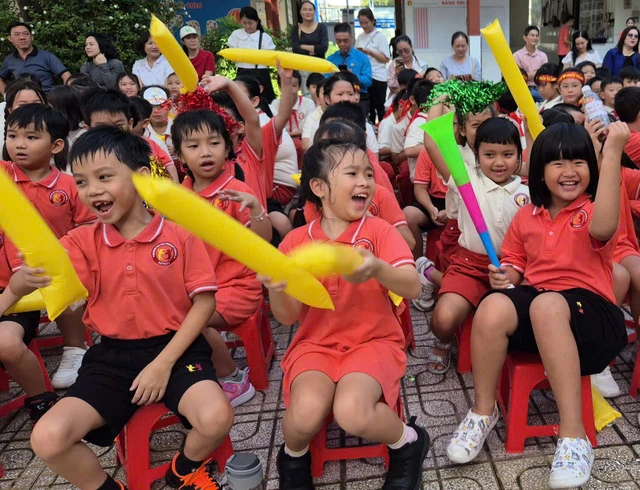
Children cheer on their schoolmates during a tug-of-war game at a physical activity day at a primary school in Ho Chi Minh City. Photo: H.H.
A private teacher can help a child acquire knowledge more effectively, but the relationship between an adult and a child is asymmetrical, with adults often accommodating and adjusting to the child.
By contrast, relationships with peers are more equal, requiring children to deal with friction, resolve conflicts, regulate their emotions and cope with disappointment.
Such experiences contribute to the development of the prefrontal cortex and self-regulation skills.
"A child who performs very well academically but has never had to lose to a peer or resolve a conflict they themselves caused is missing a form of developmental nourishment that grades cannot measure," Hao explained.
She said this deficiency may not become apparent immediately but could emerge during adolescence or when children enter an overseas study environment, when social pressure is high but the necessary skills have not been sufficiently developed.
Hao explained that the ability to learn independently does not develop naturally, and learning at home based primarily on a child's interests can almost completely eliminate opportunities to practice that ability.
The more important question, she said, is why parents want to withdraw their children from school.
It is not necessarily because they are enthusiastic about homeschooling, but because they see their children studying for too many hours, getting insufficient sleep and exercise, and spending more time memorizing than understanding.
"Those concerns are legitimate and consistent with neuroscience, because sleep, physical activity and free play are three factors that directly affect children's ability to learn,” Hao said.
“But the solution should not be to remove children from the social environment,” she stressed.
“The solution is to make schools more child-brain-friendly,” she added.
“In the meantime, parents can still take the initiative to protect their children's sleep, exercise and unstructured play time outside school hours.”
Not every country accepts homeschooling
According to an education expert in Ho Chi Minh City, approaches to homeschooling vary among countries and territories.
Germany imposes strict restrictions and even bans it in some circumstances, Taiwan regulates it, while the U.S. allows it relatively freely.
Homeschooling partly stems from public schools' failure to meet individual needs, such as pressure over grades and achievements, school violence or a lack of time for play and experiential activities.
However, not every family has the conditions, ability or financial resources to educate their children at home.
If not properly implemented, homeschooling could put children at a disadvantage and create an additional burden on society.
"Between parents' expectations and personal views and the government's need for oversight, social stability naturally needs to be prioritized. The most balanced solution is for the government to regulate outcomes while allowing greater flexibility in how children learn," the expert said.
Under this approach, children could study at home in a way chosen by their families but would have to undergo competency assessments at certain milestones.
If they fail to meet the requirements, they would need to return to the mainstream education system.
Some countries allow children to be homeschooled while remaining connected to a mainstream school, which maintains their school records and learning plans. Teachers assess the students, who also take common examinations.
"Control the outcomes rather than scrutinizing the learning journey too deeply, while maintaining certain mandatory requirements alongside some 'breathing room,'" the expert said.
In addition to academic knowledge, the expert said parents must consider their children's ability to integrate socially.
Learning at home may be comfortable, but a lack of communication and interaction can affect children's social skills.
"That is my biggest concern. I know quite a few homeschooling parents who spend a lot of money on extracurricular and social activities for their children to increase interaction," the expert said.
According to him, homeschooling, like public and private education, has both advantages and disadvantages. There is no single approach that is inherently "right" or "wrong."
Parents should not idealize one form of education, but should proactively compensate for the limitations of whichever option they choose.








Max: 1500 characters
There are no comments yet. Be the first to comment.