


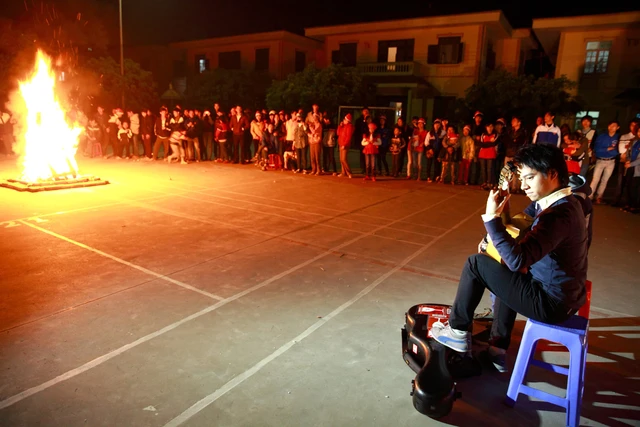
Dr. Tran Tuan An plays the guitar during a volunteer visit to Huu Nghi Village in Hanoi in 2013.
For him, the decision was not solely professional. Rather, it reflected a personal commitment to serve his homeland while sharing Vietnamese culture with audiences around the world.
Born in Hanoi in 1992, Dr. An now teaches guitar at three universities in Chicago.
Across more than two decades living far from home, he has returned to Vietnam regularly to perform, volunteer, and teach free guitar classes, helping connect a growing network of young guitarists across the Southeast Asian country.
During many of those visits, he dedicates most of his time to community music projects.
One memory remains especially vivid: performing for visually impaired students at Nguyen Dinh Chieu Middle School in Hanoi.
The atmosphere was nothing like a traditional chamber concert, where audiences would usually listen in silence. Instead, the performance was full of movement and sound.
“Everyone was standing, moving with the music, singing along with the guitar in the most innocent way,” he said. “It made me feel like music had reached the freedom and liveliness it was always meant to have.”
Building community around music
In 2024, he launched An Tran’s International Guitar Workshop, bringing together young classical guitar players from across Vietnam.
He personally teaches the program, which is designed as more than technical training.
Students live and learn together, practicing from early morning until late at night. Music becomes part of daily life rather than simply a subject to study.
The philosophy behind it comes from his own early experience in the United States.
When he first arrived, he received free lessons and mentorship from Professor Anne Waller, which later allowed him to attend a summer music camp in Chicago for high school students.
There, he encountered a model of music education built around community. Young musicians were given space to grow through music, not just perform it.
Since then, he has worked to bring that spirit back to Vietnam.
The impact is already visible in students like Tran Phan Thuan Nguyen, 22, from Ho Chi Minh City, who joined the workshop for two years.
Nguyen said he gained technical skills, but also something harder to measure: openness, humility, and a sense of responsibility to share knowledge.
He has since begun organizing music workshops of his own, continuing that cycle of support.
“Because I received so much help from An, I want to help other young musicians with what I’ve learned,” he said.
The influence extends beyond Vietnam.
Sixteen-year-old Thai guitar prodigy Nuttachai Chaivanich said the experience at An’s workshop was not only about technique, but also about learning how to truly listen to his own sound.
More importantly, he said he saw in An a model of humility in work, generosity in life, and responsibility toward society.
Music as cultural language
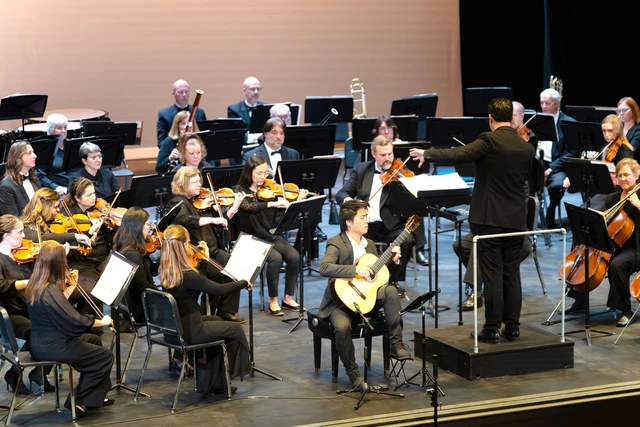
Dr. Tran Tuan An, playing the guitar, performs with a symphony orchestra in the United States.
That same philosophy shapes how An approaches performances on international stages.
After concerts abroad, he often hears audiences say, sometimes clearly moved, that they did not know classical guitar could produce such sounds.
Many people still see Vietnam mainly through history. For An, music offers another way to introduce the country, its people, and its culture to the world, in a way that is both subtle and direct.
That understanding confirmed the direction he wanted to follow: bringing Vietnamese music to global audiences through the guitar.
Vietnamese songs such as Nguoi oi nguoi o dung ve, Beo dat may troi, Nui rung Tay Nguyen, arranged for guitar, have strongly shaped his artistic path.
He believes the guitar can produce a wide range of tonal colours, depending on intention and technique. That flexibility allows it to carry the emotional character of a nation.
For Nui Rung Tay Nguyen, he spent long periods studying the T’rung, a traditional bamboo xylophone used by ethnic minority communities in Vietnam’s Central Highlands.
He worked to recreate its sound using the guitar.
In performance, he also evokes the rhythms of Central Highlands dance, along with the sounds of rivers, wind and birds, allowing audiences to imagine the landscape of Vietnam.
“Musicians have to play what they love,” he said. For him, that love is tied to his homeland, its land, people, and music.
He left Vietnam at 15, but those early years shaped him deeply.
The guitar became a way to express that connection outward.
He reckons that when an artist truly understands, believes, and falls in love with what they play, audiences can feel it, no matter where they come from.
Carrying Vietnam onto global stages
The sounds of home have accompanied him through international competitions and performances, helping him win major awards.
But he says the greatest reward is hearing Vietnamese music recognized in concert halls around the world.
Now serving regularly as a judge at guitar competitions in Vietnam and internationally, he has noticed a shift.
Judges increasingly value individuality, especially artists who are willing to express cultural identity and follow their own path. That is something he constantly reminds his students.
His academic work also reflects the same focus. In his PhD research, he studied how Vietnamese artists use the guitar to express cultural identity.
He believes this not only his story, but one shared by Vietnamese artists across the world, each using art to communicate with global audiences through their own culture.
On international stages, he feels a strong sense of responsibility.
“I’m no longer just an individual,” he said. “My responsibility is to become better every day so I can contribute to my country.”
He often compares artists to ‘bricks’ in a larger wall. The wall of a nation’s artistic identity. Each brick may be small, but none can be missing.
Every artist, whether at home or abroad, contributes something essential to Vietnam's music future.
Early path in music
An began formal guitar study at age 10 at the Vietnam National Academy of Music in Hanoi. By 12, he had already won first prize at the Young Guitarist Vietnam competition.
At 16, after receiving a scholarship to study in the United States, he went on to win major awards including the New Orleans International Guitar Competition, the Hamilton International Guitar Competition, and a competition hosted by the Society of American Music.
He was also named Outstanding Student at Lincoln Academy.
In 2016, he earned his master's in music from Yale University. In 2023, he completed his doctor of musical arts at Northwestern University.
Today, alongside teaching at universities in Chicago, he is also the creative director for several guitar concert programs at Northern Illinois University.









Max: 1500 characters
There are no comments yet. Be the first to comment.