


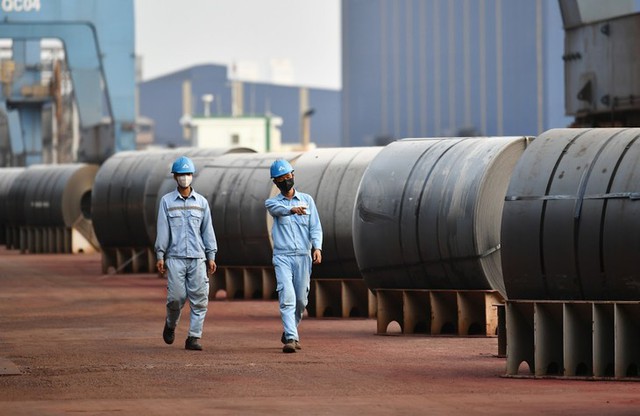
Europe is Vietnam's second-largest steel importer after ASEAN. Photo: HPG
According to the Department of Vietnam Customs, the country shipped 1.16 million metric tons of steel and iron products in July and 1.2 million metric tons in August, the highest monthly totals since August 2024.
In the first eight months of 2026, exports reached 7.9 million metric tons worth US$5.43 billion, up 10.9 percent in volume and 16 percent in value compared to the same period last year.
The Vietnam Steel Association said the EU remains Vietnam’s second-largest steel market after ASEAN, accounting for 17.5 percent of exports in the first seven months of this year.
Shipments to Italy, Belgium, Spain, Poland, and Germany exceeded 189,000 metric tons in July and 192,000 metric tons in August, higher than the monthly average of 170,000 metric tons earlier in the year.
However, not all steel products saw growth.
The Vietnam Steel Association said that coated steel and cold-rolled steel recorded declines in production and sales between January and July.
The surge in exports came shortly after the EU changed its system for managing steel imports.
On July 1, 2026, the EU introduced annual quotas of 18.35 million metric tons across 26 steel product groups.
Imports exceeding quotas face a 50-percent tariff.
The measure replaced a safeguard system that the EU had imposed since 2019 and which expired on June 30, 2026. The previous out-of-quota tariff was 25 percent.
Under a quota allocation announced by the European Commission on June 29, Vietnam received quotas for six product groups totaling more than 1.1 million metric tons per year, including nearly 470,000 metric tons for galvanized steel sheets and 415,000 metric tons for hot-rolled coil.
Quotas are divided evenly across four quarters, with unused allocations in one quarter transferable to the next during the first year through June 30, 2027.
Importers must also provide documents such as mill certificates to prove where the steel was first melted and cast.
By June 30, 2028, the European Commission will assess whether the country where steel was melted should be used as the basis for quota eligibility.
Although the same quota system applies across products, its impact varies.
Brokerage firm KIS Vietnam said hot-rolled coil exports would be largely unaffected.
Vietnam exported 350,000 metric tons of hot-rolled coil to the EU in 2025, while first-quarter 2026 exports, if annualized, would amount to 420,000-450,000 metric tons, close to the 415,000-metric-ton quota.
By contrast, KIS expected exporters of coated steel, steel pipes, and stainless steel to face greater difficulties.
The brokerage assumed that Nam Kim Steel JSC's coated steel sales to the EU will fall 50 percent in the second half of 2026 compared with its average sales in the previous two quarters.
According to KIS, Nam Kim Steel has already reduced sales to Europe since late 2025, shifting focus to ASEAN markets.
Ton Dong A Corporation is exploring new destinations such as Ukraine and Brazil, where protective measures are not applied.
In the U.S., hot-rolled coil and billets remain exempt from anti-dumping and countervailing duties, keeping prospects positive.
In addition to quotas, steel entering the EU is subject to the Carbon Border Adjustment Mechanism, which took effect on January 1 this year.
Importers must purchase certificates reflecting emissions embedded in steel products.
Without third-party-certified emission reports, exporters face default emissions values equivalent to those of the least efficient producers, said NH Securities Vietnam.
According to the brokerage's analysis, each kilowatt-hour of electricity generated in Vietnam produces 0.85-0.95 kilograms of carbon dioxide emissions, compared with about 0.3 kilograms in Europe.
NH Securities Vietnam called the combination of tighter quotas and the Carbon Border Adjustment Mechanism a ‘double burden’ on exporters.
Despite challenges, KIS forecast Vietnam's total steel exports in the second half of 2026 to rise 1-2 percent, supported by diversification into new markets and steady demand in the U.S. and ASEAN.








Max: 1500 characters
There are no comments yet. Be the first to comment.