


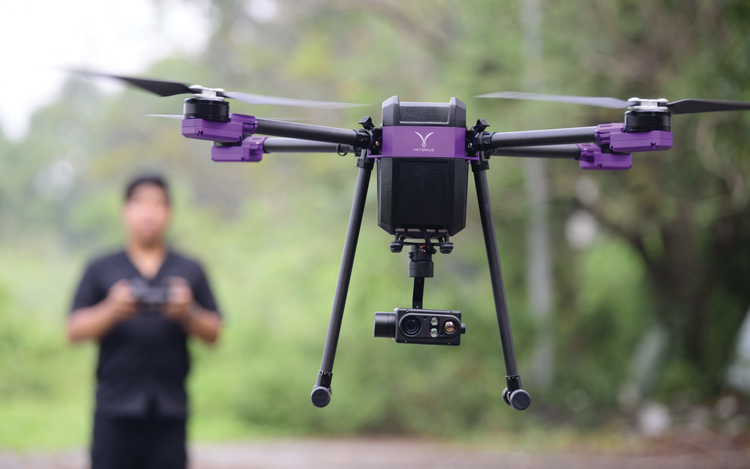
Drone Vatomus produced by Saolatek features a foldable frame. Photo: Quang Dinh / Tuoi Tre
For the first time, drones developed in-house by Vietnam's leading postal firm Viettel Post were deployed in an emergency rescue operation.
What began as an experimental application quickly became the only bridge between relief centers and stranded residents.
The UAVs took on two critical roles: delivering essential supplies and guiding rescue boats through submerged terrain.
In chaotic conditions where landmarks had disappeared and currents shifted unpredictably, the drones identified safe locations with remarkable precision, allowing on-site forces to reach victims point by point.
With a payload capacity of up to 50 kilograms, a flight range of five kilometers, an operational altitude of 100 meters, and a margin of error of just 10 centimeters, the drones flew continuously day and night despite heavy rain and strong winds.
In just two days, October 8 and 9 last year, Viettel Post completed more than 200 delivery flights and 30 navigation missions.
The flood response was only one glimpse of Vietnam’s rapidly expanding UAV capabilities.
Viettel moved beyond civilian drones into reconnaissance, long-range multi-purpose UAVs and loitering munitions.
For instance, loitering munition VU-C2 is equipped with a warhead, sensor cameras, and integrated artificial intelligence, capable of autonomous target detection and lock-on, reaching attack speeds exceeding 130 kph under command authorization.
Lieutenant General Tao Duc Thang, chairman of Viettel, described UAV development as a strategic move toward building a comprehensive low-altitude economy ecosystem.
The firm is moving toward expanding UAV development for logistics, rescue and defense services.
Meanwhile, the Hera drone developed by RealTime Robotics Vietnam (RtR), led by Dr. Luong Viet Quoc, has drawn international attention for its foldable structure, 15-kilogram payload, 56-minute flight endurance without load, and operational radius of 11 kilometers, figures that outperform many competitors of similar size.
The product has secured patents in the United States and Australia and passed stringent evaluations for use by Los Alamos National Laboratory and police forces in the United States and the Netherlands.
Furthermore, several Vietnamese drone makers are exporting their products.
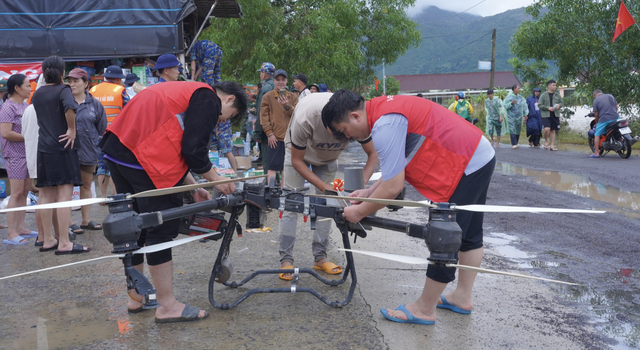
Viettel drones were used for rescue and relief operations in flood-affected areas in 2025. Photo: Duc Tho / Tuoi Tre
Path from bus assistant to aerospace founder
At Xponential, an annual gathering where the uncrewed industry’s greatest minds converge, held in Houston in 2025, experts showed their interest in drone Vatomus, created by Saolatek Company, founded by Tran Anh Tuan.
Brought to the exhibition from Vietnam, Vatomus’ frame and wings can be folded vertically in under five seconds.
Tuan’s path to aerospace innovation was anything but conventional.
As a child, he worked alongside his father as a bus assistant on long interprovincial routes, absorbing the rhythms of engines, abrupt braking, and roadside repairs.
A near-fatal traffic accident became a turning point.
He later moved to Ho Chi Minh City to study mechanical engineering at the Ho Chi Minh City University of Technology.
An early attempt to launch a used-car forum failed.
Years of trial and error followed before Saolatek was quietly set up in 2022.
Tuan chose drones for a simple reason: they solve multiple problems at once.
At the time, Vietnam’s drone market was fragmented and heavily dependent on imports.
Inside Saolatek’s headquarters at the Saigon Hi-Tech Park business incubator, each floor houses specialized teams in R&D, mechanical engineering, AI, and design.
While off-the-shelf propellers were widely available, Tuan wanted more than functionality.
His team engineered a folding mechanism that reduces deployment time from the typical 20 seconds to just five.
Fully extended, the drone measures 85 centimeters by 59 centimeters; folded, it shrinks to 32 by 28 centimeters.
The airframe weighs only 4.2 kilograms (6.9 kilograms with battery), reflecting careful optimization between payload, endurance, and energy efficiency.
Tuan shared that his goal was not technical spectacle but practical utility: rapid deployment, lower risk, lower cost, and high performance.
Saolatek has localized roughly 50-60 percent of its input materials and fully owns its intellectual design.
Compared to industrial drones of similar performance, Vatomus is priced 20-30 percent lower.
Call for further strength
At the outset of his drone-making journey, Tuan and several close associates identified a troubling bottleneck: many Vietnamese drone projects had failed not because of weak technology, but due to limited testing spaces, market barriers, and the lack of coordination among businesses and research institutions.
“You can’t expect great players if the village doesn’t even have a football field,” Tuan said.
Together with peers, he began advocating for what he called the infrastructure of innovation – appearing at technology forums, meeting policymakers, and promoting the concept of a ‘low-altitude economy,’ still new in Vietnam.
These efforts led to the formation of the Vietnam Aerospace and Unmanned Aerial Vehicle Systems Network and later the Low Altitude Economy Alliance, which helped connect enterprises, research institutes, startups, and regulatory bodies.
Truong Gia Binh, chairman of FPT, expressed his appreciation for the dedication and efforts of Tuan and his fellow co-founders of the Low Altitude Economy Alliance.
He believed Vietnam has a significant opportunity to manufacture UAVs for global export.
However, he noted that the biggest obstacle at present lies in institutional and regulatory barriers.
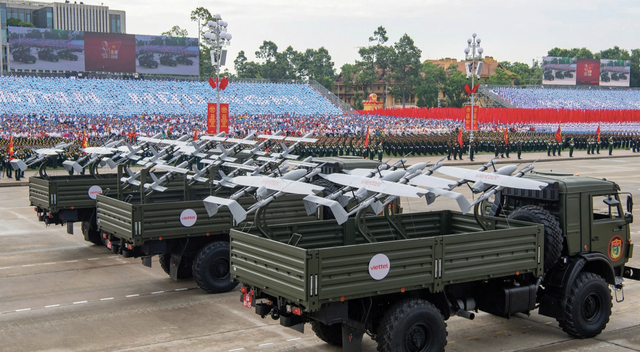
A fleet of Viettel's unmanned aerial vehicles at the parade marking the 80th anniversary of Vietnam's August Revolution and National Day on September 2, 2025. Photo: Duc Tho / Tuoi Tre
Vietnam lacks comprehensive business regulations governing UAV operations and foreign investment partnerships in this sector.
Companies face uncertainty around certification standards, origin requirements, licensing, business conditions, and experimental sandbox mechanisms.
“Saolatek cannot grow if it stands in a desert,” Tuan said.
“Only when there is a forest – an ecosystem – can small trees rise.”
Saolatek’s drones may not yet be strong enough to transform the market.
However, Tuan’s journey points to something more important: building technology in Vietnam requires not only products, but also pioneers willing to blaze the trail.
Associate Professor Dr. Le Hoai Quoc, chairman of the Ho Chi Minh City Automation Association, praises Saolatek’s mastery of design and technology.
Rather than assembling imported parts, the company controls the full chain, from concept and blueprint to optimization and domestic supply integration.
About 60 percent of the materials are localized, and 100 percent of the intellectual design is Vietnamese.
He emphasized that innovations such as the folding-wing mechanism and rapid deployment are commendable achievements, but the core value lies in independently designing, manufacturing, optimizing the product, and building a domestic supply chain.
Dreaming of drone hub
Vietnam’s UAV industry is currently valued at around US$100 million annually.
The country aims to multiply that figure one hundredfold within a decade.
At a recent meeting between Ho Chi Minh City Party secretary Tran Luu Quang and the innovation community, Binh from FPT shared that the Low Altitude Economy Alliance is teaming up with the southern metropolis to build a $10 billion UAV industry over the next 10 years and creating some one million jobs.
“We dream of building a drone hub in Vietnam,” he said.
With competitive labor costs and strong software development capabilities, Vietnam possesses advantages that could translate into global competitiveness.
“Software is a field where we can win almost any arena,” Binh affirmed.
“I believe the low-altitude economy will be the same."
A drone is a type of UAV, but the term ‘drone’ typically refers to small, versatile aircraft – often multi-rotor – used for civilian purposes such as recreation, filming, and delivery.
‘UAV,’ by contrast, is a broader term that encompasses all types of unmanned aircraft.
In other words, all drones are UAVs, but not all UAVs are drones.








Max: 1500 characters
There are no comments yet. Be the first to comment.