


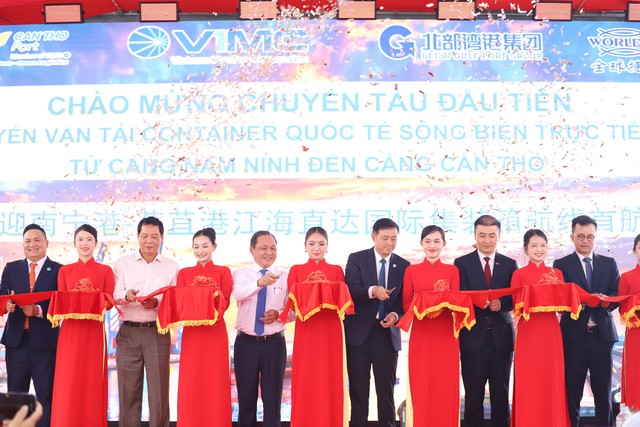
City leaders and delegates welcome the first container vessel from China’s Nanning Port at Can Tho Port in Can Tho City, southern Vietnam, September 24, 2026. Photo: Chi Quoc / Tuoi Tre
The vessel departed Nanning Port on September 16, traveling through the Pinglu Canal to the Gulf of Tonkin before continuing through the East Vietnam Sea and entering the Hau River to reach Can Tho Port, also known as Cai Cui Port.
Speaking at the welcome ceremony, Le Cong Ly, standing vice-chairman of the Can Tho administration, said the Pinglu Canal had opened a direct maritime outlet for Guangxi’s inland waterway network.
The Nanning-Can Tho container route brings that outlet closer to the Mekong Delta, potentially fostering regular trade between the two regions, Ly said.
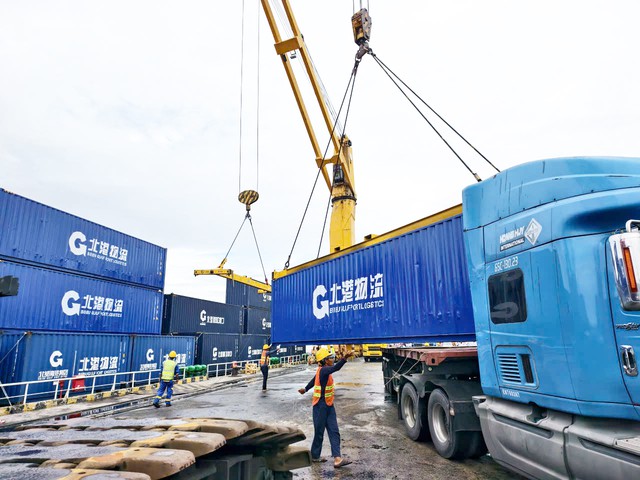
The first containers are unloaded from a vessel onto tractor-trailers for delivery to recipients in Can Tho and the wider Mekong Delta in southern Vietnam, September 24, 2026. Photo: Chi Quoc / Tuoi Tre
Ly added that the Mekong Delta has abundant exports such as rice, seafood, fruit, and processed goods, while Guangxi and southwestern China offer a vast market with diverse needs.
A stable shipping service could reduce costs and transit times, giving businesses more options for import and export.
He urged operators to secure two-way cargo flows to ensure sustainable operations.
A steady flow of cargo in both directions would help stabilize sailing schedules, create room to reduce costs and encourage businesses to use the route over the long term, he said.
The route should also provide convenient end-to-end services and be regularly evaluated and improved based on actual operations, the vice-chairman added.
“Can Tho pledges to expand port and logistics infrastructure, connecting Cai Cui Port with industrial parks and production hubs across the Mekong Delta,” he said.
The Nanning-Can Tho container route will initially operate twice a month, with a seven-day voyage.
The service is expected to use river-sea container vessels with a maximum capacity of about 500 twenty-foot equivalent units each.
Refrigerated containers are expected to account for some 25 percent of capacity, while the remaining will be dry containers.
Can Tho Port JSC and Beibu Gulf Port Group are jointly developing the route with logistics firms, shippers, and supply chain partners.








Max: 1500 characters
There are no comments yet. Be the first to comment.