


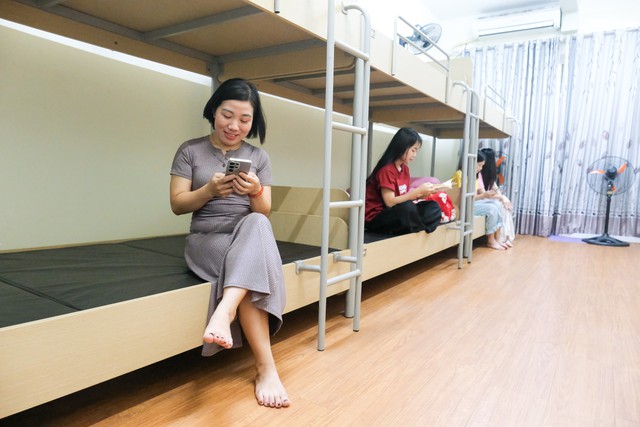
Nguyen Thi Thanh Tuyen calls her child after work from her company dormitory. Photo: Ha Quan / Tuoi Tre
After years of renting outside the company, Nguyen Thi Thanh Tuyen, 36, from Luc Ngan, Bac Ninh province, decided to move into Samsung Display Vietnam's employee dormitory.
FDI giants race to build worker housing
For Tuyen, the dormitory is more than a stable place to live. It also helps cut living costs, allowing her to send more money home to support her two young children.
"I used to rent a room near the company, but the living conditions and security were not as good as at the dormitory. Since moving here, my life has become more stable, and the facilities are well equipped," she said.
"The trade union also gives us gifts and support during holidays and Tet, which gives me peace of mind."
Similarly, Luc Thi Minh, 22, from Ha Quang, Cao Bang province, said that in addition to competitive pay and good benefits, the company provides workers with well-equipped dormitories featuring facilities such as washing machines, a supermarket, gym and hair salon.
"The trade union regularly gives gifts and organizes transportation for workers from remote hometowns like mine to return home during holidays and Tet," she said.
Still, both Tuyen and Minh hope to eventually be able to rent a home long-term or buy a social housing unit at an affordable price so they can feel more secure about staying in their jobs.
Speaking with workers, Hoang Anh Tuan, chairman of the Samsung Display Vietnam trade union, which represents more than 25,000 members, said providing housing is one of the company's key employee welfare policies.
The company has invested in a dormitory with capacity for about 4,500 people, allowing workers to avoid renting accommodation outside the company.
Workers whose hometowns are more than 60 kilometers from the company, as well as those who need accommodation, can stay at the dormitory with low electricity and water costs.
Beyond clean and well-equipped rooms, the facility also has a reading room and English and Korean language classrooms to support workers in their daily jobs.
"The dormitory is not just a place to live. It is also an environment where employees can share, connect and look out for one another, helping them feel secure at work and stay with the company," Tuan said.
Meanwhile, Bui Thi Ngoc Quyen, vice-chairwoman of the Goertek Vietnam trade union, which represents more than 11,000 members, said the union and company work closely to help provide housing for workers, contributing to stable living conditions and uninterrupted production.
In addition to dormitories for new workers, the trade union also serves as a bridge between employees and housing providers, helping workers find suitable accommodation with convenient access to work.
Goertek Vietnam's worker housing facility is expected to open in 2028, providing additional accommodation for employees.

The trade union gives gifts to workers at the company dormitory during major holidays and commemorative occasions. Photo: Ha Quan / Tuoi Tre
More worker housing on the way
Driven by demand from workers and union members, the Vietnam General Confederation of Labor is developing housing projects that workers can rent.
Three projects have already broken ground in Bac Ninh and Vinh Long, with a combined total of more than 1,700 apartments.
The projects are being accelerated and are expected to open in 2027, helping meet some of the housing needs of workers in industrial parks.
From 2026 to 2030, the confederation plans to invest in 10 to 15 additional projects across the country, with an estimated 9,000 apartments.
The rental housing projects are intended not only to support the government's social housing goals but also to give workers stable accommodation, allowing them to focus on their jobs and stay with companies for longer.
Alongside projects led by the trade union, Bac Ninh, one of northern Vietnam's major industrial hubs, is also stepping up housing development for the 2021-2030 period.
The province aims to complete at least 135,000 social housing units by 2030, in line with a target set by the prime minister, while also focusing on rental housing for low-income residents and industrial workers.
Total investment in housing development during the period is estimated at VND945 trillion (US$36.3 billion).
Bac Ninh has outlined several measures to achieve the goal, including improving policies, planning land reserves, securing funding, streamlining administrative procedures, and developing housing projects and the real estate market.
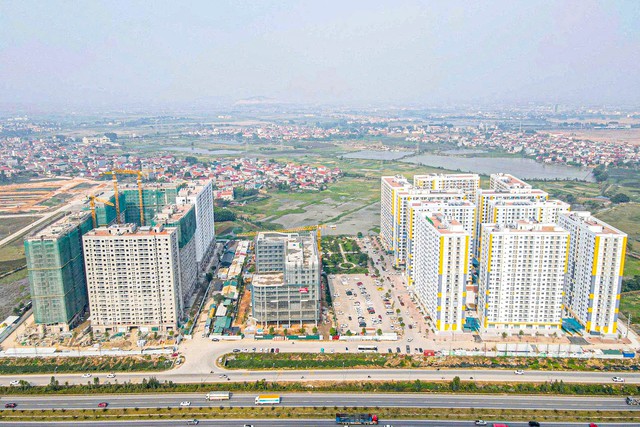
Bac Ninh steps up inspections and action against developers who allow residents to move into buildings before they are legally eligible for occupancy. Photo: Thu Huong
According to the Vietnam General Confederation of Labor, the trade union has broken ground on rental housing projects for workers in Dong Thap and Bac Ninh and added investment funding plans for projects in Ninh Binh, Da Nang, Quang Ngai and Tay Ninh.
In late September 2025, the confederation held a groundbreaking ceremony for a trade union social housing project in Viet Yen Ward, Bac Ninh, featuring a 10-story building with 477 self-contained rental apartments, elevators, parking and other facilities.
The project is expected to be completed in 2027.
In late August 2026, Standing Deputy Prime Minister Pham Gia Tuc commented on a program to build at least 1 million social housing units for low-income people and industrial workers between 2021 and 2030.
The government's latest policies, particularly those focused on rental housing, aim to meet the growing demand for affordable rentals.
As a result, the targets for social housing development need to be adjusted appropriately, with a stronger focus on rental housing while carefully reviewing the basis, rationale and potential reduction in the overall social housing target.


Max: 1500 characters
There are no comments yet. Be the first to comment.