


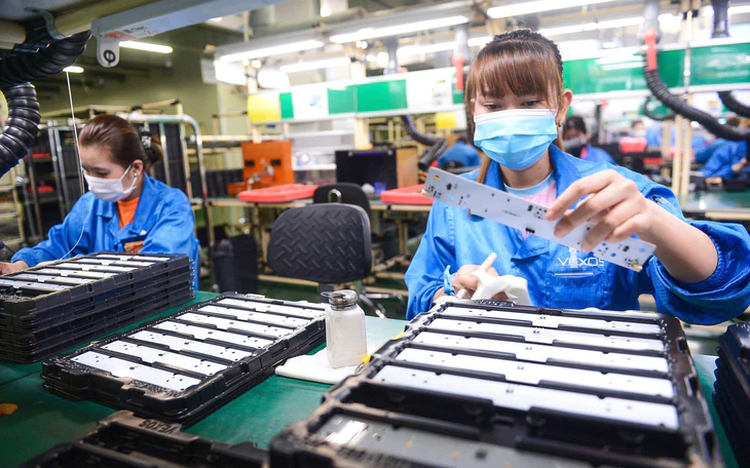
Workers at Vexos, a 100-percent foreign-invested company, in Tan Thuan Export Processing Zone in Ho Chi Minh City. Photo: Quang Dinh / Tuoi Tre
Of nearly 1,600 companies listed or registered for trading in Vietnam, only around 10 are FDI enterprises, according to the State Securities Commission of Vietnam.
As of the end of 2025, these companies had combined charter capital of around VND12.629 trillion (US$487.4 million), equivalent to just 0.15 percent of the total charter capital of the market — an extremely small share compared with the FDI sector's contributions to GDP, exports and employment.
Unexpected bottleneck
Since Vietnam's stock market was established, only 11 FDI companies have been listed or registered for trading, with 10 remaining.
Siam Brothers Vietnam was the most recent FDI company to join the stock market. It conducted its IPO in 2016, and its SBV shares were officially listed on the Ho Chi Minh Stock Exchange (HoSE) in May 2017.
For nearly a decade afterward, the market has welcomed no new FDI listings, although companies such as Seoul Metal Vietnam, Ngu Kim Fortress Vietnam and AEON have signaled interest in listing.

The paradox is that many FDI companies do not lack the necessary capabilities.
The State Securities Commission of Vietnam said that many FDI companies have strong financial capacity, operate efficiently and maintain transparent governance, meaning they could conduct IPOs and list their shares like domestic companies.
The first difficulty lies in the original investment project documents. When many FDI companies received their investment licenses, they made commitments to local authorities in exchange for incentives, such as developing infrastructure, maintaining project operations for a specified period or refraining from transferring capital before a certain deadline.
When a company seeks to list its shares — opening the way for founding shareholders to divest part of their holdings — these commitments can immediately become bottlenecks that must be reviewed and confirmed as fulfilled.
For public-private partnership (PPP) projects, those that have been awarded through bidding, or projects subject to international commitments, the list of conditions is even longer.
However, companies whose commitment periods have expired can still face difficulties conducting IPOs for various reasons.
The next issue lies at the intersection of investment, corporate and securities laws.
Before entering the IPO and listing process, an FDI company may have to review and resolve a range of issues arising from its investment history and legal structure, including project conditions and commitments, changes in capital and shareholder structures, tax obligations during periods of investment incentives, and related investment procedures.
These issues generally have to be handled on a case-by-case basis rather than through a standardized process applicable to all FDI companies.
The Vietnamese government's Decree 245/2025/ND-CP, which took effect in September 2025, removed companies' ability to voluntarily set a lower foreign ownership limit, shortened the period for shares to begin trading after listing approval from 90 days to 30 days, and allowed IPO and listing applications to be processed concurrently.
These changes represent significant improvements, but accounting standards, multilayered ownership structures and tax obligations arising from periods of investment incentives still have to be handled on a case-by-case basis rather than through a standardized process.
The third difficulty, which receives less attention but may be the most costly, is the lack of a sufficiently clear coordination mechanism for issues specific to FDI companies that fall outside the securities process, where investment, corporate, tax and foreign-exchange regulations can overlap.
Decree 245 has significantly integrated the processing of IPO and listing applications within the securities market.
However, FDI companies may still have to work with multiple other agencies to resolve issues involving investment, capital structures, taxes or foreign exchange. A solution adopted for one company does not automatically become a uniform approach for the next.
For investors, a predictable 60-day process is better than a 20-day process in which no one is sure how regulators will interpret the rules.
The real cost lies not in the number of days needed to process an application, but in uncertainty.
FTSE Russell announced that Vietnam's stock market would be upgraded from frontier to secondary emerging-market status, effective September 21, 2026, with the full reclassification completed through a four-phase roadmap by September 2027.
The upgrade reflects years of reforms to trading infrastructure and information transparency.
The IPO market has also shown a clear recovery since the second half of 2025, with several major deals completed and many other companies preparing capital-raising plans.
However, developments so far in 2026 indicate that the recovery remains selective and has yet to develop into the broad IPO wave the market had expected.
Vietnam's policy thinking on FDI is also changing. The country has made a deeper shift from attracting large volumes of capital to attracting the right capital — investment capable of boosting productivity and generating spillover effects for the domestic economy.

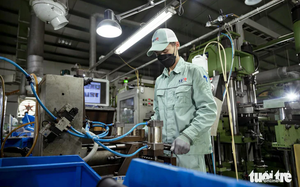
Several FDI companies have signaled interest in listing on Vietnam's stock market. Photo: Huu Hanh / Tuoi Tre
Listing FDI companies to unlock more capital
Creating a pathway for qualified FDI companies to list should no longer be viewed merely as a technical issue for the stock market. It should be considered part of the country's growth policy.
A mature FDI company that lists its shares can generate three streams of capital at the same time: the company gains additional equity to expand production; founding investors recover part of their capital and can reinvest it in new projects in Vietnam; and the stock market gains another quality company.
Based on the bottlenecks identified, the solution is not to relax listing standards for FDI companies, but to make the path toward meeting those standards clearer and more predictable.
Several approaches are being discussed by regulators and the FDI business community, including developing a dedicated listing roadmap, turning lessons from several pilot deals into a standardized process instead of requiring each company to negotiate the same issues from scratch, establishing a pre-consultation mechanism with clear response deadlines, and studying instruments such as depositary receipts that would allow foreign investors to access Vietnamese shares without being constrained by foreign ownership limits.
Uncertainty over completion and processing times needs removing.
Vietnam has set a target of double-digit GDP growth for 2026-30, with total investment expected to equal 35-40 percent of GDP each year.
The sectors Vietnam aims to develop — semiconductors, artificial intelligence, data centers, energy and high-tech manufacturing — all require substantial equity capital and the ability to take on long-term risks, something the banking system cannot shoulder alone without the economy soon reaching its leverage limits.
* This article was originally written in Vietnamese by Vu Ngoc Bao, Master of Public Policy, and rewritten in English by Tuoi Tre News.








Max: 1500 characters
There are no comments yet. Be the first to comment.