


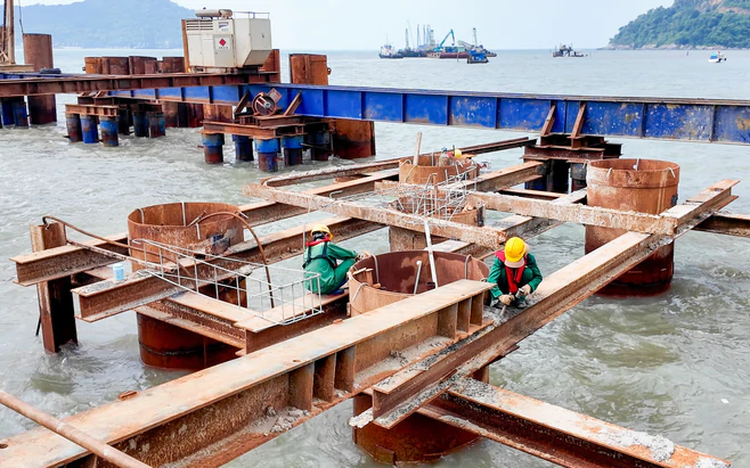
Workers take advantage of calm seas to work extended shifts day and night at the sea-crossing bridge project connecting the mainland to Hon Khoai Island in Ca Mau Province. Photo: Thanh Huyen / Tuoi Tre
The project is targeted for completion by late 2028.
The Hon Khoai Island access road project, designed as a four-lane sea-crossing route, broke ground in August 2025 with a total investment of more than VND25.7 trillion (US$989 million).
The project will connect to the end of the Ca Mau-Dat Mui Expressway and feature a 16.5-meter-wide roadway with a designed speed of 80km/h.
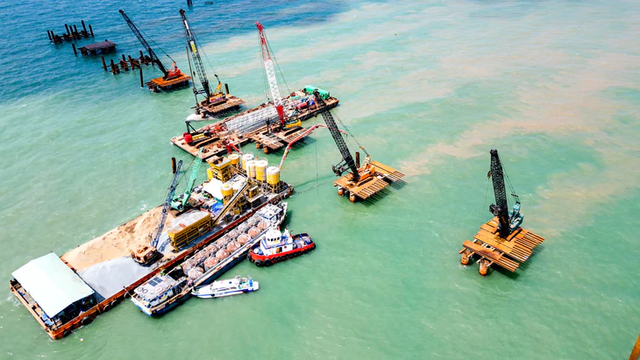
Construction workers can work for only around four to five months a year because offshore construction is highly dependent on weather conditions. Photo: Thanh Huyen / Tuoi Tre
Once completed, it will be the longest sea-crossing bridge in Vietnam and the third longest in Southeast Asia.
The project includes nearly 500 bored piles and steel piles, driven 80-110m into the seabed.
Construction has been complicated by the terrain, with numerous underwater scour holes and extremely weak seabed conditions.
Because the work is being carried out offshore, crews have been able to work for only about four months over the past year due to rough seas and strong winds, particularly during the rainy and stormy season.
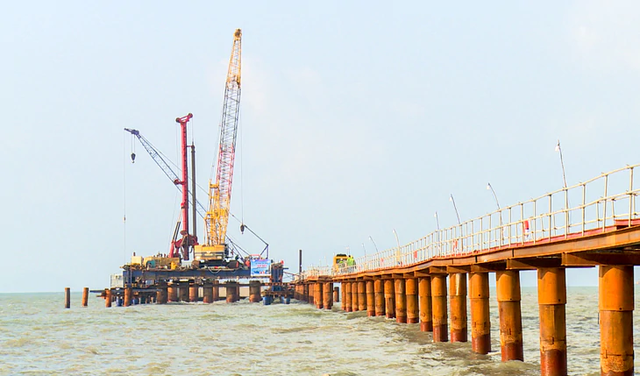
Bored piles have been installed along several sections of the sea-crossing route. Photo: Thanh Huyen / Tuoi Tre
These conditions have also made it difficult to transport machinery and materials to the construction site.
To cope with the harsh conditions, contractors have mobilized more than 1,000 pieces of equipment and over 2,000 engineers and workers, organizing multiple construction teams to work extended shifts day and night.
According to Army Corps 12, the unit has invested in four high-tech offshore construction machines, each costing around VND1 trillion ($38.5 million), to ensure the project stays on schedule.
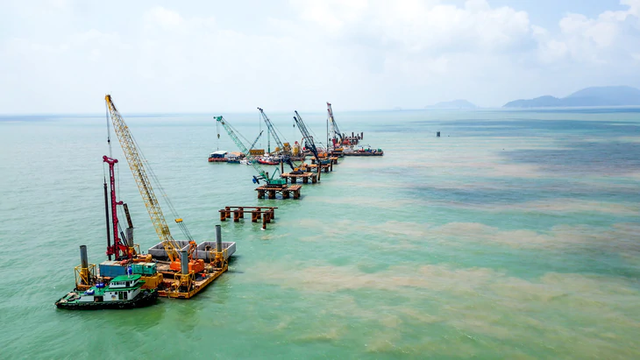
Rough seas and material shortages are among the main challenges facing construction. Photo: Thanh Huyen / Tuoi Tre
Major General Nguyen Huu Ngoc, commander of Army Corps 12 under the Ministry of National Defense, said the project is currently broadly on schedule.
The bridge piers are gradually taking shape using specialized offshore construction technology, demonstrating the military unit’s capacity to build large-span bridges in areas with complex geological conditions while also contributing to the protection of Vietnam’s sovereignty over its seas and islands, he said.
So far, 263 onshore bored piles and 157 offshore bored piles have been completed, while concrete has been poured for 17 piers.
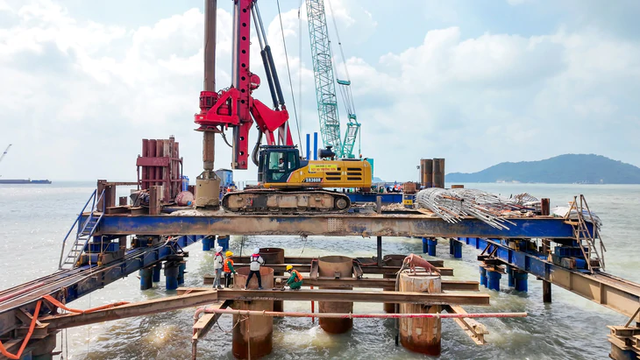
Modern machinery and equipment have been deployed at multiple construction sites. Photo: Thanh Huyen / Tuoi Tre
Material supply has also posed a major challenge.
Sand and rock have had to be sourced from multiple localities and transported by sea. While sand supplies are basically sufficient, specialized rock for asphalt concrete and high-strength bridge girders remains in significant short supply, with only a quarry in An Giang Province currently meeting supply requirements.
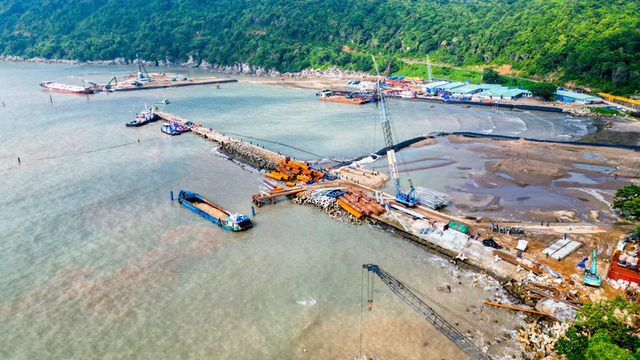
The dual-use Hon Khoai Seaport is also nearing completion. Photo: Thanh Huyen / Tuoi Tre
Alongside the sea-crossing bridge, work on the dual-use Hon Khoai seaport project is also being accelerated.
Efforts to resolve construction bottlenecks and keep the projects on schedule are expected to provide a major boost to Ca Mau, opening up new transport links to attract investment and strengthen regional connectivity.








Max: 1500 characters
There are no comments yet. Be the first to comment.