


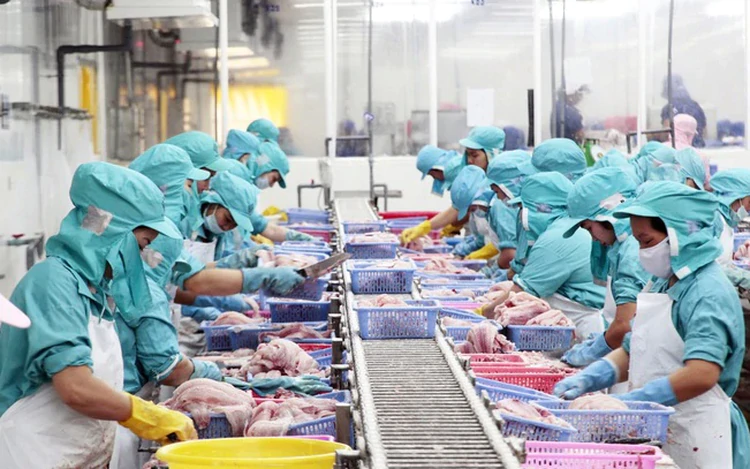
Workers are seen at a pangasius processing plant for export in Can Tho City, southern Vietnam. The Mekong Delta must have more factories to retain its workforce. Photo: C. Quoc / Tuoi Tre
Many workers from the Mekong Delta want to return home after years of working away, but they will do so only if they can find stable jobs, earn enough to support their families, and have opportunities for long-term career development.
The region has a population of 17-18 million, according to the General Statistics Office of Vietnam.
For years, it has recorded slow population growth, with some localities experiencing net population declines as young people leave their hometowns in search of jobs.
Mekong Delta workers need better pay, career prospects
This paradox shows that labor shortages are not simply a matter of worker numbers.
The gap between recruitment needs and the conditions required to retain workers also involves wages, skills, transportation, and career prospects.
A factory worker may choose to work in Ho Chi Minh City because of higher wages and more opportunities for overtime, even if that means renting accommodation far from home and family.
By contrast, factories in their hometowns may struggle to recruit workers despite being closer to home if wages are low, jobs are seasonal, and opportunities for advancement are limited.
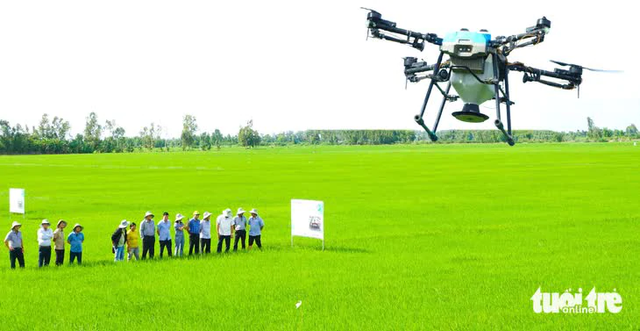
Agricultural drones used for fertilizing, pesticide spraying, and rice seeding help farmers in Vietnam work faster, reduce labor requirements, and lower production costs. Photo: Chi Cong / Tuoi Tre
Identifying the root causes is essential to making employment policies effective.
This challenge requires two parallel approaches.
One is to create more quality jobs so residents can stay in or return to their hometowns.
The other is to improve productivity so businesses become less dependent on increasing their workforce.
Investment in infrastructure, industrial development, agricultural modernization, vocational training, and social welfare must all contribute to these goals.
First, sustainable employment must be built on an efficient production base.
Business investment decisions depend heavily on the costs of transporting raw materials and goods, as well as access to markets.
Various logistics reports show that transportation and storage account for a significant share of costs in Vietnam's agricultural supply chains.
Therefore, transport infrastructure in the Mekong Delta must ensure connectivity between raw material production areas, processing facilities, industrial parks, and export hubs.
With improved infrastructure in place, cooperation between Ho Chi Minh City and Mekong Delta localities should be strengthened to redistribute some manufacturing activities.
For example, garment factories, handicraft businesses, and agricultural and seafood processing facilities seeking to expand or relocate from residential areas could be connected with suitable sites in the region.
The experience of the former Long An Province, now part of Tay Ninh Province, shows how proximity to Ho Chi Minh City, together with an increasingly developed network of industrial parks and transport infrastructure, has helped attract numerous manufacturing projects.
This model could be adapted for Dong Thap Province, as well as Vinh Long Province and Can Tho City, where raw materials and labor are available but non-agricultural employment opportunities remain limited.
Such an approach would redistribute job opportunities while easing pressure on urban infrastructure and the environment.
Helping Mekong Delta residents adopt technology
Alongside attracting new investment, improving productivity in existing industries is a direct way to reduce demand for manual labor.
In agriculture, priority should be given to mechanizing harvesting and automating irrigation, feeding, sorting, and aquaculture environment monitoring.
In many rice-growing areas of An Giang and Dong Thap Provinces, transplanters, combine harvesters, and agricultural drones used for spraying pesticides have significantly reduced manual labor, shortened harvesting times, and minimized losses.
In shrimp farming, automatic feeding systems, environmental sensors, and surveillance cameras help reduce the time farmers need to spend directly monitoring ponds while improving disease prevention and control.
To help small-scale producers access technology, financial support for equipment purchases must be accompanied by the development of farm machinery service providers.
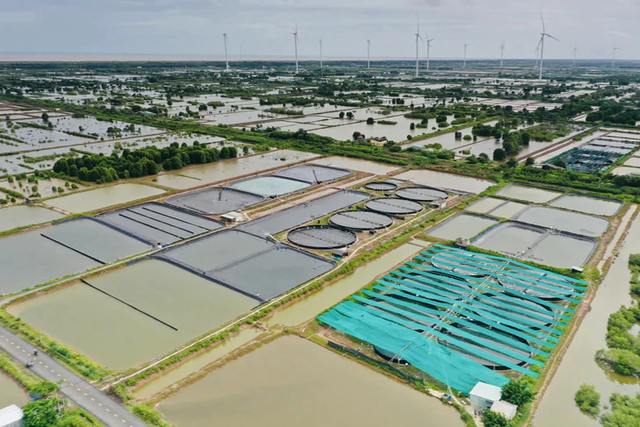
Shrimp farming areas in Ca Mau Province, southern Vietnam have expanded, with greater investment in intensive farming. Photo: Quang Dinh / Tuoi Tre
Cooperatives and businesses can offer farm machinery services based on cultivated area or output, allowing farmers to use machinery without having to invest in entire equipment systems themselves.
Renting combine harvesters, rice seeders, and agricultural drones for seasonal farming has become common in many localities and is suitable for households with small plots.
Technological transformation must also be accompanied by workforce preparation.
Training programs tailored to businesses' recruitment needs, in which students gain hands-on experience with actual equipment and have opportunities to sign employment contracts after graduation, have been adopted at several vocational colleges in Ho Chi Minh City and Dong Nai City.
Mekong Delta seeks to recruit workers with experience in southeastern Vietnam
In addition to training new workers, efforts should be made to attract people who have already gained experience in major industrial centers.
Skilled workers, technicians, and managers will return only if they have opportunities to put their expertise to good use.
Online recruitment campaigns specifically targeting Mekong Delta residents working in Ho Chi Minh City and Dong Nai could be organized, with information about housing, schools, living costs, and support policies included.
This relatively low-cost solution could significantly expand the pool of potential candidates.
The decision to return home is often tied to the future of an entire family.
Even if one person finds a job, life may remain unstable if their spouse cannot find employment or their children have no suitable school.
Therefore, policies to attract workers back must link employment opportunities with housing, education, and healthcare.
Childcare facilities with hours suited to shift workers and convenient transportation services would give people with family responsibilities more options.
Some industrial parks have already provided childcare facilities, employee shuttle buses or rental assistance for workers. Such policies should be considered for adoption in Mekong Delta industrial clusters, particularly those employing large numbers of women.
When people can return to their hometowns without sacrificing career opportunities, they bring back experience, skills, and aspirations for innovation.
This represents an important internal resource for sustainable regional development and a stronger position in the national economy.
* This article was originally written in Vietnamese by Nguyen Tuan Anh, who holds a master's degree in public policy, and rewritten in English by Tuoi Tre News.


Max: 1500 characters
There are no comments yet. Be the first to comment.