


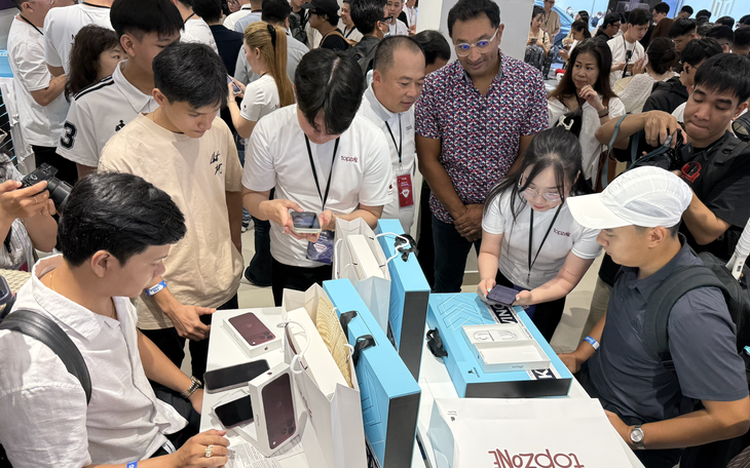
Customers buy iPhone 18 models and accessories at a TopZone store in Vietnam. Photo: Duc Thien / Tuoi Tre
Vlad Savin, director of markets & growth for ASEAN at business advisory firm Acclime, told Tuoi Tre (Youth) online newspaper that Apple’s new product cycle could benefit Vietnam as the country has become an important manufacturing base for several Apple products beyond the iPhone.
“I see Apple’s new product cycle not simply as a short-term export boost, but also as an opportunity to strengthen Vietnam’s industrial foundation,” Savin said.
More than opportunity to boost exports
Around 20 percent of iPad production and a large share of Apple’s wearable-device assembly are currently linked to Vietnam.
Production of AirPods, Apple Watch, MacBook, and Mac mini is also expanding through suppliers such as Luxshare, GoerTek, and Foxconn.
Savin said a stronger product cycle would first increase factory capacity utilization, boosting exports, logistics, and employment.


More importantly, it could accelerate investment in Vietnam’s manufacturing ecosystem.
Apple’s growing recruitment needs for positions in manufacturing engineering, supplier quality, automation, logistics, and new-product introduction suggest that Vietnam is moving from basic assembly toward a more sophisticated manufacturing platform.
Luxshare’s large-scale investment plans in Bac Ninh City, northern Vietnam, and Nghe An Province in the north-central region also point to this trend.
However, the impact should be assessed based on value added and investment flows rather than export turnover alone.
Electronics assembly has relatively thin domestic profit margins. Meanwhile, a significant share of components and machinery is still imported.
This was evident in the first half of 2026, when Vietnam recorded strong trade growth but it also posted a trade deficit of US$16.65 billion.
The Acclime expert said part of the deficit stemmed from imports of machinery, components, and raw materials before the finished products were exported.
The contribution of the processing and manufacturing industry to economic growth is therefore a more meaningful indicator of the actual benefits.
The processing and manufacturing industry contributed around 33 percent of Vietnam’s economic growth in the first half of 2026, according to the National Statistics Office.
“In the long term, the benefits will be greater if Vietnamese companies move deeper into the supply chain as Tier 2 and Tier 3 suppliers, thereby retaining more value domestically,” Savin said.
According to Savin, faster VAT refunds, predictable customs procedures, improved technical skills, and the development of more domestic suppliers will determine how much value Vietnam can retain from this opportunity.

Vlad Savin, director of markets & growth for ASEAN at Acclime. Photo: Supplied
From manufacturing base to technology economy
Savin said the biggest opportunity lies not simply in Samsung, Apple or NVIDIA expanding R&D activities in Vietnam, but in the ability of Vietnamese businesses and workers to learn from their presence and move up the value chain.
This has already begun to happen in recent years.
Samsung has established a large R&D center in Hanoi and stepped up cooperation with Vietnamese universities.
NVIDIA is working with more than 100 AI startups and 65 universities.
Apple has expanded training in smart manufacturing, robotics, and automation for workers at its suppliers.
Vietnamese workers and businesses opportunities can learn how leading technology companies develop products, manage quality, and solve technical problems.
The spillover effect could first come through people. Engineers at multinational corporations could later move to domestic companies or establish their own businesses.
Vietnamese suppliers could also learn how to meet international standards for testing, quality control, automation, and manufacturing.
Universities could benefit from linking research more closely with real-world problems rather than focusing mainly on academic research.
The presence of R&D centers does not automatically make Vietnam a technology hub. The bigger challenge lies in building connections around these centers.
Vietnamese businesses need to be capable of working directly with multinational corporations and taking on more demanding, higher-value tasks.
Universities need to strengthen links with businesses, while researchers need better access to equipment, data, computing capacity, and funding. Startups also need a clearer path from research to commercial products.
Human resources will play a key role, but the business environment is equally important. Companies need to be able to make decisions, invest, recruit skilled workers, and scale up without facing excessive obstacles.
Savin said success should not be measured by the number of factories Vietnam attracts, but by the amount of technology, technical expertise, and intellectual property created by Vietnamese people.
That, he said, could help Vietnam move from a manufacturing base toward a technology economy.
Vietnam: A major Apple AirPods manufacturing base
Apple sold around 80 million AirPods in 2025, The Wall Street Journal reported, citing Business of Apps.
Market research firm Omdia reported that Apple shipped 16.8 million true wireless stereo devices last quarter.
Vietnam currently plays a major role in the AirPods supply chain. Data from Smart Analytics Global’s Wearable 360 service showed that Vietnam accounted for 62 percent of the AirPods produced globally in the first quarter of 2026, compared with 34 percent in China and four percent in India.
Vietnamese consumers place nearly 300,000 iPhone 18 orders
The iPhone 18 series has been on sale in Vietnam for a week, with unprecedented sales figures.
Reports from Apple-authorized retailers in Vietnam showed that the total number of customers who registered and placed deposits for the entire new product line-up reached nearly 300,000, reflecting exceptionally strong demand in the premium smartphone segment.








Max: 1500 characters
There are no comments yet. Be the first to comment.