



Mekong Delta neighbors often help one another with tasks ranging from putting up tents to moving tables and cabinets, with both the hosts and helpers enjoying the occasion. Photo: AI-generated
The request is part of a local culture in which neighbors readily lend a hand when someone is building a house, putting up a tent for a family event, dealing with an emergency or doing farm work.
Instead of directly saying, "Come over for drinks," the host may ask a neighbor to help move a cabinet, repair a corrugated metal roof, drain a fish pond or clear fishing gear.
Once the work is done, the host will often thank the helper by inviting him or her to stay for a few drinks.
'My husband went to help move a cabinet and came home hours later'
Pham Thi Trinh, a teacher from Thanh Hoa Province, north-central Vietnam, who got married and moved to Phong Dien Commune in Can Tho City, said she was initially puzzled by the practice.
"When a neighbor asked my husband to come over and help move a cabinet, I wondered why he would not come home for hours," she said.
In the Mekong Delta, people rarely invite someone directly by saying, "Come over for drinks," because they do not want to inconvenience the other person.
The person being invited could easily decline by saying they were busy or did not feel well.
Instead, the invitation is often disguised as a request for help.
"Come help me move this cabinet," a neighbor may say.
Other requests include helping repair a roof, drain a fish pond or clear fishing gear.
There will usually be food and drinks waiting after the work.
After seeing her husband return home late from helping neighbors, sometimes with alcohol in his breath, Trinh eventually understood what the "cabinet-moving" requests meant.
Was there really a cabinet to move?
The work is often real, but it is usually only a pretext for neighbors to get together.
After helping, Trinh's husband might hear an invitation such as, "Have a drink or two before you go?"
In the Mekong Delta, neighbors routinely help one another when there is a family event, a funeral, house construction or other work.
They do so without expecting payment.
A simple request for help is often enough to bring people over.
They treat a neighbor's work as if it were their own, readily putting aside a meal or rest to lend a hand.
Those acts of mutual help strengthen neighborhood ties through meals, drinks, and conversations.
Because the request usually involves something the neighbor can easily do, refusing can feel difficult.
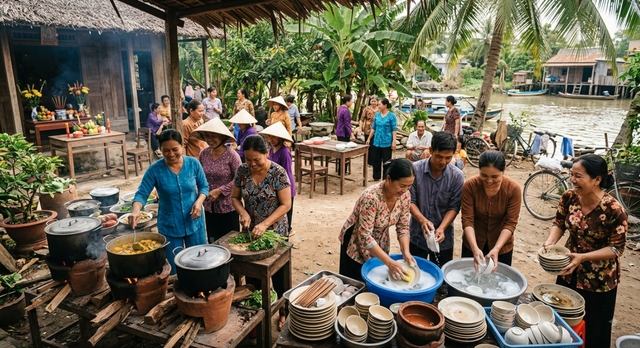
Mekong Delta neighbors often gather for lively get-togethers whenever someone in the neighborhood needs a hand with a task. Photo: AI-generated
Sometimes the requested work genuinely needs to be done and takes only 15-30 minutes.
The homeowner may then invite the helper to stay for a few drinks as a gesture of thanks.
Conversations can range from neighborhood matters and farming to weddings and family events.
What begins as a quick helping hand can therefore turn into a gathering that lasts for hours.
Why not simply say, 'Come for drinks'?
Avoiding a direct invitation to drink is part of the region's informal and considerate way of interacting with neighbors.
Instead of saying, "Come over for drinks," someone may say, "Come help me move this cabinet."
The indirect invitation also adds an element of humor because both sides often understand what is really going on.
Ut Tung, from Can Tho, joked that the indirect wording also helps men avoid having to tell their wives directly that they are going for a drink.
He said telling their wives they were drinking could be difficult, while saying they were going to help a neighbor was more acceptable, even though the wives knew they were actually going for drinks.
Ta Duc Tu, a lecturer at Can Tho University, said the practice reflects the importance of neighborhood ties in the Mekong Delta.
People value the idea of being there for one another in difficult times, he said, and regularly exchange help in a practice known locally as 'van cong,' in which neighbors help one another with work without expecting immediate payment, with the favor returned when needed.
Such reciprocal labor does not necessarily require an exact calculation based on the amount of work or hours spent.
The principle is that help is exchanged between neighbors.
Food and drinks may be offered after the work as a way of returning the favor.
Moving a cabinet or a bed is not normally considered part of the formal exchange of labor, Tu said, so the helper is likely to be invited to stay for a few drinks.
The "come help me move the cabinet" request is therefore both a practical favor and a convivial invitation.
Both sides understand that after the cabinet is moved, there will likely be a few drinks and some conversation.
That combination of mutual help, hospitality, and humor is part of the neighborly culture of the Mekong Delta.








Max: 1500 characters
There are no comments yet. Be the first to comment.