


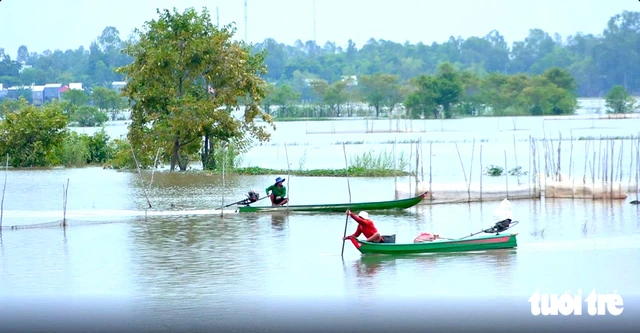
Residents in upstream Dong Thap Province, Mekong Delta, southern Vietnam make a living on the flooded fields during August 2025. Photo: Dang Tuyet / Tuoi Tre
Every year, from around August to December, water from the upper Mekong River flows into the Mekong Delta, turning vast areas into a sea of water.
Unlike a sudden flood, the water rises gradually, filling rivers before spilling over their banks and into the fields.
For Mekong Delta tourism and local communities, the annual flood season is seen as a gift from nature, bringing fertile alluvial soil and an abundance of fish, shrimp, fruits, and other local produce.
Khuong Le Binh, director of the Dong Thap Hydrometeorological Station, said the province’s annual flood season has changed considerably in recent years, with early-season water flows becoming increasingly rare.
Water levels in upstream areas have generally remained low, typically reaching low to moderate flood levels, or Alert Levels I-II.
“Notably, high-tide levels in the middle and downstream areas have tended to rise higher than during the past decade,” he noted.
“Due to climate change, combined with numerous water extraction and use projects along the river, the likelihood of low and delayed floods in Dong Thap’s upstream areas has become relatively high,” Binh said.
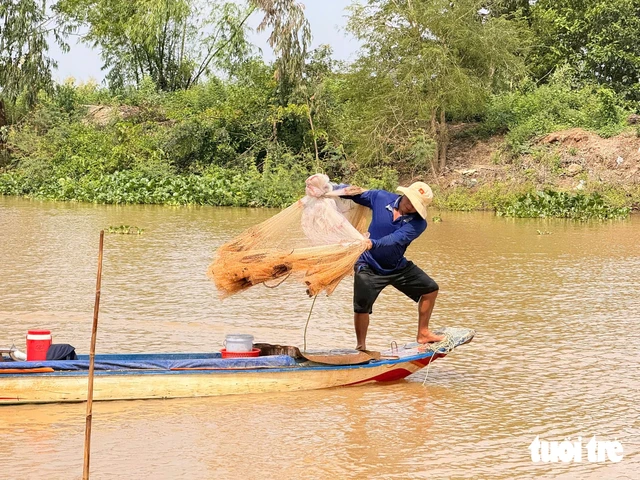
A resident catches aquatic products in the river in Thuong Phuoc Commune, Dong Thap Province, southern Vietnam. Photo: Dang Tuyet / Tuoi Tre
The significance of annual flood cycle
Speaking to Tuoi Tre (Youth) online newspaper on Tuesday, Le Ha Luan, director of the Department of Agriculture and Environment of Dong Thap Province, said that the anticipation of the annual flood season reflects a deep understanding of the region’s ecology.
Residents are not waiting for a major flood that causes damage. Rather, they are hoping for the floodwaters to arrive according to their natural cycle.
Such a flood season serves several functions at once: connecting rivers with rice fields; expanding breeding grounds for fish and shrimp; transporting and distributing alluvial sediment and nutrients; replenishing waterways and low-lying areas; and sustaining traditional livelihoods and cultural practices in the upstream region.
Missing one flood season may not immediately cause serious consequences, as ecosystems can adapt.
However, repeated years of low or delayed floods, or disruptions to the natural flood cycle, are more concerning.
Over time, these impacts can compound, leading to declines in natural fishery resources, less alluvial sediment reaching fields, reduced soil fertility, shrinking wetland ecosystems, and the gradual loss of traditional flood-season livelihoods.
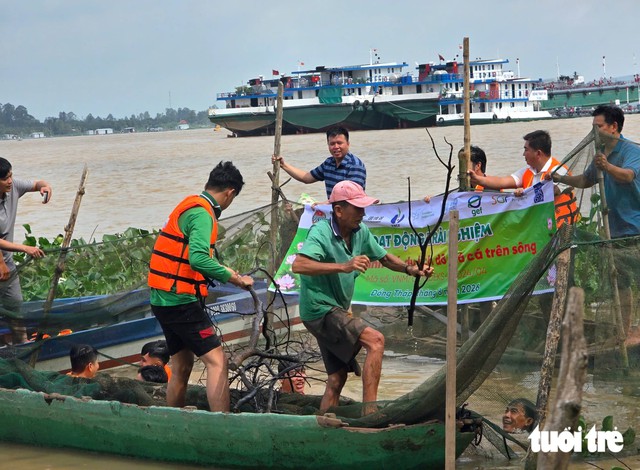
Residents lift a fish trap to catch fish on the Tien River in Dong Thap Province, southern Vietnam as floodwaters rise. Photo: Dang Tuyet / Tuoi Tre
Flood management and adaptation
Therefore, from a management perspective, authorities need to shift from a focus on “flood prevention and control” to “flood management and adaptation.”
Areas where residents, infrastructure and production zones need protection should be actively controlled, while suitable areas should be studied to create space for receiving and storing floodwater, capturing alluvial sediment and restoring ecosystems.
For the Mekong Delta, floodwater is more than just water flowing through the region.
It carries alluvial sediment, nutrients and aquatic resources, while also sustaining the natural rhythm of the ecosystem.
When floods are lower or arrive later, the area and duration of inundation decrease, weakening connections between rivers, canals and fields.
This reduces natural habitats for fish and shrimp, along with their breeding grounds and natural food sources.
“In Dong Thap, particularly in the upstream areas, we are closely monitoring water conditions while studying ways to proactively receive, store and release floodwater according to appropriate cycles,” Luan said.
“This will help ensure production safety while making use of water and alluvial sediment, restoring fishery resources and preserving the ecological values associated with the annual flood season,” he added.








Max: 1500 characters
There are no comments yet. Be the first to comment.