


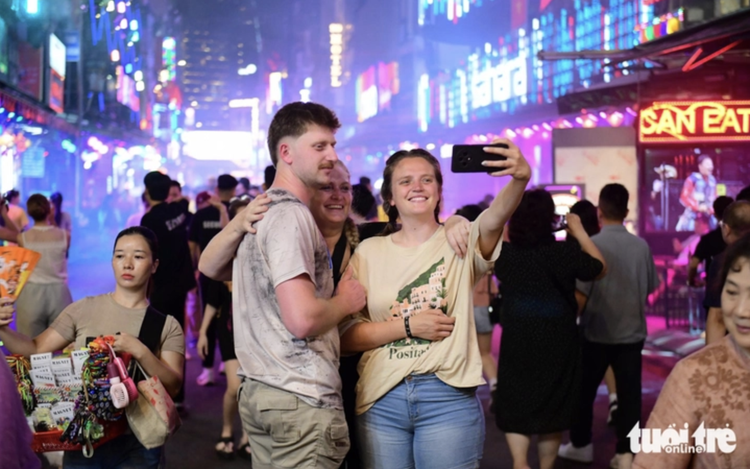
Foreign tourists take a wefie at night in Ho Chi Minh City. Photo: Quang Dinh / Tuoi Tre
Without a coherent product strategy and interconnected planning, this vast potential risks remaining fragmented and underperforming, much like its current state.
Nighttime economy not limited to tourism
Nguyen Nguyet Van Khanh, marketing and communications director at Vietravel, said that the southern metropolis’ nighttime economy remains largely untapped.
With Ho Chi Minh City expanding its development space after being merged with Binh Duong and Ba Ria–Vung Tau Provinces in July last year, the opportunity now extends far beyond the urban core.
“This is no longer confined to the inner city. It is evolving into a unique regional ecosystem linking urban and coastal destinations,” she noted.
However, one of the city’s biggest obstacles is the lack of a comprehensive regional master plan.
While market demand has already outgrown administrative boundaries, policy and planning have yet to catch up.
Therefore, the city should adopt a ‘linked night tourism corridor’ model rather than continuing to develop isolated zones.
Importantly, the nighttime economy is not solely a tourism issue.
It involves transportation systems, public safety, licensing frameworks, the use of public spaces, and supporting infrastructure.
Without synchronized development across these sectors, growth will remain constrained.
Several experts emphasized that a sustainable evening economy cannot rely solely on local residents.
While small-scale services may survive on local demand, a thriving ecosystem requires a steady influx of domestic and international visitors.
From the aviation perspective, Vietnam Airlines pointed to weak nighttime attractions as a critical bottleneck to the growth of the nighttime economy.
This imbalance concentrates travel demand during daytime hours, leading to flight congestion.
Meanwhile, the airline still has significant unused capacity at night.
If destinations offered compelling after-dark experiences, demand for late flights could increase, improving fleet utilization, raising revenue, and boosting tourism flows.
A sufficiently attractive destination will draw passengers, while convenient air routes will continue to ‘feed’ customers into the entire after-6:00 pm service ecosystem.
Air connectivity can open the door, but a functioning night economy requires a fully coordinated chain, meaning that transport links, taxi services, security, hotels, restaurants, retail, entertainment, and cultural venues must all operate in sync.
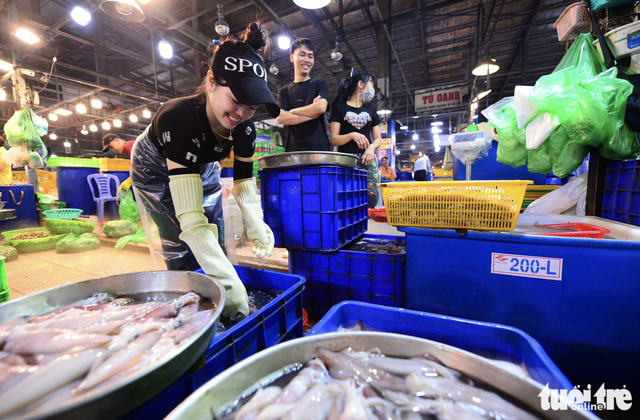
Visitors can explore the bustling atmosphere of Binh Dien Wholesale Market in Ho Chi Minh City. Photo: Quang Dinh / Tuoi Tre
Turning nighttime wholesale markets into cultural experiences
Phan Thanh Tan, director of Binh Dien Market Business Management Company, shared that Binh Dien Wholesale Market serves as a stable and unique nighttime economic entity, offering potential for value-added activities aligned with the city’s urban identity.
Over the past more than 20 years of its operation, the wholesale market has functioned as a unique and stable nighttime economic hub, handling an average of 2,000 metric tons of goods daily, with transactions averaging VND150 billion (US$5.7 million) per day.
It also serves as a crucial supplier of food, especially seafood, to Ho Chi Minh City and neighboring localities.
Building on this foundation, the development of the night economy at Binh Dien Wholesale Market is not intended to change the core nature of the wholesale market, but to add new layers of value.
This is especially true given that experiential value – based on infrastructure, supply chains, and nighttime trading activities – has been established and operating steadily for many years.
Under its development strategy, the company is simultaneously upgrading and completing the wholesale market’s infrastructure according to master plans, while gradually creating new spaces dedicated to the evening economy.
These areas are planned separately from the main wholesale zones to ensure that core trading activities remain unaffected.
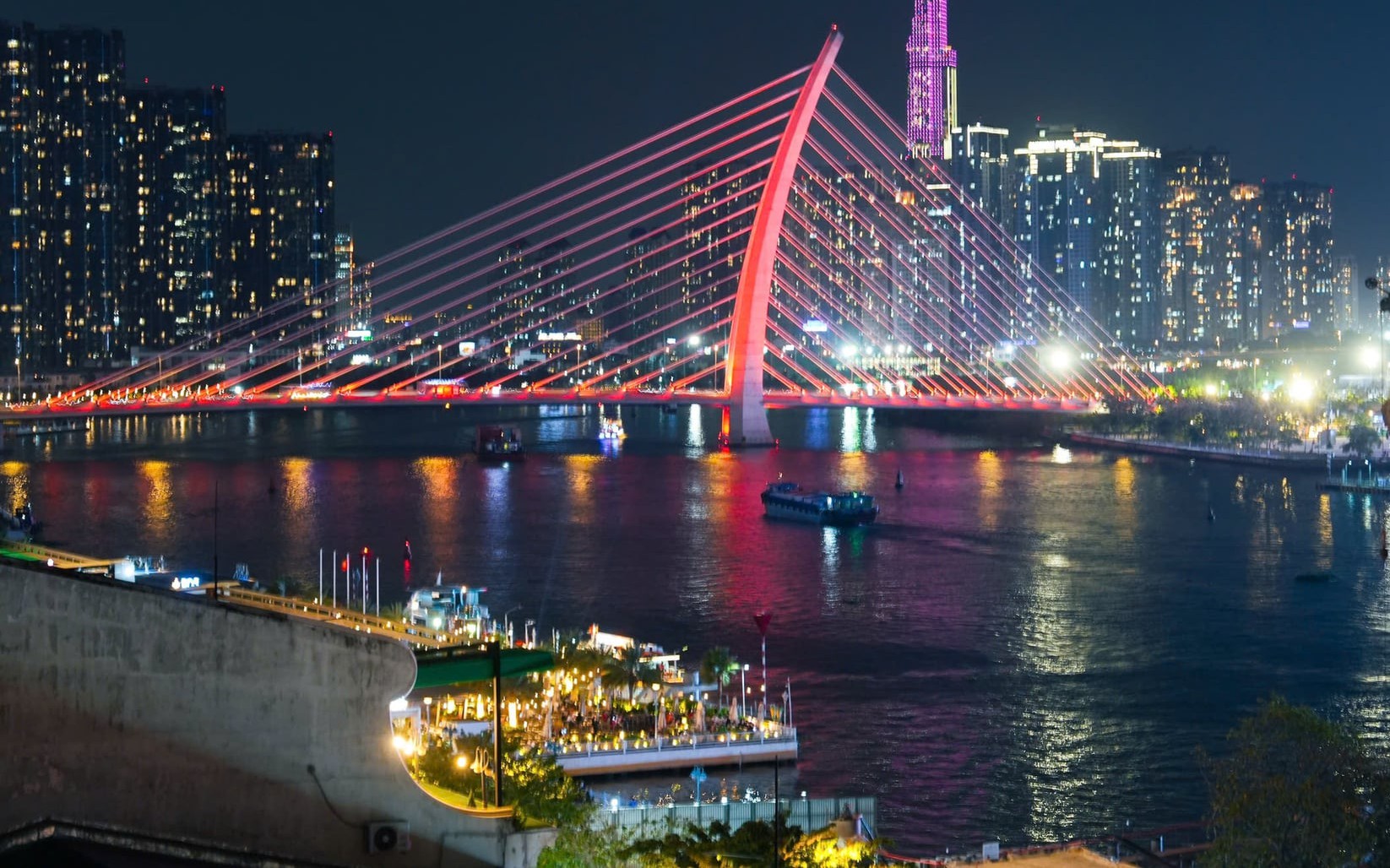
The firm also aims to leverage cultural elements as economic and tourism products.
Notably, it plans to establish cultural exhibition spaces and traditional houses to showcase the market’s history and its role in ensuring the city’s food security.
In addition, the story of Vietnam’s seafood, from farming regions and cultivation practices to seasonal cycles and dining tables, will be highlighted, positioning the market as a ‘living museum’ of urban agriculture.
Fixed tour routes, including city tours and food tours, will be developed to give visitors a first-hand experience of urban life and the vibrant atmosphere of nighttime wholesale trading.
Interactive activities such as agricultural gift packaging and culinary workshops will also be introduced to create additional livelihoods and enhance visitor engagement.
Tan said that the ‘nighttime market culture’ at Binh Dien lies in its fast-paced yet organized trading rhythm.
Combined with the diversity of fresh goods, regional connectivity, and the stories of thousands of merchants and workers operating overnight, it forms a uniquely vibrant ecosystem.
“These elements, if properly structured and closely managed, could be developed into selective economic-tourism products, extending visitor stays, boosting nighttime spending, and making a significant contribution to Ho Chi Minh City’s evening economy,” Tan said.
Nighttime economy: Driving growth in Ho Chi Minh City
To identify bottlenecks and unlock resources for the nighttime economy, Tuoi Tre (Youth) newspaper and the Ho Chi Minh City Food Association will co-host a thematic seminar titled 'Nighttime economy: Driving Growth in Ho Chi Minh City' on Wednesday in Ho Chi Minh City.
The event takes place as the city is drafting a special urban law and a resolution on specific policy mechanisms, creating opportunities for the city to proactively plan, attract investment, and develop its evening economy.
The seminar will bring together government officials, policymakers, leading economists, the Ho Chi Minh City Food Association, and representatives of major companies such as Saigontourist Group, Vietravel, Satra, and Viettel.
Discussions will focus on spatial planning, diversifying culturally distinctive arts and entertainment products, and gathering direct feedback from businesses on policies for developing the nighttime economy.
The event is expected to showcase successful international models and propose effective pilot roadmaps, helping position the night economy as a new growth engine for the city.









Max: 1500 characters
There are no comments yet. Be the first to comment.