


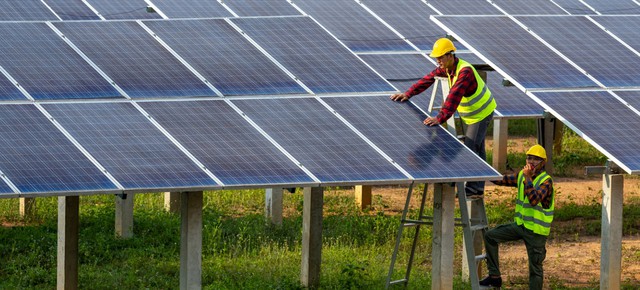
Energy transition was among the largest recipients of investment in Vietnam’s climate tech ecosystem in 2025. Photo: New Energy Nexus Vietnam
According to the Vietnam Climate Tech Ecosystem Report 2026 series, total funding for the sector reached $49.86 million across 33 deals in 2025, down 52 percent from $104.2 million across 60 deals in 2024.
The sharp decline was largely due to Techcoop's $70 million Series A funding round in 2024. Excluding the largest deal in each year, total funding fell by just 19 percent, from $34.2 million to $27.86 million.
However, a more pressing issue is the funding gap facing startups seeking to move from early-stage grants to commercial investment. Despite investor interest, many businesses still struggle to access the capital needed to scale up.
The report series was jointly produced by New Energy Nexus Vietnam, SNV Vietnam, World University Service of Canada, and RMIT Vietnam, with support from the Swiss Entrepreneurship Program.
Investor interest grows, but funding remains out of reach
One of the report’s key findings is that no investment deals valued between $350,000 and $1 million were recorded in 2025, compared with four deals in this range in 2024.
This so-called 'missing middle' highlights a funding gap between early-stage grants and startups' first institutional investment rounds.
At an early stage, startups may receive grants to develop technologies, test products, or establish business models. However, as they seek to expand, they must meet stricter financial and commercial requirements to attract institutional investment.
The difficulty of moving beyond early-stage funding was identified in previous research.
According to the Vietnam Climate Tech Funding Ecosystem Report 2025, only 11.11 percent of climate tech enterprises had reached stages beyond seed funding, compared with 32.2 percent across the broader technology sector.

Meanwhile, interest from capital providers in Vietnam’s climate tech sector remains evident.
Of the 15 funders surveyed for the 2026 report, 10 either had a Vietnam-specific climate investment mandate or were actively evaluating opportunities in the market. New funding providers from Japan, Singapore, Europe, and Taiwan also entered the market in 2025.
Tran Thi Phuong Thao, country director of New Energy Nexus Vietnam, said investors had indicated that funding was available for climate tech startups in Vietnam, while founders themselves were eager to raise capital.
Yet no deals were recorded in the $350,000-1 million range in 2025, she noted, describing it as a critical stage for businesses transitioning from grant support to their first major commercial investment.
The researchers identified three main obstacles: a shortage of financial instruments suited to this funding range, too few businesses ready to access such financing, and weak coordination between grant providers, investment funds, and banks.
While grants primarily support early-stage businesses, commercial financing requires stronger evidence of financial capacity and business viability. However, suitable financial products and support mechanisms to help startups bridge the gap between these funding sources remain limited.

A robotic arm cares for plants in a high-tech farming system. Photo: New Energy Nexus Vietnam
Collateral requirements, talent shortages pose further challenges
Vietnam’s climate tech startups also face obstacles in accessing bank financing. None of the 22 enterprises surveyed had secured a green loan from a domestic bank, according to the report.
The researchers found that bank lending continues to rely heavily on collateral rather than business performance, creating difficulties for startups with limited assets to pledge.
These barriers are particularly significant for women-founded enterprises. Although they account for 33 percent of active climate tech businesses and received 56 percent of total grant funding in 2025, they secured just 1.7 percent of the sector’s overall investment capital.
The disparity partly reflects differences in sector concentration.
Women-founded enterprises are more prevalent in agriculture, food production, and the circular economy, where average deal sizes range from $44,000 to $77,000, substantially below the $3.82 million to $7.35 million recorded in the energy and mobility sectors.
The report also identifies collateral constraints, investor bias, and limited intermediary support as additional barriers.
According to Thao, many women do not hold land titles in their own names, making it harder for them to meet bank lending requirements.
Beyond financing, climate tech startups face shortages of skilled workers. Some 73 percent of surveyed businesses ranked technical expertise among their top three workforce needs, while 50 percent identified it as the hardest talent category to recruit.
In addition, 86 percent had provided in-house training over the previous two years, primarily through on-the-job learning.
Team capability is also a key consideration for funders when assessing investment opportunities, although it is rarely incorporated explicitly into formal investment scoring systems.
Lindsay Umalla, head of energy at SNV Vietnam, said capital was entering the sector faster than the workforce could keep pace.
To scale up, Vietnamese climate tech startups need more experienced professionals with cross-disciplinary skills, she said.
Better financing mechanisms needed to help startups scale
According to the report, Vietnam introduced 29 policies related to climate action, investment, and innovation in 2025. However, many implementation guidelines, certification systems, and corresponding financial products are still being developed.
To narrow the missing-middle financing gap, the researchers recommend developing financial instruments tailored to funding needs of $350,000 to $1 million.
Banks are also encouraged to accept equipment and contracts as collateral and consider cash-flow-based lending, rather than relying primarily on land or real estate as security.
Meanwhile, startup support organizations should establish clearer pathways to help businesses transition from grants to commercial financing, share due diligence costs, and prepare startups to meet investor requirements.
For businesses, the report recommends developing financing strategies for different growth stages, preparing investor-ready financial records early, and selecting funding instruments that suit their business models.
The researchers conclude that bridging the financing gap requires more than investor interest. It also depends on appropriate financial instruments, investment-ready enterprises, and stronger coordination among funding providers.


Max: 1500 characters
There are no comments yet. Be the first to comment.