


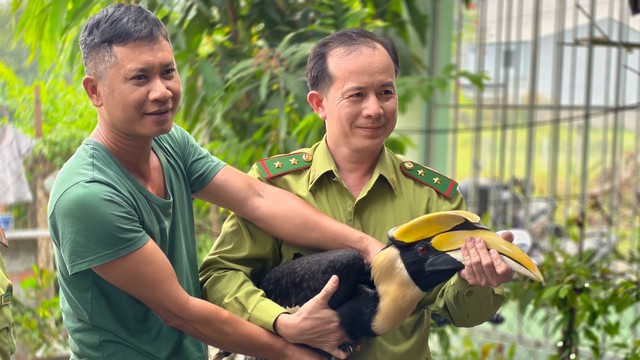
Forest ranger Cam Van Tung (right) receives a great hornbill voluntarily handed over by a resident of Xuan Thoi Son Commune in Ho Chi Minh City. Photo: Ngoc Khai / Tuoi Tre
One day in late 2025, forest ranger Cam Van Tung of Mobile Forest Ranger and Forest Fire Prevention Team No. 1 under the Ho Chi Minh City Forest Protection Department drove with colleagues to receive two rare birds in quick succession.
One was a changeable hawk-eagle voluntarily handed over by a resident in Binh Thanh Ward after being kept for seven years, while another was a great hornbill captured and handed over by residents in Xuan Thoi Son Commune.
After completing procedures and conducting health checks, Tung and his colleagues transferred the two birds to be cared for at the team’s Facility No. 2 in An Nhon Tay Commune.
Two days later, Tung and fellow ranger Doan Dinh Hung continued to receive another great hornbill, also handed over by a resident in Xuan Thoi Son.
“The work is often sudden. Once we receive an assignment, we quickly go to receive the wildlife and bring it back for care and handling in accordance with regulations,” Tung said.
Demanding work
Trained as a veterinarian, Tung has spent 13 years working in wildlife rescue and care at the Ho Chi Minh City Forest Protection Department.
He said animals voluntarily handed over by residents are often kept as pets, or found after wandering into homes or residential areas from unknown locations.
Many animals arrive in poor condition, including old age, injuries or illness.
According to Nguyen Cong Bang, deputy head of Mobile Forest Ranger and Forest Fire Prevention Team No. 1, the team’s Facility No. 2 is currently caring for more than 2,700 wildlife individuals from 46 species, with most originating from administrative violation seizures or voluntary handovers by residents.
In 2025 alone, residents voluntarily handed over 341 animals.
The wildlife care team consists of four rangers from the unit and two contract workers.
Their daily tasks include feeding the animals, monitoring their health, preparing food, and cleaning enclosures.
Rehabilitated animals are released back into the wild after health checks.
Beyond animals voluntarily handed over by residents, the team is also tasked with capturing wildlife that poses risks to residential areas.
Tung has worked with Nguyen Quang Hoang, deputy head of the Division for Forest Product Management and Violation Handling under the Ho Chi Minh City Forest Protection Department, to capture monkeys that disturb residential areas or injure people.
The work requires patience, with some monkeys taking days to approach.
Hoang said that in 2025, he tranquilized about ten monkeys and one gibbon for rehabilitation before release.
In addition to these duties, the four rangers are also responsible for forest management and protection, forest fire prevention and control, and enforcing forestry regulations in the former Cu Chi District.
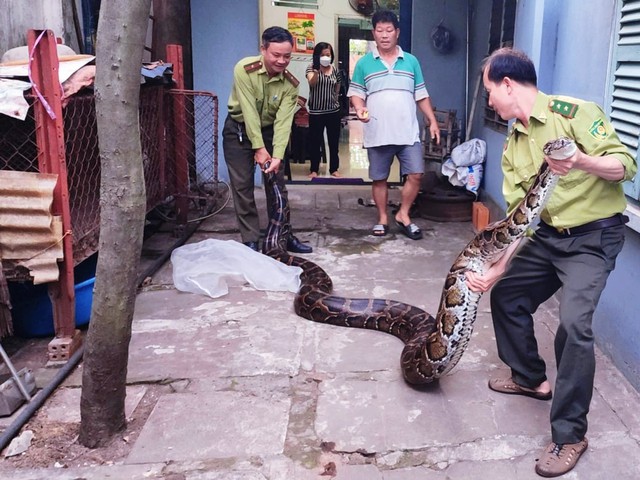
Forest ranger Cam Van Tung (right) and Nguyen Quang Hoang transport a 63kg Burmese python, which was sedated, for care before its release into the wild. The python was voluntarily handed over by local residents to the Ho Chi Minh City Forest Protection Department. Photo: Ngoc Khai / Tuoi Tre
The emotional toll of wildlife rescue
However, not all rescues are successful, Bang said, recalling a two-month-old pangolin that required intensive care, including 2:00 am milk feedings, yet did not survive despite three to four months of effort.
“We are deeply saddened when we lose an animal,” Bang said. “I always encourage my colleagues to do their best so as not to fail the trust of residents who hand animals over to us.”
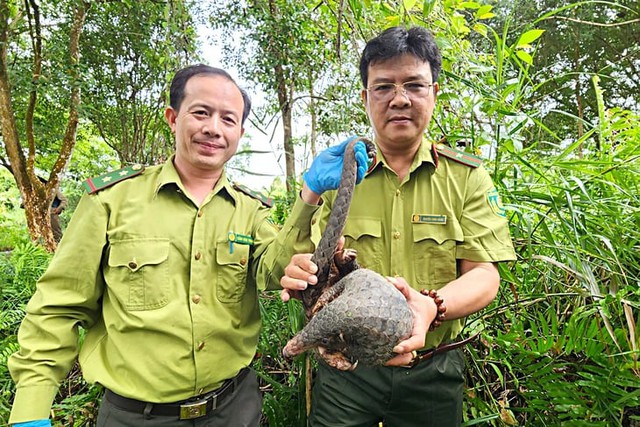
Forest rangers Cam Van Tung (right) and Nguyen Cong Bang release a rescued Javan pangolin into U Minh Thuong National Park in An Giang Province, southern Vietnam after rehabilitation. Photo: Ngoc Khai / Tuoi Tre
Bang said a rescue success rate of 70-80 percent represents a significant achievement.
Animals that do not survive are usually severely injured, elderly or seriously ill.
Many animals are accustomed to captivity and processed food prior to rescue, requiring a gradual transition back to natural diets before release.
To improve care effectiveness, rangers regularly study species-specific behaviors, draw lessons from field experience, and learn from rescue centers and experts.
Bang, who has worked in wildlife rescue and care for six years, shared many unforgettable moments, including monkeys that refused to leave after being released, or even tried to follow rangers back to their vehicles.
During one otter's release, rangers had to run to prevent it from following them.
“When an animal recovers well and reintegrates into the wild, we all feel immense joy,” Bang said.
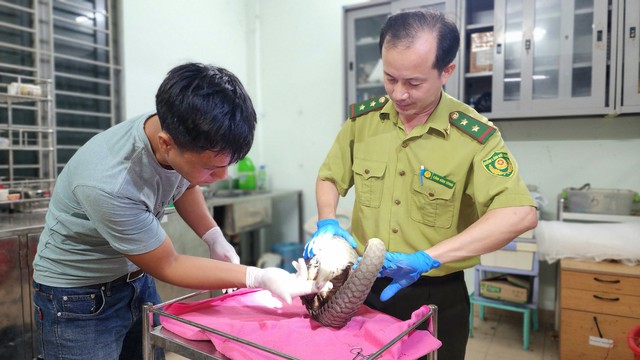
Forest ranger Cam Van Tung (right) checks the health of a Javan pangolin before its release to U Minh Thuong National Park in An Giang Province, southern Vietnam. Photo: Ngoc Khai / Tuoi Tre
Meanwhile, one of forest ranger Cam Van Tung’s most memorable cases involved a monkey suffering from abdominal pain, refusing food, and becoming frightened when approached.
After a week of treatment, the monkey recovered and grew attached to its caretaker.
When it was released back into the forest, the monkey ran a short distance before suddenly turning back, and only moved on after Tung offered it some water.
“I’m happy when I can save an animal, and even happier when I see it return to the wild,” Tung said.
In recent years, the growing willingness of residents to voluntarily hand over wildlife has led to a sharp increase in rescue missions.
From 2022 to date, the Ho Chi Minh City Forest Protection Department has released 1,423 wildlife individuals into national parks and protected areas, including Cat Tien, Bu Gia Map, U Minh Thuong, Chu Yang Sin, Phuoc Binh, Dong Nai Nature and Culture Reserve, and Lang Sen Wetland Reserve.
Another 48 individuals were transferred to conservation facilities.








Max: 1500 characters
There are no comments yet. Be the first to comment.